Le Poète de la Campagne Française
Jules Breton (1827–1906) s'impose comme une pierre angulaire du Réalisme français, un mouvement artistique dédié à dépeindre la vie avec exactitude et vérité, sans artifice—une mission qu'il a embrassée de tout son être sur ses toiles. Né dans le petit village de Courrières, dans le Pas-de-Calais, au nord de la France, la jeunesse de Breton fut marquée par des circonstances modestes, mais nourrie par une passion inébranlable pour l'observation et la représentation. Son éducation, profondément ancrée dans les paysages agricoles et riches de l'Artois, lui a inculqué un respect profond pour la tradition et un amour de la terre qui resteront au cœur de son art tout au long de sa longue carrière. La perte de sa mère à un jeune âge et son éducation par son père, qui gérait des terres pour un riche propriétaire, lui ont offert un lien intime avec les rythmes de l'existence rurale.
Alors que nombre de ses contemporains recherchaient la grandeur des sujets mythologiques ou historiques, Breton a tourné son regard vers la dignité du travailleur ordinaire. Il possédait une capacité rare à élever le quotidien—les glaneuses, les moissonneurs et les bergers—en les traitant avec une grâce académique traditionnellement réservée aux figures classiques. Cette synthèse unique lui a permis de devenir l'un des principaux transmetteurs d'une vision idyllique de la vie rurale, capturant la beauté de la campagne française à travers un prisme à la fois profondément naturaliste et intensément poétique.
Évolution Artistique et Esprit Réaliste
Le parcours artistique de Breton fut façonné par un engagement rigoureux envers les principes du Réalisme et du Naturalisme. Sa formation initiale, comprenant des études au Collège St. Bertin, l'a finalement conduit vers un engagement plus profond auprès des maîtres de son époque. Il a absorbé les techniques sans compromis du mouvement, cherchant à créer une œuvre qui serve de miroir à la société dans toute sa complexité. Cette période de développement fut marquée par le désir d'atteindre ce qu'il appelait le grand style—une manière d'insuffler au genre rustique un sentiment d'importance monumentale et d'intemporalité.
Sa technique se caractérisait par une précision méticuleuse et une palette de couleurs lumineuses, qu'il employait avec maestria pour transmettre les textures du monde naturel. Qu'il s'agisse de capturer la lumière douce de l'aube sur une prairie ou l'atmosphère lourde et gorgée de soleil d'un champ d'été, Breton utilisait l'huile sur toile pour atteindre une profondeur remarquable. Ses compositions évoquent souvent un sentiment de tranquillité pastorale, mettant en scène des tableaux tels que :
- Des femmes lavant le linge au bord de la rivière, où les jeux de lumière sur l'eau reflètent la sérénité du paysage.
- Des enfants jouant dans les prés, capturant l'innocence et la vitalité de la jeunesse au sein du cadre naturel.
- Le labeur rythmé des moissonneurs, illustrant la force et la noblesse présentes dans le travail manuel.
À travers ces sujets, Breton ne s'est pas contenté de décorer une toile ; il a créé de véritables méditations sur la relation durable entre l'humanité et la terre.
Héritage et Importance Historique
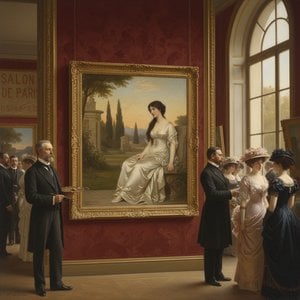
L'importance historique de Jules Breton réside dans sa capacité à jeter un pont entre les traditions académiques du passé et le réalisme moderne du XIXe siècle. En appliquant des méthodes classiques sophistiquées à la représentation de la vie paysanne, il a conféré un sentiment de permanence et de dignité à une classe de personnes souvent négligée par le grand art. Son œuvre a trouvé un écho profond auprès du public de son temps, lui valant une reconnaissance significative au Salon de Paris et l'établissant comme une figure de proue de l'art français.
Au-delà de ses toiles individuelles, l'influence de Breton s'est étendue à travers sa famille et son rôle au sein de la communauté artistique élargie. Sa fille, Virginie Demont-Breton, deviendra elle aussi une peintre célèbre, perpétuant cet héritage d'observation profonde et de maîtrise technique. Aujourd'hui, les œuvres de Jules Breton restent chéries pour leur puissance nostalgique et leur capacité à transporter le spectateur vers une époque disparue de la vie pastorale française. Ses peintures servent de fenêtre intemporelle sur l'âme du XIXe siècle, nous rappelant la beauté tranquille nichée dans les moments les plus simples de l'existence.
Questions et réponses
Puis-je explorer les œuvres de Jules Breton par mot-clé ?
Pour trouver des œuvres de Jules Breton sur un thème spécifique, consultez la page Par mots-clés de l'artiste, qui regroupe les œuvres par mot-clé.
Dans quelle ville et quel pays Jules Breton est-il/elle né(e) ?
Jules Breton est né à Courrières, en France.
Combien d'œuvres de Jules Breton sont disponibles à la consultation ?
Vous pouvez parcourir 141 œuvres œuvres de Jules Breton sur la page Toutes les œuvres d'art.