The Eye of the Diorama
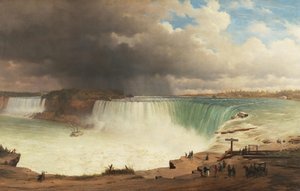
To understand Hippolyte Victor Valentin Sebron, one must look past the traditional canvas and toward the light-driven spectacle of the nineteenth-century diorama. He was not merely a painter of landscapes or portraits; he was a technician of atmosphere. His early career was defined by a partnership with Louis Daguerre, where Sebron contributed to at least fourteen of the thirty large-scale paintings used in Daguerre’s theatrical dioramas. These works were massive, measuring sixty-five by forty feet, and relied on the clever use of transparencies to manipulate light. This experience left an indelible mark on his oil painting style. Even when he moved away from these massive installations, his brushwork retained a specific focus on how light interacts with physical surfaces.
His training at the École des Beaux-Arts under Léon Cogniet provided the academic foundation necessary for his later versatility. By 1825, Sebron was already exhibiting at the Salon in Paris. While he initially gained recognition for interior portraits and decorative painting, his true impact lies in his ability to translate the fleeting effects of light into permanent pigment. He possessed a unique eye for nuance, likely sharpened by his work with early photographic pioneers. This technical precision allowed him to capture the heavy, overcast skies of a winter day at the Louvre or the murky, reflective waters of a Louisiana harbor with equal clarity.
A Cartography of Light and Travel
Sebron’s life was marked by a restless movement across continents, a fact that directly dictated his subject matter. His travels were not mere sightseeing; they were expeditions to document the changing light of different geographies. In 1830, he produced over 150 views of cities and monuments during a stay in Italy. Later, his path took him through Spain, Portugal, and North Africa. This period of movement allowed him to build a repertoire that functioned like a visual travelogue, presenting distant locales to a European audience with a sense of documentary accuracy.
The years between 1849 and 1855 brought him to North America, specifically Canada, New York, and Louisiana. In New Orleans, his work took on a new dimension. He captured the industrial energy of the Mississippi River, notably in works like Bateaux à Vapeur Géants. These paintings utilized a monochrome palette to emphasize the structural weight of steamboats against the water. His time in Louisiana also produced significant landscape studies, such as Crocodile Lake, Louisiana, which demonstrated his mastery of luminism. He did not rely on color to create depth; instead, he used the interplay of shadow and light to define the scale of the American landscape.
Technical Precision and Historical Weight
The significance of Sebron’s work lies in its refusal to succumb to pure romantic sentimentality. While his landscapes often feature nocturnal or wintry settings, they are grounded in a polished, cool style characteristic of late nineteenth-century academic practice. He utilized chiaroscuro effects and a meticulous approach to texture to ensure that every ripple in a harbor or snowflake on a rooftop felt tangible. His ability to manipulate light was a direct inheritance from his time working with Daguerre’s light-based illusions.
His legacy is found in the intersection of fine art and early visual technology. He bridged the gap between the decorative painter and the modern observer of light. Though much of his work faced destruction—including over twenty pieces lost during the burning of the Château de Neuilly in 1848—the surviving paintings remain essential for studying the transition from Romanticism to Realism. He documented a world in flux, from the rise of steam technology in New Orleans to the architectural grandeur of Paris, always prioritizing the physical reality of light over mere decoration.
Questions et réponses
Où trouver les œuvres de Hippolyte Sebron classées par couleur ?
La page Index spectral organise les œuvres de Hippolyte Sebron par couleur.
Où puis-je voir la palette de couleurs des œuvres de Hippolyte Sebron ?
L'usage de la couleur par Hippolyte Sebron à travers les œuvres répertoriées sur ce site web peut être étudié sur la page Génome de la palette de l'artiste.
Où les œuvres de Hippolyte Sebron sont-elles regroupées par mots-clés ?
Pour trouver des œuvres de Hippolyte Sebron sur un thème spécifique, utilisez la page Par mots-clés de l'artiste, qui regroupe les œuvres par mot-clé.