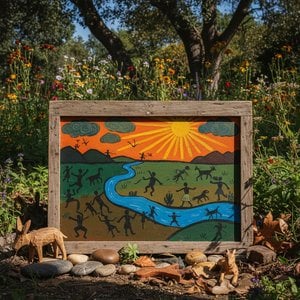
Henri Emile Rousseau (1875 – 1933): The Enchanted Vision of Primitive Beauty
Henri Emile Rousseau, born in Lyon, France, in 1875, defied the conventions of Impressionism and Post-Impressionism to forge a singular artistic path—one characterized by an uncompromising embrace of Naïve Art. His canvases depict fantastical landscapes populated by animals and humans rendered with childlike simplicity and vibrant color palettes, transporting viewers into dreamlike realms brimming with symbolic resonance. Rousseau’s upbringing in a working-class family instilled in him a deep appreciation for the natural world and folklore, influences that would profoundly shape his artistic vision. Despite facing considerable skepticism from critics of his time—who dismissed his style as amateurish—Rousseau persevered, establishing himself as one of France's most distinctive painters and securing a place among the pioneers of Modern Art.- Early Life & Artistic Beginnings: Rousseau’s formal artistic training was minimal; he largely self-taught, honing his skills through sketching outdoors and studying prints. He initially pursued commercial illustration work to support himself, but his passion for painting remained unwavering.
- The Influence of Primitive Art: Rousseau's fascination with African masks and tribal art—particularly those collected by Alexandre Cabanel—served as a catalyst for his stylistic evolution. These artworks captivated him with their bold colors, stylized forms, and rejection of academic realism, inspiring him to abandon traditional techniques in favor of a more direct and expressive approach.
- Key Paintings & Artistic Style: Rousseau’s oeuvre is dominated by monumental landscapes infused with mythological elements and populated by animals imbued with spiritual significance. Notable works include “The Sleeping Venus” (1890), “The Promised Land” (1893), “The Concert” (1897), and “The Shepherdess,” which exemplifies his signature style—characterized by flattened perspectives, luminous colors, and a deliberate blurring of outlines.
- Recognition & Legacy: Despite initial rejection by the Parisian avant-garde, Rousseau gained recognition in 1905 thanks to the patronage of Ambroise Vollard, who championed his work and secured exhibitions at Galerie Bernheim-Jeune. His paintings gradually attracted admirers among artists like Picasso and Matisse, cementing his reputation as a visionary artist whose uncompromising vision anticipated Surrealism.
- Death & Enduring Influence: Rousseau died in Étampes in 1933, leaving behind a legacy of approximately 800 paintings—a remarkable achievement considering his unconventional methods. His distinctive Naïve Art style continues to inspire artists today, demonstrating the enduring power of imagination and the beauty found in unfiltered observation.
Exploring Rousseau’s Palette & Technique
Rousseau's artistic technique was remarkably simple yet profoundly effective. He eschewed meticulous detail, opting instead for bold brushstrokes and vibrant hues—often achieved through layering thin glazes of color onto a toned ground. This method allowed him to capture the essence of his subjects with remarkable immediacy and luminosity, conveying emotion and atmosphere as much as visual representation. His use of complementary colors—such as reds and greens—created striking contrasts that heightened the dramatic impact of his compositions. Furthermore, Rousseau’s deliberate flattening of perspective—a technique borrowed from African art—reinforced the dreamlike quality of his landscapes and contributed to their captivating allure.Questions et réponses
Quelles œuvres de Henri Emilien Rousseau sont les plus consultées ?
Une page Statistiques est disponible pour Henri Emilien Rousseau, présentant des statistiques sur les œuvres de l'artiste sur ce site web.
Dans quels mouvements Henri Emilien Rousseau a-t-il travaillé ?
La page Tous les mouvements regroupe les œuvres de Henri Emilien Rousseau par mouvement artistique.
Combien d'œuvres de Henri Emilien Rousseau sont disponibles à la consultation ?
Vous pouvez parcourir 21 œuvres d'art œuvres de Henri Emilien Rousseau sur la page Toutes les œuvres.
Quelles émotions les œuvres de Henri Emilien Rousseau expriment-elles ?
La page L'ambiance par émotion de l'artiste présente les œuvres de Henri Emilien Rousseau classées par atmosphère.
Comment puis-je suivre l'évolution de l'œuvre de Henri Emilien Rousseau année après année ?
Les œuvres de Henri Emilien Rousseau peuvent être consultées par ordre chronologique sur la page Chronologie des œuvres de l'artiste.
Où les œuvres de Henri Emilien Rousseau sont-elles regroupées par mots-clés ?
Les œuvres de Henri Emilien Rousseau peuvent être explorées par mot-clé sur la page Par mots-clés de l'artiste. Chaque mot-clé regroupe les œuvres associées.
Où puis-je voir toutes les œuvres de Henri Emilien Rousseau ?
Chaque œuvre de Henri Emilien Rousseau sur ce site web peut être consultée depuis la page Toutes les œuvres de l'artiste.
Puis-je étudier l'utilisation de la couleur par Henri Emilien Rousseau à travers l'ensemble de ses œuvres ?
Le profil chromatique des œuvres de Henri Emilien Rousseau est présenté sur la page Génome de la palette de l'artiste.