A Life of Letters and Lines
Frances Talbot, Countess of Morley, lived a life where the boundaries between literature and visual art often blurred. Born in 1782, she was the daughter of a surgeon named Thomas Talbot from Wymondheim. Her early years were shaped by a family lineage that traced back to the Talbots of Salesbury and Bashall, a branch that had held the estate of Gonville Hall since the era of Queen Elizabeth I. While history often remembers her through her marriage to John Parker, the 1st Earl of Morley, she maintained a distinct identity as an author, illustrator, and painter.
Her intellectual world was deeply connected to the literary circles of her time. She is noted for her correspondence with Jane Austen, even receiving a personal copy of Emma from the author herself. This connection to the great novelists of the age mirrored her own creative output. As a writer, she produced works such as The Flying Burgomaster in 1832 and The Man Without a Name in 1852. She also took on the role of an editor, managing the publication of Dacre in 1834.
The Practice of Art
Though her social position as a Countess might suggest a life of leisure, Frances devoted significant energy to the technical aspects of art. Her training was marked by both formal study and personal initiative. During the Peace of Amiens, she traveled to Paris to study under François Gérard, a man known for his portraits of the French nobility. This period of study helped her refine her ability to capture figures and light.
Her artistic achievements were recognized with several honors from the Society for the Encouragement of Arts, Manufactures and Commerce. At the age of sixteen, she received a silver medal for her painting of Raphael’s Virgin and Child. Later in life, she earned a silver palette medal for a work based on a painting by Titian, as well as another silver medal for her depiction of a Herb Girl from nature. These awards suggest a persistent engagement with the challenges of figure painting.
Beyond the canvas, her creativity extended into other mediums:
- Lithography: She produced the lithographed plates for Portraits of the Spruggins Family.
- Watercolours: A collection of her watercolours is held at Saltram in Devon, featuring scenes from continental Europe and copies of works by artists like David Roberts.
- Wax Modelling: Inspired by the artist Samuel Percy, she created family portraits using coloured wax, including tender depictions of her stepson, Henry Villiers Parker.
Final Years at Saltram
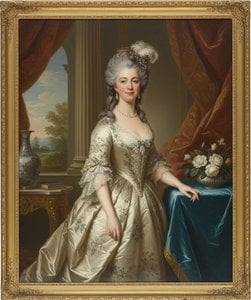
The later years of her life were spent in the quiet surroundings of Saltram. Her work during this period reflected a woman deeply immersed in her various passions. Portraits painted of her show her surrounded by the tools of her trade—reading a book while an easel sits ready beside her. This image captures the essence of a person who found meaning in the act of creation.
Frances Talbot passed away on 6 December 1857. She was laid to rest in the family vault at Plympton St Mary. Her legacy remains preserved through the many paintings, writings, and illustrations she left behind, much of which continues to be held within the National Trust collections.
Questions et réponses
Puis-je parcourir les œuvres de Frances par ambiance ?
La page L'espace des émotions de l'artiste présente les œuvres de Frances classées par atmosphère.
Puis-je visiter un musée virtuel des œuvres de Frances ?
Retrouvez les œuvres de Frances dans une galerie 3D sur la page Musée en 3D de l'artiste.
Où peut-on retrouver les œuvres de Frances classées par sujet ?
L'Index thématique de Frances est une page qui répertorie les œuvres de l'artiste par thématiques.
Dans quel pays Frances est-il né ?
Frances est né(e) en royaume de Grande-Bretagne.