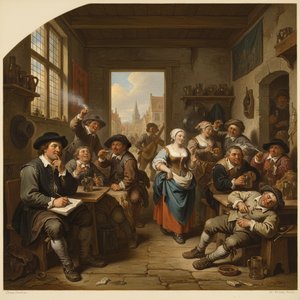
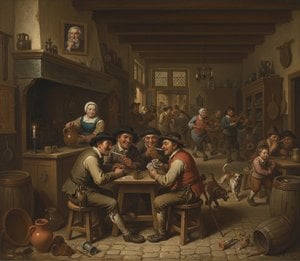
Jacob Hoefnagel: A Court Artist’s Legacy of Detail and Observation
Jacob Hoefnagel (c. 1564 – 1630) stands as a pivotal figure in Flemish Baroque painting, renowned for his meticulous botanical illustrations and portraits that captured the spirit of Rudolf II's court in Prague—a testament to the artistic flourishing of the era. Unlike many of his contemporaries who embraced grand narratives or dramatic compositions, Hoefnagel’s genius resided in an unparalleled dedication to observation and painstaking rendering of natural forms and human likenesses. This approach cemented his place as one of the most influential artists of his time and continues to inspire admiration for its precision and beauty.- Early Life & Training: Born in Antwerp, Hoefnagel’s artistic talent emerged early under the tutelage of Peter Paul Rubens—a relationship that proved formative not only professionally but also intellectually. Rubens instilled in him a profound appreciation for classical ideals and encouraged experimentation with new techniques, shaping Hoefnagel's distinctive style.
- Botanical Illustrations: Hoefnagel’s fame rests primarily on his extraordinary botanical drawings, commissioned by Rudolf II to create an encyclopedic depiction of the Habsburg imperial gardens. These works represent a monumental achievement in scientific illustration—characterized by astonishing accuracy and artistic sensitivity. He meticulously documented plants from across Europe, employing techniques that anticipated modern botany and elevating illustration beyond mere representation to become a form of scholarly inquiry.
- Portraiture: Alongside his botanical pursuits, Hoefnagel produced numerous portraits, primarily for aristocratic patrons. His portraits are distinguished by their subtle psychological insight—capturing not just physical appearance but also conveying character and emotion with remarkable subtlety. He skillfully utilized chiaroscuro—the dramatic interplay of light and shadow—to sculpt form and imbue his subjects with a sense of presence.
- Influence & Artistic Style: Hoefnagel’s style embodies the Baroque preoccupation with detail and illusionism, reflecting Rubens' influence. His compositions are often asymmetrical and balanced, prioritizing clarity and elegance over theatrical grandeur. He favored muted color palettes—primarily greens, browns, and golds—creating harmonious visual experiences that prioritized naturalistic representation.
- Legacy: Hoefnagel’s work profoundly impacted subsequent generations of artists, establishing a precedent for botanical illustration as an art form and influencing portrait painters throughout Europe. His meticulous observation and masterful technique continue to inspire admiration for its timeless beauty and intellectual rigor—a lasting contribution to the artistic heritage of Flanders and beyond.
The Habsburg Court & Rudolf II’s Patronage
Rudolf II, Holy Roman Emperor (1558–1613), recognized Hoefnagel's exceptional talent and entrusted him with the ambitious task of documenting his imperial gardens—a project that epitomized the artistic ambitions of the Habsburg court. Prague at the time was a crucible of intellectual curiosity and artistic innovation, attracting artists from across Europe eager to engage in dialogues about art and science. Rudolf II’s patronage fostered an environment where Hoefnagel could pursue his passions for botanical illustration and portraiture—resulting in a prolific output that solidified his reputation as one of the era's foremost visual artists.Technique & Artistic Innovation
Hoefnagel’s artistic prowess stemmed from his mastery of oil paint—a medium championed by Rubens and other Baroque masters. He employed innovative techniques to achieve unparalleled levels of realism—particularly in botanical illustrations where he meticulously layered pigments to capture the textures and nuances of plant surfaces. His use of chiaroscuro—the dramatic manipulation of light and shadow—further enhanced the sculptural quality of his portraits—creating images that conveyed depth and psychological complexity.Notable Works
Among Hoefnagel’s most celebrated achievements are his botanical drawings for Rudolf II's gardens—a monumental undertaking that resulted in a comprehensive visual record of European flora. His portrait commissions included depictions of prominent figures from the Habsburg court—demonstrating his ability to capture both physical likeness and psychological character with remarkable precision. Furthermore, Hoefnagel’s landscapes—particularly those depicting views of Prague—revealed an artist deeply attuned to capturing atmospheric effects and conveying a sense of place.Influence on Subsequent Artists
Hoefnagel's meticulous observation and masterful technique served as inspiration for generations of artists who followed him—establishing a precedent for botanical illustration as an art form and influencing portrait painters throughout Europe. His legacy extends beyond his individual artworks—representing a cornerstone of Baroque artistic innovation and demonstrating the enduring power of visual representation to convey knowledge and beauty.Questions et réponses
Où peut-on trouver les œuvres de Flemish Painters regroupées par mouvement artistique ?
Les œuvres de Flemish Painters peuvent être consultées par mouvement sur la page Tous les mouvements de l'artiste.
Comment puis-je suivre l'évolution de l'œuvre de Flemish Painters année après année ?
Les œuvres de Flemish Painters peuvent être consultées par ordre chronologique sur la page Chronologie des œuvres de l'artiste.
Comment puis-je trouver toutes les œuvres de Flemish Painters dans une technique donnée ?
Pour trouver toutes les œuvres de Flemish Painters dans une technique donnée, consultez la page Tous les médiums de l'artiste.
Où puis-je admirer les œuvres de Flemish Painters dans une galerie en 3D ?
Une visite virtuelle est possible : la page Musée 3D de Flemish Painters présente les œuvres de l'artiste dans une galerie en trois dimensions.
Puis-je étudier l'utilisation de la couleur par Flemish Painters à travers l'ensemble de ses œuvres ?
Le profil chromatique des œuvres de Flemish Painters est présenté sur la page Génome de la palette de l'artiste.
Existe-t-il un aperçu de tous les sujets peints par Flemish Painters ?
Les œuvres de Flemish Painters peuvent être explorées par sujet sur la page Atlas thématique de l'artiste.
Comment l'art de Flemish Painters a-t-il évolué au fil du temps ?
La Chronologie de Flemish Painters est une frise chronologique interactive qui présente les œuvres de l'artiste par ordre chronologique, regroupées en chapitres correspondant aux différentes périodes de sa carrière.
Où puis-je trouver des statistiques sur les œuvres de Flemish Painters ?
La page Statistiques de Flemish Painters présente des statistiques calculées à partir des œuvres de l'artiste répertoriées sur ce site web.