Menu
CONSEIL EN ART GRATUIT

Informations clés

  • Born: Pays-Bas
  • Works on APS: 2
  • Top 3 works:
    • Self Portrait with cap
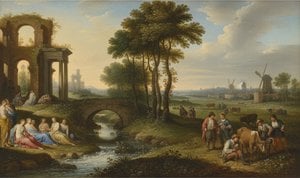
    • River Landscape
  • Plus…

Quiz d'art

Chaque question ne comporte qu'une seule bonne réponse.

Question 1:
Q1
Question 2:
Q2
Question 3:
Q3
Question 4:
Q4
Question 5:
Q5

Biography of Adriaan van der Cabel

Adriaan van der Cabel (b. ca. 1630, Rijswijk, d. 1705, Lyon) stands as a quiet yet significant contributor to the Dutch Golden Age landscape tradition. While overshadowed by contemporaries like Jacob Isaaksz Voorhout and Rembrandt Harmensz van Rijn, his meticulous depictions of serene river landscapes and introspective self-portraits reveal a distinctive artistic vision rooted in realism and psychological observation—characteristics that resonate deeply within the broader context of 17th-century Dutch art. Born around 1630 in Rijswijk, Netherlands, Van der Cabel’s early life remains sparsely documented, leaving much to speculation regarding his formative influences. He apprenticed under Nicolaes Berckenbosch, a respected landscape painter who instilled in him the principles of tonal painting and atmospheric perspective—techniques crucial for conveying the grandeur and subtlety of nature. This training undoubtedly shaped Van der Cabel's artistic approach, prioritizing accuracy and emotional resonance over flamboyant ornamentation. His professional career unfolded primarily in Lyon, France, where he established himself as a portrait artist and worked extensively for aristocratic patrons. Despite residing abroad, Van der Cabel consistently returned to landscape painting, producing a substantial body of work characterized by calm compositions and masterful rendering of light and shadow. These landscapes aren’t merely scenic representations; they are imbued with a contemplative spirit—a reflection of the artist's own inner life and philosophical concerns. He sought to capture not just what he saw but also how it felt—a profound ambition that distinguishes him from many of his peers who focused on mere visual spectacle. Van der Cabel’s artistic style is notable for its understated elegance and meticulous attention to detail. He favored crayon drawing as his medium, allowing him to achieve remarkable tonal gradations and textural nuances that captured the essence of his subjects with exceptional fidelity. Unlike many artists of his era who sought to impress their audiences with grand gestures or dramatic effects, Van der Cabel prioritized conveying a sense of tranquility and psychological depth—a hallmark of Early Netherlandish painting’s evolving sensibilities. His landscapes are bathed in soft light, subtly shifting hues that evoke feelings of serenity and contemplation. Among his most celebrated works is ‘Self Portrait with Cap,’ completed in 1664, which exemplifies this artistic ethos. This portrait showcases Van der Cabel's mastery of tonal shading and anatomical precision—elements that underscore his commitment to realism while simultaneously conveying a sense of inner reflection. Furthermore, he produced several river landscapes that exemplify his artistic prowess, notably ‘La Madonne avec le Canon van der Paele,’ which demonstrates the influence of Jan van Eyck’s pioneering use of atmospheric perspective. These paintings stand as testament to Van der Cabel's enduring legacy within the Dutch landscape tradition—a tradition marked by intellectual curiosity and a deep appreciation for the beauty of the natural world. His contribution reminds us that true artistic achievement lies not only in technical skill but also in conveying profound emotional truths.