

Cristóbal Balenciaga: Deconstructing Haute Couture's Architectural Legacy
Sommaire
The Basque Roots of Genius: Balenciaga’s Early Life and Influences
 Cristóbal Balenciaga Museoa
Discover the legacy of Cristóbal Balenciaga at his hometown museoa! Explore iconic designs, Basque heritage & the genius behind haute couture in Getaria, Spain.
Cristóbal Balenciaga Eizaguirre was not born into the gilded world of Parisian haute couture, but rather amidst the rugged beauty of Getaria, a small fishing village in Spain's Basque Country. This origin story is crucial to understanding his singular vision; it wasn’t merely a birthplace, but an immersive education in form, texture, and practicality. His mother, María Jesús Eizaguirre, was a skilled seamstress who served the local aristocracy, and from her, Balenciaga absorbed the fundamentals of dressmaking – not as abstract art, but as a craft deeply interwoven with daily life. He began sketching designs at a remarkably young age, captivated by the women around him and the interplay between fabric and figure. The sea itself played a role, influencing his later fascination with volume and dramatic silhouettes; the billowing sails of fishing boats, the powerful curves of waves – these were early lessons in sculptural form. Unlike many of his contemporaries who pursued formal training, Balenciaga’s education was largely self-directed, honed through observation and apprenticeship. This independent path fostered a unique approach to design, one rooted in technical mastery rather than adherence to prevailing trends.
The Spanish aristocracy became early patrons, recognizing the exceptional quality of his work even before he established formal houses in San Sebastián, Madrid, and ultimately, Paris. These commissions weren’t simply about creating beautiful garments; they were about embodying a sense of tradition and refined elegance – qualities that would become hallmarks of the Balenciaga aesthetic. The political turmoil of the Spanish Civil War proved to be a catalyst, forcing his relocation to France in 1937, but it was a move that ultimately cemented his place as one of the most influential couturiers of the 20th century.
Sculpting Form: Innovation in Silhouette and Construction (1937-1950)
 Evening coat
Discover Cristóbal Balenciaga’s iconic ‘Evening Coat’ (1935). A masterpiece of sculptural design & innovative tailoring. Explore its unique features & historical significance.
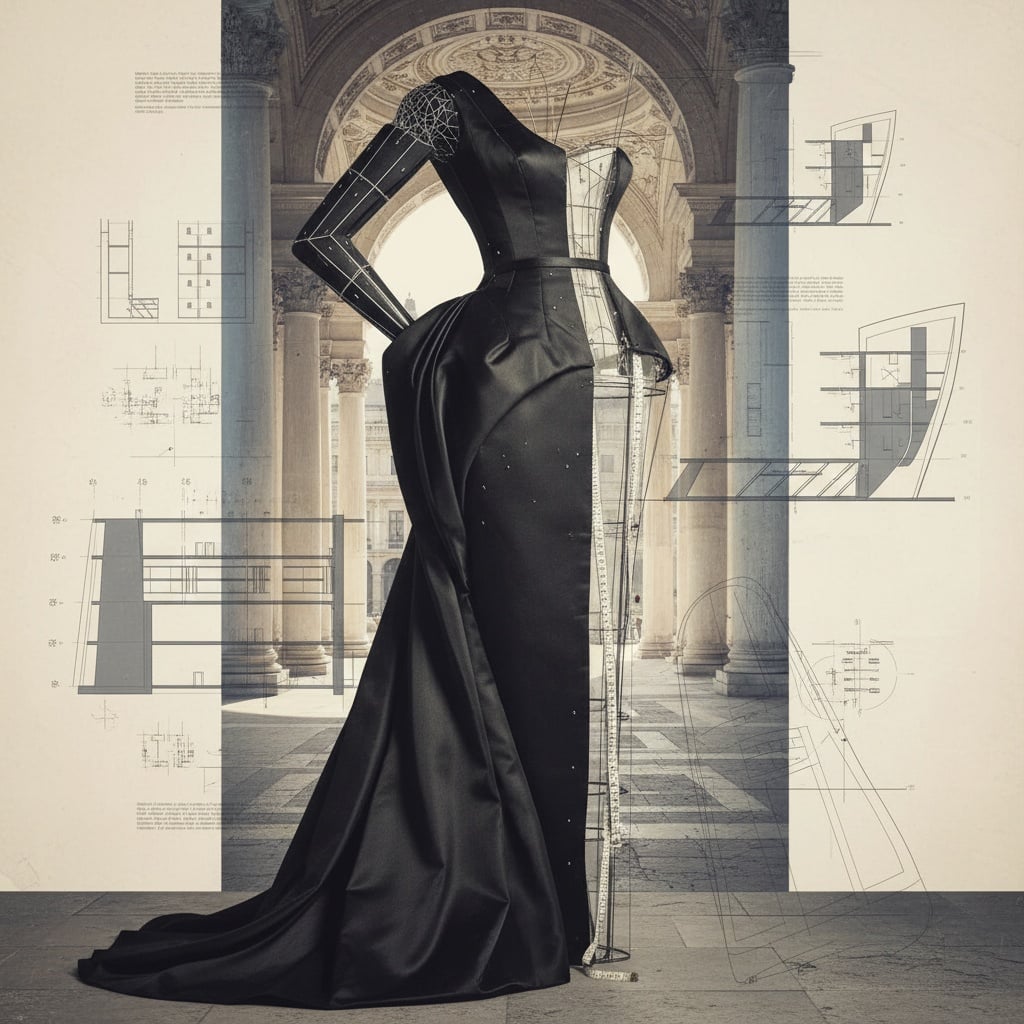
Balenciaga’s arrival in Paris wasn't met with immediate fanfare. He didn’t seek to revolutionize fashion overnight, but rather to refine it – to elevate the standards of construction and silhouette. His early collections were characterized by a quiet sophistication, a deliberate rejection of the flamboyant styles popular at the time. He possessed an almost architectural understanding of fabric, manipulating its weight and drape with unparalleled skill. Where others focused on embellishment, Balenciaga prioritized structure; he *built* garments rather than simply draped them. This approach was immediately recognized by discerning clients and fellow designers like Coco Chanel, who famously declared him “the only couturier in the truest sense of the word.”
The late 1930s saw the emergence of his signature Spanish influences – the dramatic ‘Infanta’ dresses inspired by Velázquez's portraits, with their wide skirts and structured bodices. These weren’t mere historical pastiches; they were reinterpretations, imbued with a modern sensibility. He explored the use of bold color combinations and luxurious fabrics like velvet and silk, creating garments that exuded both power and grace. The war years presented challenges, but Balenciaga continued to operate, maintaining his commitment to quality and craftsmanship even amidst scarcity. This period solidified his reputation as a couturier who valued artistry above all else.
A Revolution in Volume: The Mid-Century Designs That Redefined Couture (1950s)
 Evening Dress
Cristóbal Balenciaga’s 1961 ‘Evening Dress’ showcases exquisite Chantilly lace & sculptural form. A masterpiece of haute couture, explore this iconic black gown's layered elegance.
The 1950s marked the apex of Balenciaga’s creative power, a decade defined by his groundbreaking exploration of volume and shape. He challenged conventional notions of femininity, moving away from the cinched waists and hourglass figures popularized by Christian Dior's New Look. Instead, he embraced looser, more fluid silhouettes – balloon skirts, sack dresses, cocoon coats – that liberated the body and redefined elegance. These designs weren’t simply about comfort; they were about a new kind of power, one rooted in confidence and individuality.
The ‘sack dress’ of 1957 was perhaps his most controversial creation, initially met with resistance from both clients and critics. Its straight, unfitted shape seemed to defy all established notions of beauty, but Balenciaga persevered, demonstrating its versatility and inherent elegance. He understood that true style wasn't about conforming to expectations, but about challenging them. The ‘baby doll’ dress followed, further pushing the boundaries of conventional form. These designs weren’t merely fashionable; they were statements – declarations of artistic independence. His use of innovative materials like gazar, a stiff yet lightweight silk fabric, allowed him to create sculptural forms that had never been seen before.
The Legacy of 'The Master': Balenciaga’s Influence on Subsequent Designers
 Cristóbal Balenciaga Eizaguirre
Explore the world of Cristóbal Balenciaga Eizaguirre (Balenciaga), a revolutionary Spanish couturier known for his elegant, sculptural designs & avant-garde influence. Discover paintings like 'Tree Roots' & his lasting impact on fashion.
Cristóbal Balenciaga wasn't just a couturier; he was an educator. Throughout his career, he mentored a generation of talented designers, including Oscar de la Renta, Andre Courrèges, and most notably, Hubert de Givenchy. These protégés went on to establish their own successful houses, carrying with them the principles of technical mastery, innovative construction, and unwavering commitment to quality that Balenciaga instilled in them. His influence extends far beyond those he directly mentored; his designs continue to inspire contemporary designers across the globe.
The impact of his work can be seen in everything from minimalist silhouettes to avant-garde experimentation. He taught a generation to prioritize form over embellishment, structure over surface decoration. Even today, designers return to Balenciaga’s archives for inspiration, seeking to understand the principles that underpinned his revolutionary approach. His emphasis on craftsmanship and attention to detail remains a benchmark for excellence in the fashion industry.
Beyond the Gown: Exploring Balenciaga's Evening Coats and Accessories
While renowned for his exquisite gowns, Balenciaga’s mastery extended beyond evening wear. His coats, particularly those from the 1930s and 40s, are considered masterpieces of sculptural design. The ‘Evening Coat’ (1935), for example, exemplifies his ability to transform a simple garment into a work of art – its dramatic lines and impeccable tailoring creating a sense of timeless elegance. These coats weren't merely functional; they were statements of sophistication and power.
Accessories, too, received the same meticulous attention as his gowns. Hats, gloves, and shoes were carefully considered elements of the overall ensemble, designed to complement and enhance the silhouette. He understood that true style wasn't about a single garment, but about the harmonious interplay between all its components. His accessories weren’t afterthoughts; they were integral parts of the Balenciaga aesthetic.
Collecting Balenciaga: A Guide for Connoisseurs
Acquiring a piece of Balenciaga couture is an investment in artistry and history. Given the rarity and value of his designs, careful consideration is paramount. Early pieces from the 1930s and 40s, particularly those showcasing his Spanish influences, are highly sought after. The iconic gowns and coats from the 1950s – sack dresses, cocoon coats, baby doll dresses – represent the pinnacle of his creative power.
Provenance is crucial; establishing a clear history of ownership adds significant value to any piece. Look for garments with documented origins, such as labels indicating original clients or auction records. Condition is also paramount; while some wear and tear is inevitable given the age of these pieces, avoid items with significant damage or alterations. Consulting with a reputable vintage dealer or art appraiser is highly recommended before making a purchase. At ArtsDot.com, we offer expert appraisal services to help you authenticate and value your potential acquisitions, ensuring that you invest in genuine masterpieces of haute couture.
Articles connexes

Águeda Ruiz de la Prada: A Study of Eclecticism & Emotional Resonance in Contemporary Spanish Painting
Discover the vibrant world of Ágatha Ruiz de la Prada, a leading figure in contemporary Spanish art. Explore her eclectic style, emotional depth & legacy – a must-read for discerning collectors.


Gianfranco Ferré: Deconstructing Haute Couture – A Legacy of Architectural Form
Explore the revolutionary world of Gianfranco Ferré, 'the architect of fashion.' Discover his architectural approach to haute couture, iconic Dior designs, and lasting influence on luxury style. A deep dive for collectors & enthusiasts.

