
- Accueil

- Œuvres
- Clyfford Still's Abstract Expressionism: A Study of Color, Form & the Existential Landscape
Clyfford Still's Abstract Expressionism: A Study of Color, Form & the Existential Landscape
Sommaire
The Genesis of Abstraction: Still's Early Influences & Departure from Representation
Clyfford Still (November 30, 1904 – June 23, 1980) was an American painter, and one of the leading figures in the first generation of Abstract Expressionists, who developed a new, powerful approach to painting in the years immediately following World...
Clyfford Still, a name synonymous with the raw power and emotional depth of Abstract Expressionism, didn’t emerge fully formed as the pioneer we recognize today. His artistic journey was one of deliberate excavation, a shedding of representational constraints that began in the late 1930s and early 40s—a period marked by both personal struggle and a growing disillusionment with traditional forms of expression. Born in 1904, Still’s formative years were steeped in the landscapes of the American West, initially reflected in his paintings through regionalist depictions. However, these early works, while demonstrating technical skill, lacked the visceral intensity that would come to define his mature style. A crucial turning point came with his exposure to European modernism and, importantly, a growing awareness of the psychological turmoil brewing beneath the surface of post-war society. He wasn’t simply rejecting figuration; he was actively seeking a visual language capable of conveying something beyond the tangible world—a realm of primal emotion and existential questioning.
The influence of artists like Arshile Gorky, with his biomorphic forms and subconscious imagery, proved pivotal. Yet Still diverged significantly from Gorky’s lyrical abstraction, opting for a more rugged, fractured aesthetic. His time teaching at Washington State College also played a role, forcing him to articulate the principles of art and ultimately leading him to question the very foundations of pictorial representation. This period saw a gradual simplification of form, a move towards increasingly non-objective compositions that hinted at the monumental canvases to come. It was a process of reduction—stripping away detail not to achieve mere flatness but to expose something essential beneath.
Monumental Fields of Color: Analyzing Still’s Unique Compositional Style
 PH-210
Explore Clyfford Still’s PH-210 – a monumental abstract expressionist work featuring rich browns & white. A striking vertical composition, reminiscent of an instrument, showcasing impasto texture and dynamic form.
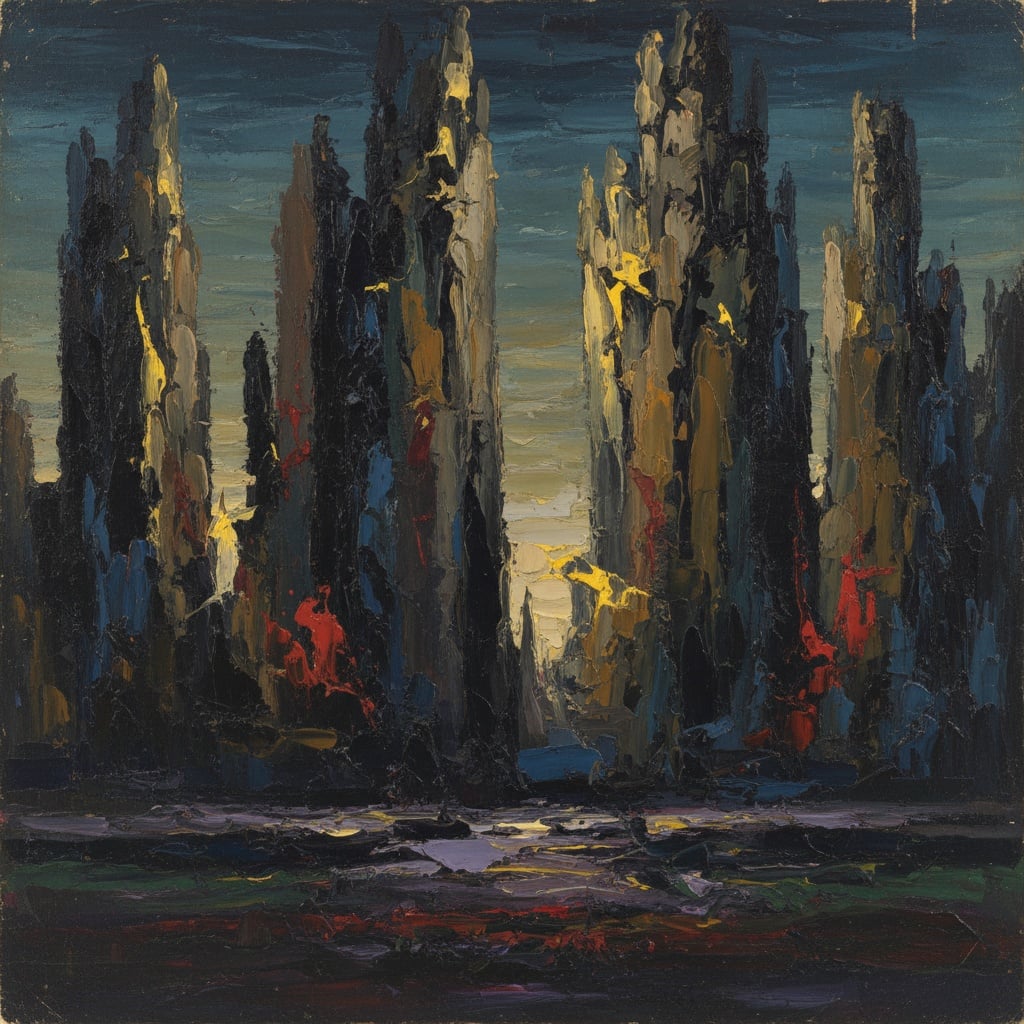
The hallmark of Clyfford Still's work is undoubtedly his imposing scale and the dramatic interplay of color within vast, often vertically oriented fields. These are not paintings one simply *looks* at; they demand to be experienced—enveloping the viewer in a world of pure chromatic energy. Unlike many of his Abstract Expressionist contemporaries who embraced all-over compositions or gestural brushwork, Still’s canvases possess a distinct internal architecture. Jagged, irregular shapes, often described as “stalagmites” or “rifts,” cleave through monolithic blocks of color, creating a sense of dynamic tension and implied movement. Consider PH-210, a striking example where rich browns and whites collide in a vertical composition reminiscent of an instrument—a visual metaphor for the artist’s attempt to channel profound emotional forces.
This compositional strategy isn't arbitrary. Still deliberately avoided traditional notions of balance or symmetry, instead favoring asymmetrical arrangements that evoke a sense of precariousness and unresolved conflict. The edges of his canvases are rarely clean-cut; colors often bleed into one another, creating ambiguous boundaries and suggesting infinite depth. He wasn’t interested in depicting objects *in* space but rather in creating the sensation of space itself—a boundless realm where color becomes form and form becomes feeling. This deliberate rejection of conventional pictorial logic is what sets Still apart and contributes to the unique power of his work.
Texture, Impasto, and the Physicality of Paint: A Tactile Exploration of His Work
 1947 48 W No. 1
Explore Clyfford Still’s monumental ‘1947 48 W No. 1,’ a powerful abstract expressionist canvas of stark contrasts & dynamic texture. A key work by a pioneer of Color Field painting.
While often categorized alongside Color Field painters like Mark Rothko, Still’s approach to paint application distinguishes him significantly. Rothko sought a luminous, ethereal quality through thin washes of color; Still, conversely, embraced the physicality of the medium itself. He employed palette knives with remarkable dexterity, layering thick impasto onto the canvas to create surfaces that are richly textured and deeply expressive. This isn’t merely about applying paint; it's about building up a topography of emotion—a visual record of the artist’s physical engagement with the material.
The texture in Still’s paintings is not simply an aesthetic device but integral to their meaning. The rough, uneven surfaces suggest geological formations, ancient landscapes, or even the scarred flesh of the human body. This tactile quality invites a closer examination—a visceral connection between viewer and artwork. 1947-48 W No. 1, for instance, exemplifies this dynamic texture, showcasing stark contrasts and a powerful sense of depth achieved through layers of paint. The impasto isn’t merely visible; it *is* the form, defining the contours of his jagged shapes and contributing to the overall feeling of raw energy. It's a testament to Still’s belief that painting should be an act of physical creation—a direct translation of emotion onto canvas.
Existential Themes in Abstract Form: Life, Death, and the Human Condition
 Clyfford Still
Clyfford Still (1904-1980) was an American Abstract Expressionist known for his monumental, non-figurative paintings exploring themes of life, death, and nature through dynamic color fields and jagged forms. A pioneer of the movement, his work profou...
Beneath the surface of Still’s abstract forms lies a profound engagement with existential themes. He wasn't interested in depicting specific narratives or allegories; rather, he sought to evoke universal emotions—the struggle between life and death, the isolation of the individual, and the search for meaning in a chaotic world. His paintings are often described as landscapes, but they aren’t depictions of *actual* places. They are internal landscapes—representations of the human psyche grappling with fundamental questions.
PP-40, with its minimalist composition of bold color blocks and gestural texture, embodies this sense of isolation and vibrant energy. The stark contrasts and ambiguous forms suggest a world both beautiful and terrifying. Still himself spoke of his paintings as “life and death merging in fearful union,” emphasizing the inherent duality of existence. This isn’t about offering answers but rather about confronting the complexities of the human condition—acknowledging the pain, uncertainty, and ultimately, the beauty that lies within it. The monumental scale of his work further reinforces this sense of awe and vulnerability, placing the viewer face-to-face with the immensity of existence.
Clyfford Still's Legacy & Influence on Subsequent Color Field Painters
While often a solitary figure—deliberately distancing himself from the New York art world—Clyfford Still’s influence on subsequent generations of artists is undeniable. He laid crucial groundwork for the development of Color Field painting, inspiring artists to explore the expressive potential of pure color and non-objective form. His emphasis on scale, texture, and emotional intensity resonated deeply with painters seeking a more direct and visceral mode of expression.
However, Still’s legacy is complex. He resisted easy categorization and actively discouraged comparisons between his work and that of others. His uncompromising vision and refusal to conform made him something of an outlier within the Abstract Expressionist movement. Nevertheless, his impact can be seen in the work of artists who followed—those who sought to create paintings that were not merely objects but rather immersive experiences. His insistence on the importance of personal expression and the moral value of art continues to inspire artists today.
Collecting Clyfford Still: Rarity, Provenance, and Investment Considerations
Acquiring a work by Clyfford Still is a significant undertaking—not only due to the artist’s stature but also because of the relative scarcity of his paintings on the market. For decades, Still meticulously controlled access to his work, keeping most pieces in his private collection until his death in 1980. The subsequent establishment of the Clyfford Still Museum in Denver further limited availability, making each painting a rare and highly sought-after treasure.
Provenance—the documented history of ownership—is particularly crucial when considering a Still acquisition. His meticulous record-keeping provides valuable insight into the authenticity and lineage of his works. Investment potential is also significant, with Still’s paintings consistently achieving high prices at auction. However, collecting should always be driven by passion and aesthetic appreciation rather than solely financial considerations. A work by Clyfford Still isn't simply an investment; it’s a profound artistic statement—a testament to the power of abstract form and the enduring search for meaning in a complex world. ArtsDot.com offers expert guidance on navigating the art market, providing access to high-quality reproductions and valuable resources for discerning collectors.
Articles connexes

Au-Delà de la Représentation : Exploration du Paysage Émotionnel de l'Expressionnisme Abstrait
Explorez l'univers fascinant de l'Expressionnisme Abstrait avec ArtsDot. Analyse approfondie des maîtres (Pollock, Rothko, De Kooning) et conseils d'experts pour collectionner ces œuvres emblématiques. Découvrez une sélection unique.


Beyond Representation: Emotional Resonance & Formal Innovation in Abstract Painting
Explore the profound emotional depth & formal innovations of abstract painting. Discover key artists like Rothko & Kandinsky, understand art collecting insights, and elevate your space with timeless masterpieces. Expert analysis for discerning collectors.

Carl Newman: Exploring Abstraction's Spiritual Resonance Through Color Field Painting
Explore the profound spiritual resonance of Color Field Painting with insights into Rothko, Newman & Still. Discover the techniques & legacy of this influential abstract art movement.

Philip Guston: Reassessing Abstraction, Figuration & the Weight of Representation
Explore the complex evolution of Philip Guston's art – from abstraction to raw figuration. Discover his powerful social commentary, lasting influence & collecting insights with ArtsDot.

Les 10 Chefs-d'œuvre Bronzes Qui Ont Révolutionné la Sculpture | ArtsDot
Plongez dans l'univers fascinant des 10 sculptures en bronze les plus emblématiques de l'histoire de l'art. Rodin, Degas et autres maîtres révélés ! Découvrez leur histoire, leurs techniques et trouvez l'œuvre parfaite pour sublimer votre intérieur sur ArtsDot.com.

