
- Accueil

- Œuvres
- Asher Brown Durand: Luminism, Landscape & the American Ideal – A Comprehensive Exploration
Asher Brown Durand: Luminism, Landscape & the American Ideal – A Comprehensive Exploration
Sommaire
Early Life & Apprenticeship: From Engraver to Aspiring Artist
 Wikipedia: Asher Brown Durand
Asher Brown Durand (August 21, 1796 – September 17, 1886) was an American engraver and painter of the Hudson River School. == Early life == Durand was born in, and eventually died in, Maplewood, New Jersey (then called Jefferson Village). He was t...
Asher Brown Durand’s journey toward becoming a defining voice of American landscape painting was not one of immediate artistic calling, but rather a gradual unfolding shaped by the practicalities of early 19th-century life. Born in Jefferson Village, New Jersey, in 1796, young Durand initially followed a path dictated by family necessity – that of an engraver. His father, a watchmaker and silversmith, instilled a sense of precision and meticulous detail that would later become hallmarks of his artistic style. From the age of twelve, he apprenticed under Peter Maverick in Newark, honing skills crucial to the burgeoning printmaking industry. This early training wasn’t merely technical; it cultivated an acute observational eye and a deep understanding of light and shadow – qualities essential for accurately reproducing existing works. Durand quickly proved adept, rising through the ranks and eventually managing the New York City branch of the firm. His reputation solidified in 1823 with his masterful engraving of John Trumbull’s *Declaration of Independence*, a project that demanded not only technical prowess but also an appreciation for historical narrative and compositional balance.
However, even amidst this success, a nascent artistic ambition stirred within Durand. He began to accept independent commissions, a move that ultimately led to a parting with Maverick in 1820. This pivotal moment signaled a shift – a growing desire to create original works rather than simply replicate those of others. The seeds of his future as a painter were sown, though the full flowering would take another decade and be profoundly influenced by a burgeoning artistic community.
The Rise of the Hudson River School: Founding Principles & Durand’s Role
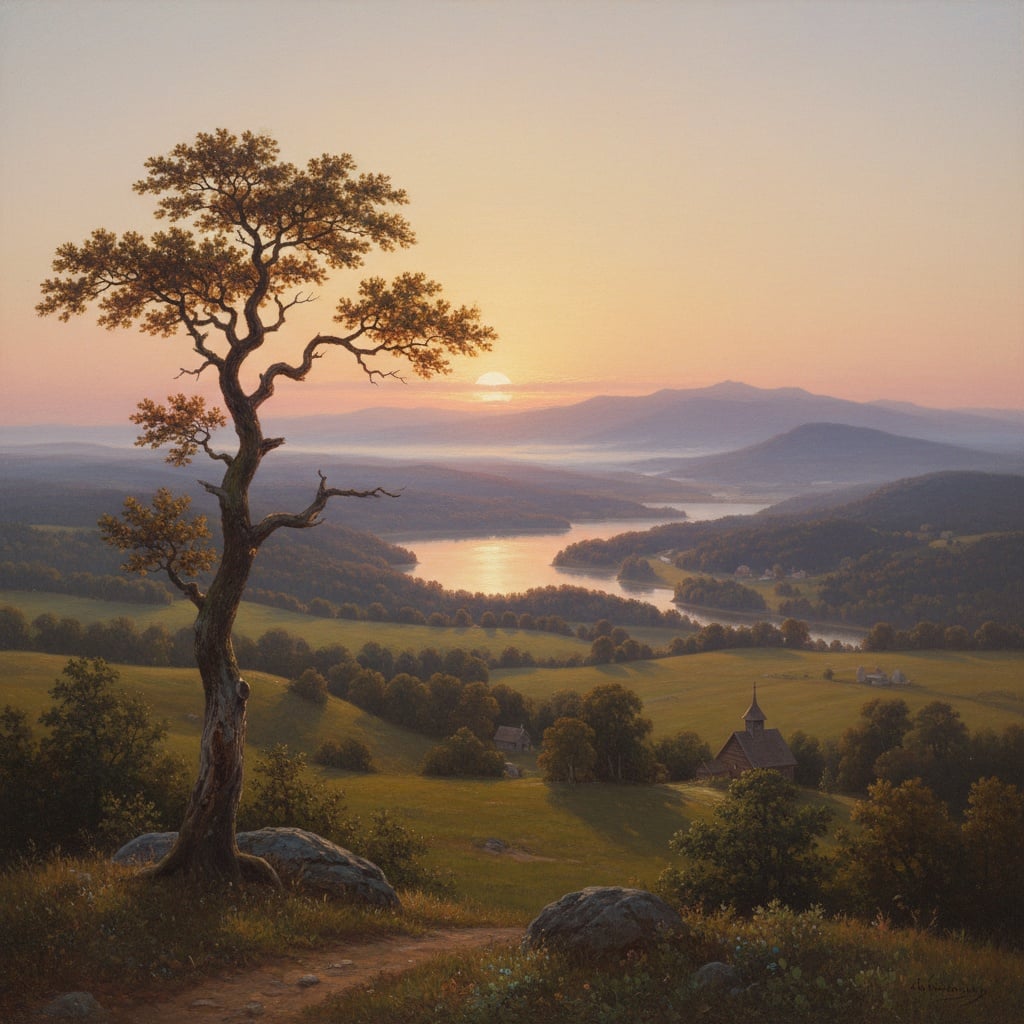
 Asher Brown Durand
Explore the serene landscapes of Asher B. Durand (1796-1886), a founding member of the Hudson River School. Discover his romantic depictions of 19th-century America & influence on American landscape painting.
The 1820s witnessed a growing sense of national identity in America, coupled with a romantic fascination with the untamed beauty of its landscapes. This fertile ground gave rise to the Hudson River School, a loosely affiliated group of artists who sought to capture the grandeur and spiritual resonance of the American wilderness. Durand was not merely a participant in this movement; he was instrumental in its formation. In 1825, alongside kindred spirits like Thomas Cole, Samuel F.B. Morse, and William Sidney Mount, he co-founded the New-York Drawing Association, which would evolve into the prestigious National Academy of Design. This organization provided a crucial platform for American artists to exhibit their work and establish a distinct artistic voice independent of European traditions.
The core tenet of the Hudson River School was a belief in nature as a divine manifestation – a source of sublime beauty, moral instruction, and national pride. Early paintings focused on the dramatic vistas of the Hudson River Valley, the Catskill Mountains, and the White Mountains, often depicting scenes imbued with a sense of awe and reverence. Durand initially explored genre scenes and portraiture, but his encounter with Thomas Cole proved transformative. Their shared sketching expeditions in the Adirondacks and New England sparked a deep connection to the landscape and ultimately steered Durand toward his life’s work.
Mastering Landscape Painting: Technique, Realism & the Influence of Nature
 Study of Trees, (painting)
Explore Asher Brown Durand’s ‘Study of Trees,’ a captivating black & white landscape showcasing Romanticism & Luminism. Discover the artist's masterful technique & serene natural beauty.
Durand's commitment to landscape painting wasn’t simply aesthetic; it was underpinned by a rigorous approach to technique and an unwavering dedication to realism. He believed in drawing directly from nature, meticulously studying trees, rocks, and foliage with scientific precision. This emphasis on observation wasn’t about slavish imitation but rather about understanding the underlying structure and organic forms of the natural world. His paintings are characterized by their detailed portrayals, subtle gradations of light and shadow, and a sense of atmospheric depth that draws the viewer into the scene.
A crucial turning point came with Durand’s journey to Europe in 1840-41. While he diligently copied Old Masters, his most significant encounter was with the works of John Constable in London. Constable's naturalistic approach – his emphasis on plein-air sketching and capturing the fleeting effects of light – resonated deeply with Durand. He returned home invigorated, determined to apply these principles to his own work. Durand’s landscapes weren’t idealized fantasies but rather carefully observed representations of specific places, imbued with a sense of personal connection and emotional resonance.
Kindred Spirits & Beyond: Key Works and Artistic Evolution
While Durand produced numerous compelling landscapes throughout his career, two paintings stand out as particularly emblematic of his artistic vision. *Progress* (1853), commissioned by a railroad executive, is a complex meditation on the tension between industrialization and the preservation of nature. The painting juxtaposes a pristine wilderness with encroaching signs of civilization – roads, telegraph wires, canals – prompting viewers to contemplate the consequences of unchecked progress. However, it’s *Kindred Spirits* (1849) that remains his most celebrated work. This poignant scene depicts Durand's close friend Thomas Cole and poet William Cullen Bryant in a Catskill Mountains landscape.
Kindred Spirits is more than just a portrait of two prominent figures; it’s a symbolic representation of the harmonious relationship between art, nature, and friendship. Painted as a tribute to Cole after his untimely death, the work embodies Durand's belief in the power of landscape painting to capture the essence of the American spirit. The meticulous detail, subtle lighting, and emotional depth make it a masterpiece of organic verisimilitude.
Durand's Legacy: Naturalism, Preservation & American Identity
Asher Brown Durand’s influence on American art extends far beyond his individual paintings. He became known as the “dean” of American landscape painters, shaping the trajectory of the Hudson River School and inspiring generations of artists to explore and celebrate the nation's natural beauty. His emphasis on realism, combined with a romantic sensibility, helped define a distinctly American aesthetic – one that valued both observation and emotional expression.
Durand’s commitment to drawing directly from nature also foreshadowed later movements in art history, such as Impressionism and Luminism. His paintings weren't simply depictions of scenery; they were statements about the importance of preserving the natural world and recognizing its spiritual significance. In an era increasingly dominated by industrialization, Durand’s work served as a powerful reminder of the beauty and fragility of the American landscape – a message that continues to resonate with audiences today.
Collecting Durand Today: Appreciation & Lasting Impact
Today, Asher Brown Durand's paintings are highly sought after by collectors and museums alike. His works offer a glimpse into a pivotal moment in American art history – a time when artists were grappling with questions of national identity, environmental responsibility, and the power of nature. While his paintings command significant prices, their value extends beyond mere monetary worth.
Durand’s landscapes provide a window into the 19th-century American wilderness, capturing scenes that have since been transformed by development. They serve as a reminder of what has been lost and inspire us to protect the natural world for future generations. ArtsDot.com offers high-quality reproductions of Durand’s masterpieces, allowing art enthusiasts to experience his vision firsthand and connect with the enduring legacy of this remarkable American artist. Explore our collection today and discover the beauty and power of Asher Brown Durand's landscapes.
Articles connexes

Évocations de Lieux : Un Voyage Historique à Travers l'Art du Paysage
Explorez l'histoire fascinante de la peinture de paysage romantique ! Découvrez les maîtres (Friedrich, Turner) et le concept du sublime. Conseils d'experts pour collectionner et apprécier cet art intemporel.


Le Luminisme Américain du XIXe Siècle : Capturer l'Éphémère et la Transcendence dans le Paysage
Explorez le luminisme américain du XIXe siècle : ses artistes emblématiques, techniques innovantes et l'art de capturer la lumière éphémère. Guide d'acquisition et reproductions haute qualité sur ArtsDot.
Evoking Eden: Nature's Enduring Legacy in Fine Art Across Historical Movements
Explore the rich history of landscape painting with ArtsDot.com! Discover Impressionism, Realism & Naturalism's impact on nature art. Find serene masterpieces and expert guidance for building your perfect collection.

James Carroll Beckwith: Luminism, Spirituality & the American Landscape Tradition
Explore the captivating world of James Carroll Beckwith (1852-1917), a leading figure in American Luminism. Discover his landscapes, portraits & spiritual influences – a deep dive for art enthusiasts and collectors.

Sanford Robinson Gifford: Luminism & the American Landscape Tradition
Explore the serene landscapes of Sanford Robinson Gifford, a leading Luminist painter of the Hudson River School. Discover his mastery of light, atmospheric effects & lasting influence on American art. Hand-painted reproductions available.

