


 Aperçu en situation
 Partager
 Partager
 Détails
 Guide imprimable

 Télécharger
 Articles similaires
 Radiographie
 Voir le diaporama
 Statistiques
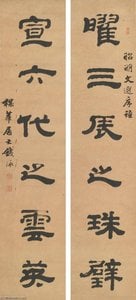
COUPLET IN SEAL SCRIPT
 Traditional Chinese Art
 138.0 x 34.0 cm
 Afficher la suite
Acquérez une image numérique haute résolution et optimisée, d'une qualité bien supérieure à l'aperçu en ligne.
Chaque fichier est méticuleusement préparé par nos spécialistes internes à l'aide d'outils avancés et d'une retouche manuelle experte. Nous garantissons que chaque image possède une clarté exceptionnelle, une précision des couleurs irréprochable et un niveau de détail fin.
Le fichier final est livré par e-mail sous 72 heures, optimisé pour une utilisation immédiate dans des contextes professionnels, éditoriaux et d'impression. Il offre la même qualité de confiance que celle utilisée par les plus grands studios de création, éditeurs et galeries.
Image numérique
Téléchargez un fichier haute résolution pour votre usage personnel, l'impression et vos projets créatifs. ( Passer au format impression Acheter la peinture faite à la main)
Inclus avec chaque commande d'image numérique
Livraison numérique experte, garantie.
En choisissant ArtsDot.com, vous n'obtenez pas seulement une simple image : vous recevez une œuvre numérique sublimée avec professionnalisme, conçue avec précision et accompagnée d'une garantie de satisfaction. Voici tout ce qui accompagne automatiquement votre commande :

Livraison rapide par e-mail
Votre fichier d'image numérique haute résolution vous sera envoyé par e-mail sous 72 heures après votre commande — prêt à un usage immédiat.

Fichier numérique optimisé par l'IA
Votre œuvre d'art bénéficie d'une optimisation professionnelle grâce à des outils d'IA avancés et une retouche manuelle, garantissant un niveau maximal de détail, de clarté et de fidélité chromatique.

Réexpédition gratuite à vie
Vous avez accidentellement supprimé ou perdu votre fichier ? Pas d'inquiétude — nous vous le renverrons gratuitement, quand vous le souhaitez.

Aucuns frais de douane — À jamais
Profitez de votre œuvre d'art instantanément sans frais de douane ni de livraison — les téléchargements numériques sont toujours exonérés de taxes.

Garantie de fidélité des couleurs
Nous garantissons que votre image numérique reproduit les couleurs de l'original aussi fidèlement que possible grâce à des outils professionnels et une gestion rigoureuse des couleurs.

Garantie de satisfaction de 100 jours
Si vous n'êtes pas satisfait de votre image numérique, nous la retoucherons ou vous rembourserons 100% sous 100 jours — sans poser de questions.

Garantie de remboursement à 100%
Pas satisfait ? Obtenez un remboursement intégral dans les 100 jours suivant la réception de votre fichier numérique — sans aucune question posée.

Remises sur les commandes groupées
Achetez 3 images, économisez 10% - Achetez 5, économisez 15% - Achetez 10+, économisez 20%. Idéal pour les projets créatifs, les galeries et les agences.
Œuvres similaires




Biographie de l'artiste
A Life Etched in Ink: The World of Yang Yisun
Yang Yisun (1813-1881), a name perhaps unfamiliar to many outside the circles of dedicated Chinese art scholars, represents a pinnacle of achievement within the tradition of *seal script calligraphy*. He wasn’t merely a calligrapher; he was a scholar-official deeply immersed in the revival of classical forms, a collector with discerning taste, and an artist who imbued his work with both technical mastery and profound personal meaning. Born into a family of modest means in Anhui province, Yang Yisun's early life foreshadowed little of the artistic renown that would later define him. He passed the imperial examinations, securing a position within the government bureaucracy – a path typical for aspiring intellectuals of his era. However, it was not official duties but an insatiable passion for antiquity and calligraphy that truly consumed him.The Revivalist’s Path: Influences and Early Development
Yang Yisun emerged during a period of burgeoning interest in epigraphy – the study of ancient inscriptions – fueled by the scholarly pursuits of the Qing dynasty. The Jiaqing Emperor's promotion of orthodox Confucianism created an environment ripe for re-examining historical models, and Yang Yisun wholeheartedly embraced this movement. He wasn’t content with simply copying past masters; he sought to *understand* the underlying principles that governed their brushwork, the very spirit of the characters themselves. His early studies focused on the bronze inscriptions of the Zhou dynasty, particularly those found on ritual vessels. These archaic forms, known as *zhuanshu*, captivated him with their solemnity and inherent power. He believed they held a direct connection to the origins of Chinese culture, embodying a purity lost in later, more stylized scripts. Influenced by epigraphers like Luo Zhenyu, Yang Yisun dedicated himself to meticulously recreating these ancient characters, not as mere reproductions but as living expressions of historical consciousness.Mastering the Seal: Technique and Artistic Philosophy
Yang Yisun’s technical skill was exceptional. He possessed an uncanny ability to replicate the textures and nuances of bronze inscriptions using brush and ink on paper. However, his artistry extended far beyond mere imitation. He understood that *zhuanshu* wasn't simply about form; it was about rhythm, balance, and the expressive potential of line. His calligraphy is characterized by a remarkable solidity – each character feels grounded, substantial, yet imbued with a subtle energy. The brushwork is deliberate, controlled, but never rigid. He employed a variety of ink tones, creating depth and visual interest within each inscription. More importantly, Yang Yisun believed that calligraphy should reflect the inner state of the artist. His work wasn’t simply decorative; it was a form of self-cultivation, a means of expressing his moral principles and philosophical beliefs. He often inscribed poems and prose passages alongside his *zhuanshu* compositions, further enriching their meaning and context.A Legacy in Stone and Ink: Major Achievements
While Yang Yisun produced numerous works throughout his career – paintings, poetry, and extensive collections of rubbings from ancient inscriptions – he is best known for his *seal script calligraphy*. His compositions were highly sought after by collectors and connoisseurs. He was commissioned to create inscriptions for steles (stone tablets) in temples and gardens, ensuring that his artistry would endure beyond his lifetime.- The Chung Young Yang Museum Collection: Today, the most comprehensive collection of Yang Yisun’s work resides at the Chung Young Yang Museum in Seoul, South Korea, founded by his descendants. This museum provides invaluable insight into the breadth and depth of his artistic achievements.
- Rubbing Expertise: His meticulous rubbings from ancient bronze vessels are considered benchmarks for accuracy and artistry, providing scholars with crucial resources for studying epigraphy.
- Influence on Later Generations: Yang Yisun’s dedication to the revival of *zhuanshu* inspired a generation of calligraphers to re-examine classical forms. His work helped to elevate the status of seal script calligraphy within the broader landscape of Chinese art.
