Aperçu en situation
 Envoyer
 Partager
 Détails de l'œuvre

 Télécharger
 Articles similaires
 Radiographie
 Diaporama
Secretary
 Oil On Paper
- WallArt
- Abstract Expressionism
 1948
1948- Modern
 62.0 x 92.0 cm
 Lire la suite
Reproduction à l'huile faite à la main
Huile sur toile peinte à la main, avec cadre et dimensions personnalisés, réalisée sur commande par nos artistes. ( Commander l'impression Acheter l'image haute résolution)




P118B $10

P118H $10

P118W $10

P438Z $10

P508JH $12

P508YH $12

P805H $10

P805Z $10

P919BZ $10

P919G $10

P919XJ $10

P959ZH $10

P968JZ $12

W106C $8

W218G $10

W218JH $8

W218Y $10

W307PJ $10

W316G $10

W316PJ $8

W316Y $10

W398PJ $8

W4111J $10

W500HY $15

W500JH $15

W692G $12

W849H $8

W940BG $15

W953PJ $8




Choisissez parmi nos formats prédéfinis qui respectent les proportions originales de l’œuvre.

Vous pouvez saisir vos propres dimensions pour l'adapter à un cadre ou à un espace spécifique. Si la taille sélectionnée ne correspond pas aux proportions de l'image d'origine, nous recadrerons l'œuvre ou prolongerons la peinture avec des éléments peints à la main supplémentaires. Une maquette numérique vous sera envoyée pour approbation avant le début de la production.
Veuillez noter que l'aperçu à l'écran ne reflète pas le recadrage ou l'extension réels. Seule la maquette montrera fidèlement la composition finale.
Bien que des tailles personnalisées soient disponibles, nous vous recommandons de sélectionner une dimension dans la liste prédéfinie afin de préserver les proportions d'origine.
Après la commande, l’équipe ArtsDot.com contactera le client par e-mail pour recueillir ses instructions et lui fournira une maquette d’aperçu
Livraison dans le monde entier () en 3 à 4 semaines au lieu des 5 semaines habituelles. (3 septembre). Aucun compromis sur la qualité.

Livraison express gratuite dans le monde entier

Toile de lin de qualité supérieure

Assurance transport complète

Garantie de remboursement des droits de douane

Garantie de fidélité des couleurs

Politique de retour de 60 jours (uniquement en cas de défaut)

Garantie de remboursement à 100%

Offre de tarifs dégressifs
 L'option verre n'est disponible que pour les dimensions inférieures à 110 cm.

Secretary
Technique de reproduction
Format de la reproduction
-


Prix total
$ 263
A Study in Tension: The Visceral World of Willem de Kooning’s ‘Secretary’
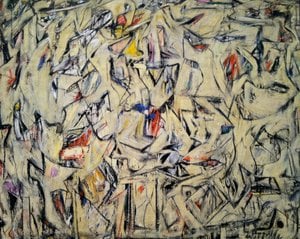
In the pantheon of Abstract Expressionism, few works capture the raw, fractured energy of the postwar era quite like Willem de Kooning’s Secretary. Executed in 1948, this masterpiece is far more than a mere portrait of a woman at her desk; it is a profound psychological landscape rendered in oil and charcoal. As one gazes upon the canvas, the viewer is immediately thrust into a world where form and emotion collide. De Kooning, a titan of the New York School, utilizes aggressive brushstrokes and fragmented shapes to dismantle the boundaries between the subject and her environment. The painting serves as a cornerstone of an era that sought to liberate art from academic rigidity, favoring instead the spontaneous, the improvisational, and the deeply personal.
The technical execution of Secretary is a testament to De Kooning’s mastery of texture and movement. By applying oil and charcoal onto paper mounted on fiberboard, the artist achieved a tactile richness that breathes life into the composition. There is an unmistakable sense of action painting here—a technique where the very act of creation becomes visible through thick, gestural marks and layered pigments. The way the colors bleed and intersect suggests a restless energy, mirroring the internal turbulence of the subject. For the discerning collector or interior designer, this piece offers a commanding presence, bringing a sophisticated edge of mid-century modernism and intellectual depth to any curated space.
Symbolism and the Subconscious Mind
Beyond its striking visual impact, Secretary is steeped in the intellectual ferment of its time, drawing heavily from the currents of Surrealism and Jungian psychology. The composition is a delicate dance of contrasts; the stark, unsettling yellow background acts as a jarring counterpoint to the muted, somber reds of the woman’s dress. This chromatic tension creates a sense of unease, reflecting the societal anxieties regarding identity and gender roles in the wake of World War II. The figure herself, though seated in a seemingly mundane position, appears caught in a moment of profound internal conflict. Her face remains obscured, inviting the viewer to project their own emotions onto her silent, downward gaze.
Every element within the frame contributes to this atmosphere of psychological complexity. The presence of clocks on the wall introduces a subtle layer of temporal pressure, suggesting the relentless march of time and the weight of duty. Even the fragmented furniture and scattered shapes contribute to a sense of disintegration, as if the physical world is dissolving into the subconscious. To possess a reproduction of such a work is to invite a conversation about the human condition into one's home—a piece that does not merely decorate a wall but challenges the spirit and inspires deep contemplation.
An Essential Acquisition for the Modern Collector
For those seeking to infuse their interiors with art that possesses both historical gravity and contemporary relevance, Secretary stands as an unparalleled choice. It embodies the transition from figurative representation to pure abstraction, making it a pivotal piece of art history. Whether placed in a minimalist gallery setting or a richly textured study, the painting’s dynamic energy and sophisticated palette command attention. A high-quality hand-painted reproduction allows the nuances of De Kooning’s brushwork and the subtle interplay of light and shadow to shine, offering an opportunity to live alongside one of the most influential movements in American art history.
Œuvres similaires


Biographie de l'artiste
jeunesse et carrière
Willem de Kooning, un artiste expressionniste abstrait néerlandais-américain renommé, est né le 24 avril 1904 à Rotterdam, aux Pays-Bas. Ses parents, Leendert de Kooning et Cornelia Nobel, ont divorcé en 1907, et de Kooning a vécu avec son père avant de passer sous la tutelle de sa mère. Il quitte l'école en 1916 et devient apprenti dans un cabinet d'arts commerciaux.développement artistique
De Kooning a suivi des cours du soir à l’Académie des Beaux-Arts et des Sciences Techniques à Rotterdam de 1916 à 1924. En 1927, il s'installe à New York City, où il travaille comme peintre décorateur et commence à développer son style artistique unique.expressionnisme abstrait
Le travail de De Kooning a évolué vers l’expressionnisme abstrait dans les années 1950, caractérisé par des coups de pinceau audacieux et des couleurs vibrantes. Sa peinture Woman I (1950-1952) est une œuvre fondamentale de ce mouvement, combinant la figuration à l'improvisation et à l'intensité émotionnelle.œuvres notables et collections
* The Glazier (137 x 112 cm, huile sur toile) : une peinture sombre aux tons terreux inspirée des fresques de Boscoreale. * Door to the River (expressionnisme abstrait) : une peinture à large coup de pinceau rappelant son passé de peintre décorateur. * Standing Man (expressionnisme abstrait) : un exemple caractéristique du style expressionniste abstrait de De Kooning.musées et collections
* Musée Boijmans Van Beuningen, Rotterdam, aux Pays-Bas : présente une impressionnante collection de plus de 151 000 œuvres d'art. * Bibliothèque universitaire de Leiden, aux Pays-Bas : abrite un centre culturel important avec plus de 5 200 000 volumes et 1 000 000 de livres électroniques. L'héritage de Willem de Kooning continue d'inspirer les artistes et les amateurs d'art, consolidant ainsi sa place en tant que pionnier de l'expressionnisme abstrait.
Willem de Kooning
1904 - 1997 , Pays-Bas
L'essentiel de l'artiste
- Artistes Influents: ['Arshile Gorky']
- Date De Décès: 19 mars 1997
- Date De Naissance: 24 avril 1904
- Lieu De Naissance: Rotterdam, Pays-Bas
- Mouvement Artistique: Expressionnisme abstrait
- Nationalité: Néerlandais-Américain
- Nom Complet: Willem de Kooning
- Oeuvres Notables:
- Woman I
- The Glazier
- Excavation
Articles connexes

Expressionnisme Abstrait : Les 10 Chefs-d'Œuvre Incontournables pour Décorer avec Art et Histoire
Plongez au cœur de l'Expressionnisme Abstrait avec ! Découvrez les 10 œuvres majeures de Pollock, Rothko et De Kooning. Histoire, techniques & inspiration déco. Explorez la collection complète en ligne.

Willem de Kooning : Abstraction, Geste et Évolution de la Peinture Américaine d'Après-Guerre
Explorez l'évolution artistique de Willem de Kooning et son rôle clé dans l'expressionnisme abstrait américain. Analyse approfondie, influences européennes et héritage durable pour les collectionneurs avertis.

25 Masterpieces by Francisco de Zurbarán: The King of Spanish Baroque Tenebrism
Immerse yourself in the dramatic world of Francisco de Zurbarán. Explore 25 iconic Spanish Baroque masterpieces defined by intense tenebrism and spiritual realism. Find inspiration for museum-quality art reproductions and decor. Discover all masterpieces on ArtsDot.com.

25 Iconic Masterpieces by Henri de Toulouse-Lautrec: The Soul of Montmartre
Step into the vibrant nightlife of Montmartre with our curated guide to the top 25 Henri de Toulouse-Lautrec masterpieces. Explore the soul of Post-Impressionism through iconic posters and paintings. Find museum-quality reproductions for your decor at ArtsDot.com. Explore the full collection online.

Goya : 25 Chefs-d'Œuvre Inoubliables d'un Maître de l'Âme
Plongez au cœur de l'œuvre inégalable de Goya ! Découvrez 25 chefs-d’œuvre emblématiques, des portraits saisissants aux scènes dramatiques. Explorez la vie et l'art du maître espagnol avec ArtsDot.com – reproductions d'art de qualité musée et inspirations déco.