- Accueil

- Impression sur toile
- Willem de Kooning
- Easter Monday

 Preview
 Partager
 Partager
 Détails de l'œuvre

 Télécharger
 Articles similaires
 Radiographie
 Diaporama
Easter Monday


 Afficher la suite
Giclée / Impression d'art
Impression giclée ou sur toile de qualité musée, avec une production rapide et des finitions au choix. ( Switch to hand made Painting Switch to Image)




P118B $10

P118H $10

P118W $10

P438Z $10

P508JH $12

P508YH $12

P805H $10

P805Z $10

P919BZ $10

P919G $10

P919XJ $10

P959ZH $10

P968JZ $12

W106C $8

W218G $10

W218JH $8

W218Y $10

W307PJ $10

W316G $10

W316PJ $8

W316Y $10

W398PJ $8

W4111J $10

W500HY $15

W500JH $15

W692G $12

W849H $8

W940BG $15

W953PJ $8




Choisissez parmi nos formats prédéfinis qui respectent les proportions originales de l’œuvre.

Vous pouvez saisir vos propres dimensions pour vous adapter à un cadre ou à un espace spécifique. Si la taille sélectionnée ne correspond pas aux proportions de l'image originale, nous recadrerons l'œuvre ou étendrons l'image avec une bordure en miroir ou une couleur unie. Une maquette numérique vous sera envoyée pour approbation avant le début de la production.
Veuillez noter que l'aperçu à l'écran ne reflète pas le recadrage ou l'extension réelle. Seule la maquette montrera avec précision la composition finale.
Bien que des tailles personnalisées soient disponibles, nous vous recommandons de choisir une dimension dans la liste prédéfinie afin de préserver les proportions originales.
Livraison dans le monde entier () en 2 semaines au lieu des 4/5 semaines habituelles. (29 juillet)

Livraison express gratuite dans le monde entier

Toile de lin de haute qualité

Assurance transport complète

Garantie de remboursement des frais de douane

Garantie de fidélité des couleurs

Politique de retour de 60 jours (uniquement en cas de défaut)

Garantie de remboursement à 100%

Réduction sur les achats groupés
 L'option verre n'est disponible que pour les dimensions inférieures à 110 cm.

Easter Monday
Giclée / Impression d'art
Format de reproduction
-


Prix total final
$ 62
Description de l'œuvre
A Study in Contrast: De Kooning’s ‘Easter Monday’
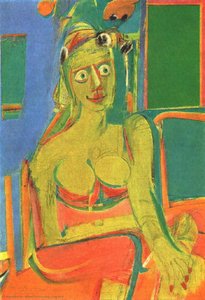
Willem de Kooning's 1956 painting, “Easter Monday,” is not merely a depiction of faces; it’s an intensely psychological exploration rendered with the artist’s signature blend of aggression and vulnerability. The work immediately confronts the viewer with two figures, dramatically differentiated in scale and presence. One face, boldly positioned and adorned with a white hat, dominates the canvas, its gaze direct and seemingly challenging. This figure embodies a forceful assertion, a deliberate engagement that draws us into the painting’s turbulent emotional landscape. The other face, partially obscured and wearing spectacles, offers a quieter, more contemplative response – a subtle acknowledgement of the dominant presence. This juxtaposition immediately establishes a dynamic tension, reflecting perhaps the complexities of human interaction and the struggle for self-expression.
De Kooning's Abstract Expressionist Technique
Executed in oil on canvas, “Easter Monday” exemplifies de Kooning’s mastery of Abstract Expressionism. His technique is characterized by broad, gestural brushstrokes – thick impasto applied with a raw energy that suggests both control and unrestrained emotion. The painting isn't about precise representation; instead, it utilizes fragmented forms and distorted perspectives to convey feeling rather than objective reality. Notice the layering of paint, particularly around the prominent face, creating a sense of depth and texture that adds to the work’s visceral impact. De Kooning’s use of color is equally significant – muted tones punctuated by flashes of white and darker shades contribute to the painting's overall mood of unease and intensity. The horse heads, seemingly placed almost arbitrarily, further disrupt any potential for serene observation, adding another layer of unsettling symbolism.
Symbolism and Context within De Kooning’s Oeuvre
Created during a pivotal period in de Kooning’s career, “Easter Monday” reflects his ongoing exploration of the human figure – often rendered with a deliberately confrontational style. The painting's title, ‘Easter Monday,’ while seemingly straightforward, adds another layer of complexity. Easter, traditionally associated with rebirth and renewal, is juxtaposed with the raw emotional intensity of the scene. This tension speaks to de Kooning’s broader concerns about identity, alienation, and the anxieties of modern life. His work during this period was heavily influenced by Surrealism, particularly its exploration of the subconscious and dreamlike imagery, though he rejected the movement's emphasis on automatic drawing.
A Legacy of Emotional Intensity
“Easter Monday” stands as a powerful example of de Kooning’s ability to translate personal turmoil into universally resonant art. Its enduring appeal lies in its unflinching portrayal of human vulnerability and conflict. The bicycle, a symbol of freedom and movement, adds an element of irony to the composition, suggesting perhaps a futile attempt to escape internal struggles. This painting is more than just a reproduction; it’s a window into the mind of one of America's most influential artists – a testament to his relentless pursuit of emotional truth through bold, expressive brushwork. A hand-painted reproduction offers an unparalleled opportunity to experience the full force of de Kooning’s vision.
Œuvres apparentées


Biographie de l'artiste
jeunesse et carrière
Willem de Kooning, un artiste expressionniste abstrait néerlandais-américain renommé, est né le 24 avril 1904 à Rotterdam, aux Pays-Bas. Ses parents, Leendert de Kooning et Cornelia Nobel, ont divorcé en 1907, et de Kooning a vécu avec son père avant de passer sous la tutelle de sa mère. Il quitte l'école en 1916 et devient apprenti dans un cabinet d'arts commerciaux.développement artistique
De Kooning a suivi des cours du soir à l’Académie des Beaux-Arts et des Sciences Techniques à Rotterdam de 1916 à 1924. En 1927, il s'installe à New York City, où il travaille comme peintre décorateur et commence à développer son style artistique unique.expressionnisme abstrait
Le travail de De Kooning a évolué vers l’expressionnisme abstrait dans les années 1950, caractérisé par des coups de pinceau audacieux et des couleurs vibrantes. Sa peinture Woman I (1950-1952) est une œuvre fondamentale de ce mouvement, combinant la figuration à l'improvisation et à l'intensité émotionnelle.œuvres notables et collections
* The Glazier (137 x 112 cm, huile sur toile) : une peinture sombre aux tons terreux inspirée des fresques de Boscoreale. * Door to the River (expressionnisme abstrait) : une peinture à large coup de pinceau rappelant son passé de peintre décorateur. * Standing Man (expressionnisme abstrait) : un exemple caractéristique du style expressionniste abstrait de De Kooning.musées et collections
* Musée Boijmans Van Beuningen, Rotterdam, aux Pays-Bas : présente une impressionnante collection de plus de 151 000 œuvres d'art. * Bibliothèque universitaire de Leiden, aux Pays-Bas : abrite un centre culturel important avec plus de 5 200 000 volumes et 1 000 000 de livres électroniques. L'héritage de Willem de Kooning continue d'inspirer les artistes et les amateurs d'art, consolidant ainsi sa place en tant que pionnier de l'expressionnisme abstrait.
Willem de Kooning
1904 - 1997 , Pays-Bas
En bref
- Artistes Influents: ['Arshile Gorky']
- Date De Décès: 19 mars 1997
- Date De Naissance: 24 avril 1904
- Lieu De Naissance: Rotterdam, Pays-Bas
- Mouvement Artistique: Expressionnisme abstrait
- Nationalité: Néerlandais-Américain
- Nom Complet: Willem de Kooning
- Oeuvres Notables:
- Woman I
- The Glazier
- Excavation
Articles connexes

Willem de Kooning : Abstraction, Geste et Évolution de la Peinture Américaine d'Après-Guerre
Explorez l'évolution artistique de Willem de Kooning et son rôle clé dans l'expressionnisme abstrait américain. Analyse approfondie, influences européennes et héritage durable pour les collectionneurs avertis.

Au-Delà de la Représentation : Exploration du Paysage Émotionnel de l'Expressionnisme Abstrait
Explorez l'univers fascinant de l'Expressionnisme Abstrait avec ArtsDot. Analyse approfondie des maîtres (Pollock, Rothko, De Kooning) et conseils d'experts pour collectionner ces œuvres emblématiques. Découvrez une sélection unique.

Expressionnisme Abstrait : Les 10 Chefs-d'Œuvre Incontournables pour Décorer avec Art et Histoire
Plongez au cœur de l'Expressionnisme Abstrait avec ! Découvrez les 10 œuvres majeures de Pollock, Rothko et De Kooning. Histoire, techniques & inspiration déco. Explorez la collection complète en ligne.

Jacob Kainen: A Pioneer of American Color Field Painting & Abstract Expressionism
Explore the life & work of Jacob Kainen, a pivotal figure in American Abstract Expressionism and Color Field painting. Discover his journey from Social Realism to vibrant abstraction and lasting influence on 20th-century art.

Au-Delà de la Représentation : L'Évolution Durable et l'Impact Profond de l'Art Abstrait
Explorez l'évolution fascinante de l'art abstrait avec ArtsDot. Découvrez les maîtres (Kandinsky, Pollock…) et apprenez à collectionner des œuvres d'exception. Conseils d'experts pour investir et sublimer votre intérieur.