

 Aperçu en situation
 Envoyer
 Partager
 Détails de l'œuvre
 Guide
Guide

 Télécharger l'image
 Articles similaires
 Radiographie
 Diaporama
 Questions et réponses
 Statistiques
Improvisation 26 (Rowing)


 Lire la suite
Giclées et impressions d'art
Impressions giclées ou sur toile de qualité musée, avec une production rapide et des finitions au choix. ( Commander la reproduction peinte à la main Passer au format numérique)




P118B €10

P118H €10

P118W €10

P438Z €10

P508JH €12

P508YH €12

P805H €10

P805Z €10

P919BZ €10

P919G €10

P919XJ €10

P959ZH €10

P968JZ €12

W106C €8

W218G €10

W218JH €8

W218Y €10

W307PJ €10

W316G €10

W316PJ €8

W316Y €10

W398PJ €8

W4111J €10

W500HY €15

W500JH €15

W692G €12

W849H €8

W940BG €15

W953PJ €8




Choisissez parmi nos formats prédéfinis qui respectent les proportions originales de l’œuvre.

Saisissez la largeur et la hauteur souhaitées pour qu'elles s'adaptent à votre cadre ou à votre mur. Une impression peut être recadrée, mais jamais agrandie au-delà de l'image originale ; ainsi, un format de forme différente entraînera la perte d'une partie de l'image. Nous vous envoyons une maquette numérique pour approbation avant toute impression. L'image présentée sur cette page ne montre pas le recadrage réel — seule la maquette le permet.
Livraison dans le monde entier () en 2 semaines au lieu des 4/5 semaines habituelles. (9 novembre)

Livraison express gratuite dans le monde entier

Toile de lin de qualité supérieure

Assurance transport complète

Garantie de remboursement des droits de douane

Garantie de fidélité des couleurs

Politique de retour de 100 jours (uniquement en cas de défaut)

Garantie de remboursement à 100%

Offre de tarifs dégressifs
 L'option verre n'est disponible que pour les dimensions inférieures à 110 cm.

Improvisation 26 (Rowing)
Giclées et impressions d'art
Format de la reproduction
-


Prix total
€ 56
Improvisation 26
Wassily Kandinsky’s “Improvisation 26” stands as an emblem of his groundbreaking approach to abstraction, firmly rooted in Expressionism and propelled by a profound desire to transcend representational art. Painted in 1912 during his formative years in Munich alongside Gabriele Münter and Franz Marc—members of the influential Blaue Reiter group—this oil painting isn’t merely pigment on canvas; it's an attempt to capture the very essence of feeling, transforming visual elements into conduits for emotional resonance.
The composition immediately draws the eye to a dominant yellow circle, pulsating with energy and radiating outwards. Surrounding this central motif are numerous shapes—circles, squares, triangles—each rendered in hues ranging from deep blues to vibrant reds and oranges. These forms aren’t depicted realistically; instead, they exist as autonomous entities governed by their own internal rhythms and relationships. Kandinsky meticulously considered color theory, recognizing its ability to evoke psychological states and create a dynamic interplay between visual sensations.
“Improvisation 26” embodies the core tenets of Expressionist art—a rejection of objective observation in favor of subjective experience. Kandinsky sought to liberate painting from the constraints of depicting the external world, prioritizing instead the expression of inner emotions and spiritual impulses. The swirling lines and fragmented shapes contribute to a sense of movement and instability, mirroring the turbulent currents of human consciousness.
Considered alongside other seminal works by Kandinsky—such as “In the Blue” and “Compensation rose”—“Improvisation 26” exemplifies his unwavering commitment to exploring the transformative power of color and form. These paintings demonstrate a masterful balance between visual harmony and emotional intensity, inviting viewers into a contemplative dialogue about art’s capacity to communicate beyond words.
For those captivated by Kandinsky's vision or intrigued by similar artistic explorations—particularly the vibrant hues and geometric precision found in Karol Hiller’s “Heliographic composition (XXIX)” and Volodymyr Loboda’s evocative depictions of Soviet Nonconformist Art—the reproductions offered by ArtsDot.com provide an unparalleled opportunity to immerse oneself in the legacy of a true pioneer.
Similar Artists & Styles: Karol Hiller's “Heliographic composition (XXIX)” shares Kandinsky’s fascination with geometric abstraction and explores similar visual languages. Volodymyr Loboda’s Ukrainian art reflects the spirit of Soviet Nonconformist Art, characterized by a rebellious rejection of official artistic dogma.
Resources: Explore more about Kandinsky's oeuvre at ArtsDot.com and discover exceptional handmade oil painting reproductions.
Additional Information: You can find detailed insights into “Improvisation 26” on WikiArt and admire its beauty in high resolution.
Explore More: Visit Posterlounge for stunning prints of “Improvisation 26” and discover the world of abstract art!
Questions et réponses
Comment puis-je obtenir une version numérique de «Improvisation 26 (Rowing)» de Wassily Wassilyevich Kandinsky ?
Pour obtenir une version numérique de «Improvisation 26 (Rowing)» de Wassily Wassilyevich Kandinsky, commandez téléchargement d'une image numérique haute résolution sur sa page Image numérique haute résolution.
Quelle est l'émotion qui se dégage de «Improvisation 26 (Rowing)» de Wassily Wassilyevich Kandinsky ?
«Improvisation 26 (Rowing)» est empreint d'un sentiment Contemplatif. La tonalité émotionnelle décrit l'impression qui se dégage de l'œuvre.
Quel usage est suggéré pour «Improvisation 26 (Rowing)» de Wassily Wassilyevich Kandinsky ?
Cette impression de « Improvisation 26 (Rowing) » est idéale pour Élément d'accentuation.
Œuvres similaires


Biographie de l'artiste
Wassily Wassilyevich Kandinsky : Pionnier de l'Abstraction
- Né : 16 décembre 1866, Moscou, Russie
- Décédé : 13 décembre 1944
- Nationalité : Russe
Jeunesse et Développement Artistique
- La jeunesse de Kandinsky a été marquée par une éducation diversifiée, étudiant initialement le droit et l'économie à l'Université de Moscou.
- À l’âge de 30 ans, il s’est tourné vers l’art, s’inscrivant à l’Académie de Munich sous la direction de Franz von Stuck. Ce changement a marqué un engagement profond envers l’expression artistique.
- Ses premières œuvres ont été influencées par l'art populaire russe, notamment lors d'un voyage ethnographique dans la région de Vologda en 1889.
- Il a développé un intérêt pour le symbolisme des couleurs et la psychologie, qui sont devenus des éléments fondamentaux de ses compositions abstraites ultérieures.
Périodes Artistiques Clés et Styles
- Expressionnisme Précoce : Caractérisé par des couleurs vibrantes et une intensité émotionnelle, comme on le voit dans "Papeln (Poplars)" (1902).
- Transition vers l'Abstraction : Kandinsky s’est progressivement éloigné de l’art représentatif, explorant la relation entre la couleur, la forme et l’émotion.
- Abstraction Géométrique : Cette période a vu un intérêt accru pour les formes géométriques et les compositions, illustré par "Several Circles" (140 x 140 cm).
- Abstraction Spirituelle : Kandinsky croyait que l'art pouvait exprimer des vérités spirituelles à travers des formes non représentatives. Ses œuvres visaient à évoquer des émotions et des expériences intérieures plutôt qu’à dépeindre la réalité externe.
Influence et Héritage
- Influence du Bauhaus : En tant que membre de faculté de l'école Bauhaus en Allemagne, Kandinsky a profondément influencé des générations d'artistes grâce à ses théories sur la couleur, la forme et l’abstraction.
- Écrits Théoriques : Ses écrits, notamment "De lo Spirituel dans l'Art", ont articulé sa philosophie artistique et ont contribué de manière significative au développement de la théorie de l'art abstrait.
- Impact sur l'Art Moderne : Kandinsky est largement reconnu comme un pionnier de l'art abstrait, ouvrant la voie à de nombreux mouvements et artistes ultérieurs.
- Collections Muséales : Ses œuvres sont conservées dans les principaux musées du monde entier, notamment la Galerie Tretyakov à Moscou, qui abrite sa "Composition VII" monumentale.
Œuvres Notables
- Composition VII : Une œuvre abstraite de grande envergure considérée comme l'aboutissement du développement artistique de Kandinsky.
- Carré Noir (en collaboration avec Kazimir Malevitch) : Une œuvre fondamentale dans l’histoire de l’abstraction, représentant un départ radical des formes artistiques traditionnelles.
- Several Circles : Démontre son utilisation innovante de formes géométriques et de couleurs vibrantes pour créer des compositions dynamiques.
- Murnau avec une Église : Équilibre les éléments abstraits avec l'imagerie représentative, mettant en valeur son style en évolution.
- Un Bal Intime : Une œuvre ultérieure présentant une abstraction géométrique et un empâtement superposé, reflétant son exploration continue des thèmes spirituels.

Wassily Wassilyevich Kandinsky
1866 - 1944 , Russie
L'essentiel de l'artiste
- Artistic Movement Or Style: Expressionnisme abstrait
- Date De Décès: 13 décembre 1944
- Date De Naissance: 16 décembre 1866
- Full Name: Wassily Wassilyevich Kandinsky
- Lieu De Naissance: Moscou, Russie
- Nationalité: Russe
- Notable Artworks:
- Composition VII
- Carré noir
- Plusieurs cercles
- Murnau avec une église
- Un après-midi intime
Articles connexes

Abstraction Géométrique : Les 10 Chefs-d'œuvre qui ont Marqué l'Histoire de l'Art
Plongez au cœur de l'abstraction géométrique avec ArtsDot.com ! Découvrez les 10 œuvres majeures de Mondrian, Malevitch et Kandinsky qui ont révolutionné l'art moderne. Inspirez votre décoration intérieure avec des reproductions de tableaux exceptionnelles. Explorez la collection en ligne !

Les 25 chefs-d'œuvre de Kandinsky : l'éveil de l'art abstrait
Explorez les 25 chefs-d'œuvre de Kandinsky et l'éveil de l'abstraction. Découvrez toute la collection sur ArtsDot.com.
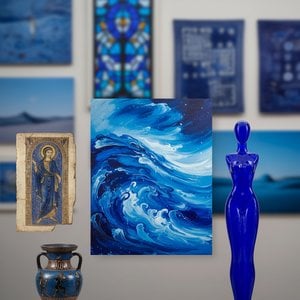
The Allure of Azure: Exploring the Symbolic & Aesthetic Depths of Blue in Art History
Explore the rich history of blue in art! Discover its symbolism, from ancient pigments to modern masterpieces by Kandinsky & Seurat. Uncover the psychological impact and cultural meanings behind this captivating hue.

Les 10 Chefs-d'œuvre Dominés par le Bleu Ardoise : Art, Histoire & Décor
Plongez dans l'univers fascinant des 10 plus beaux tableaux dominés par le bleu ardoise. Découvrez l'histoire, les artistes et les techniques de ces chefs-d'œuvre impressionnistes et contemporains. Inspirez votre décoration intérieure avec !

Expressionnisme Abstrait : Les 10 Chefs-d'Œuvre Incontournables pour Décorer avec Art et Histoire
Plongez au cœur de l'Expressionnisme Abstrait avec ! Découvrez les 10 œuvres majeures de Pollock, Rothko et De Kooning. Histoire, techniques & inspiration déco. Explorez la collection complète en ligne.


