

 Envoyer
 Partager
 Détails de l'œuvre
 Guide
Guide

 Télécharger l'image
 Articles similaires
 Diaporama
 Questions et réponses
 Statistiques
Apollo

- 120.0 x 142.0 cm


 Lire la suite
Giclées et impressions d'art
Impressions giclées ou sur toile de qualité musée, avec une production rapide et des finitions au choix. ( Commander la reproduction peinte à la main Passer au format numérique)




































Choisissez parmi nos formats prédéfinis qui respectent les proportions originales de l’œuvre.

Saisissez la largeur et la hauteur souhaitées pour qu'elles s'adaptent à votre cadre ou à votre mur. Une impression peut être recadrée, mais jamais agrandie au-delà de l'image originale ; ainsi, un format de forme différente entraînera la perte d'une partie de l'image. Nous vous envoyons une maquette numérique pour approbation avant toute impression. L'image présentée sur cette page ne montre pas le recadrage réel — seule la maquette le permet.
Livraison dans le monde entier () en 2 semaines au lieu des 4/5 semaines habituelles. (8 novembre)

Livraison express gratuite dans le monde entier

Toile de lin de qualité supérieure

Assurance transport complète

Garantie de remboursement des droits de douane

Garantie de fidélité des couleurs

Politique de retour de 100 jours (uniquement en cas de défaut)

Garantie de remboursement à 100%

Offre de tarifs dégressifs
 L'option verre n'est disponible que pour les dimensions inférieures à 110 cm.

Apollo
Giclées et impressions d'art
Format de la reproduction
-


Prix total
€ 56
A Vision of Neoclassical Serenity
In the quiet halls of the Museo Vela in Switzerland, there exists a marble masterpiece that captures the very essence of the late Enlightenment era. Attributed to the skilled hands of Vincenzo Pacetti, the sculpture Apollo serves as a profound testament to the Classical Revival. Executed in 1783, this work is far more than a mere depiction of a deity; it is an embodiment of Neoclassical ideals, seeking to resurrect the grandeur, rationality, and grace of ancient Greece and Rome. As one approaches the sculpture, the serene presence of the figure commands immediate attention, inviting the viewer into a state of deep contemplation regarding themes of divine beauty and intellectual pursuit.
The composition centers on Apollo, the revered Greek god of music, poetry, healing, and prophecy. Rather than portraying him in a moment of athletic prowess or divine intervention, Pacetti presents him in a state of profound introspection. Seated upon a simple bench, Apollo gazes upward, his expression lost in thought. This posture creates an emotional resonance that transcends the stone itself, evoking a sense of peace and scholarly devotion. The sculpture’s arrangement is rich with symbolic weight: beside the god rests a book, representing the vastness of knowledge and erudition, while a scale sits nearby to signify balance and precision—virtues held in the highest regard by the artists of this era.
Mastery of Form and Material
The technical execution of Apollo showcases Pacetti’s remarkable ability to breathe life into cold marble. The artist employs classical proportions and idealized forms, drawing upon the monumental sculptural traditions established by masters such as Michelangelo and Bernini. Every detail is meticulously rendered, from the intricate carvings that adorn the figure to the soft, lifelike textures of the stone. The choice of marble is particularly significant; its inherent ability to reflect light beautifully lends a luminous quality to the sculpture, enhancing the sense of solidity and permanence that defines the work.
For the discerning collector or interior designer, this piece offers an unparalleled opportunity to introduce an element of timeless elegance into a space. The interplay of light upon the polished surfaces and the dignified posture of the figure provide a focal point that is both intellectually stimulating and aesthetically soothing. Whether viewed as a study in Neoclassical technique or as a symbolic representation of the pursuit of virtue through reasoned observation, Apollo remains an enduring icon of artistic excellence, perfect for those seeking to surround themselves with the profound beauty of history.
Questions et réponses
Quelle est l'émotion qui se dégage de «Apollo» de Vincenzo Pacetti ?
«Apollo» de Vincenzo Pacetti dégage une tonalité émotionnelle Calm.
Dans quel musée se trouve l'original de « Apollo » ?
L'original de «Apollo» de Vincenzo Pacetti est conservé au Galleria Borghese, Rome, Italy. Une reproduction permet d'exposer l'œuvre chez soi.
Comment les couleurs de «Apollo» de Vincenzo Pacetti traduisent-elles l'émotion qui s'en dégage ?
«Apollo» de Vincenzo Pacetti allie une palette Earthy à un ton Calm.
Œuvres similaires


Biographie de l'artiste
Vincenzo Pacetti : Vie et Héritage
Jeunesse et Formation
- Né : Rome, Italie, en 1746.
- Vincenzo Pacetti a entamé son voyage artistique au sein de l'Accademia del Nudo, où il a perfectionné ses compétences dans l'étude anatomique et le dessin de figures.
- Il a poursuivi sa formation de 1766 à 1772 sous la tutelle du sculpteur-restaurateur Pietro Pacili. À la mort de ce dernier, Vincenzo a repris la direction de son atelier.
Carrière et Développement Artistique
- Pacetti s'est rapidement imposé comme un sculpteur indépendant et fut admis à l'Accademia di San Luca, dont il assura même la direction — un véritable témoignage de sa réputation grandissante.
- L'œuvre de Pacetti s'est épanouie à la croisée de la sculpture et de la restauration. Loin d'être un simple copiste, il s'attachait à compléter activement les œuvres classiques fragmentaires, ajoutant parfois des parties significatives selon son propre jugement artistique.
Réalisations Majeures et Œuvres Notables
- Le Faune Barberini (1799) : Sans doute l'œuvre la plus célèbre de Pacetti. Il a restauré et achevé cette sculpture emblématique en y ajoutant une nouvelle jambe droite ; elle est aujourd'hui conservée à la Glyptothèque de Munich.
- Dionysos de l'Espoir : Actuellement conservée au Metropolitan Museum of Art, cette pièce illustre parfaitement le talent de Pacetti pour magnifier les fragments antiques.
- L'Athéna de Velletri (1797) : Désormais exposée au Louvre, cette sculpture témoigne de sa capacité à insuffler une nouvelle vie aux formes classiques.
- Il a réalisé un travail considérable à la Galleria Borghese, notamment des reliefs et des stucs pour la Sala degli Imperatori, tels que « La Chèvre Amanthea » et « Persée délivrant Andromède ». Il a également contribué à l'ornementation de salles abritant les chefs-d'œuvre du Bernin.
- Ses autres œuvres sont dispersées dans des églises telles que San Salvatore in Lauro, Santo Spirito in Sassia, Santi Michele e Magno, ainsi qu'au Palazzo Carpegna.
Mécénat et Fin de Vie
- Lucien Bonaparte devint un mécène de premier plan plus tard dans la carrière de Pacetti, lui commandant de nombreux moulages en plâtre de sculptures antiques célèbres pour sa villa à Canino.
- Le journal de Pacetti, couvrant les années 1773–1803, ainsi que sa correspondance, offrent des perspectives inestimables sur le marché de l'art romain de cette époque.
- Décédé : Rome, en 1820.
Importance Historique et Héritage
- Vincenzo Pacetti occupe une place unique dans l'histoire de l'art, agissant à la fois comme sculpteur et restaurateur. Son travail soulève des questions fascinantes sur l'authenticité, l'intervention artistique et l'interprétation des formes classiques.
- Il a joué un rôle crucial dans la compréhension et l'appréciation de la sculpture antique durant la période néoclassique.
- Ses journaux intimes demeurent une ressource essentielle pour les chercheurs étudiant le marché de l'art et les pratiques de restauration dans la Rome des XVIIIe et XIXe siècles.

Vincenzo Pacetti
1746 - 1820 , Italie
L'essentiel de l'artiste
- Artistic Movement Or Style: Neoclassique
- Artists Who Influenced This Artist:
- Pietro Pacili
- Bartolomeo Cavaceppi
- Country: Italie
- Date Of Birth: 1746
- Full Name: Vincenzo Pacetti
- Nationality: Italien
- Notable Artworks:
- Faune de Barberini
- Espoir Dionysos
- Athéna de Velletri
- Place Of Birth: Rome
Articles connexes

Les 10 Chefs-d'œuvre Bronzes Qui Ont Révolutionné la Sculpture | ArtsDot
Plongez dans l'univers fascinant des 10 sculptures en bronze les plus emblématiques de l'histoire de l'art. Rodin, Degas et autres maîtres révélés ! Découvrez leur histoire, leurs techniques et trouvez l'œuvre parfaite pour sublimer votre intérieur sur ArtsDot.com.

L'Évolution du Volume : Analyse des Procédés et de l'Histoire de la Sculpture
Explorez l'évolution technique de la sculpture, du marbre classique à l'art cinétique. Maîtrisez l'histoire du volume dès maintenant.

The Enduring Form: Exploring Themes & Techniques in Sculpture Across Historical Periods
Explore the rich history of sculpture from ancient masterpieces to contemporary innovations. Discover key techniques, influential artists & investment potential for discerning art collectors.

Les 10 Chefs-d'œuvre en Bronze qui ont Révolutionné l'Art : Collection ArtsDot
Plongez dans l'univers fascinant des 10 chefs-d'œuvre en bronze qui ont marqué l'histoire de l'art. Découvrez Rodin, Degas et les secrets de ces sculptures iconiques. Reproductions d'art exceptionnelles sur ArtsDot.com – Explorez la collection !
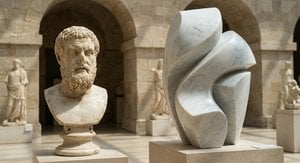
The Enduring Allure of Marble in Art History: From Classical Sculpture to Modern Abstraction
Explore the captivating history of marble sculpture from ancient Greece to modern art. Discover renowned artists like Canova & Michelangelo, carving techniques, and investment insights at ArtsDot.