


 Aperçu en situation
 Partager
 Partager
 Détails

 Télécharger l'image
 Articles similaires
 Radiographie
 Voir le diaporama
Comedia


 Afficher la suite
Giclées et impressions d'art
Impressions giclées ou sur toile de qualité musée, avec une production rapide et des finitions au choix. ( Acheter la peinture faite à la main Acheter l'image)




P118B $10

P118H $10

P118W $10

P438Z $10

P508JH $12

P508YH $12

P805H $10

P805Z $10

P919BZ $10

P919G $10

P919XJ $10

P959ZH $10

P968JZ $12

W106C $8

W218G $10

W218JH $8

W218Y $10

W307PJ $10

W316G $10

W316PJ $8

W316Y $10

W398PJ $8

W4111J $10

W500HY $15

W500JH $15

W692G $12

W849H $8

W940BG $15

W953PJ $8




Choisissez parmi nos formats prédéfinis qui respectent les proportions originales de l’œuvre.

Vous pouvez saisir vos propres dimensions pour vous adapter à un cadre ou à un espace spécifique. Si la taille sélectionnée ne correspond pas aux proportions de l'image originale, nous recadrerons l'œuvre ou étendrons l'image avec une bordure en miroir ou une couleur unie. Une maquette numérique vous sera envoyée pour approbation avant le début de la production.
Veuillez noter que l'aperçu à l'écran ne reflète pas le recadrage ou l'extension réelle. Seule la maquette montrera avec précision la composition finale.
Bien que des tailles personnalisées soient disponibles, nous vous recommandons de choisir une dimension dans la liste prédéfinie afin de préserver les proportions originales.
Livraison dans le monde entier () en 2 semaines au lieu des 4/5 semaines habituelles. (25 août)

Livraison express gratuite dans le monde entier

Toile de lin de haute qualité

Assurance transport complète

Garantie de remboursement des droits de douane

Garantie de fidélité des couleurs

Politique de retour de 60 jours (uniquement en cas de défaut)

Garantie de remboursement à 100%

Tarifs dégressifs sur quantité
 L'option verre n'est disponible que pour les dimensions inférieures à 110 cm.

Comedia
Giclées et impressions d'art
Format de la reproduction
-


Prix total final
$ 62
Description de la pièce
Thomas Wilmer Dewing’s ‘Comedia’: A Portrait of Quiet Elegance and Dreamlike Atmosphere
The painting “Comedia,” executed by Thomas Wilmer Dewing in 1894, stands as a quintessential example of American tonalist art—a movement that championed subdued colors and atmospheric effects to convey emotion rather than precise representation. More than just a depiction of a woman, Maria Oakey Dewing, it’s an exploration of inner life rendered with remarkable sensitivity and artistic finesse. This essay delves into the intricacies of Dewing's style, its historical significance, and the enduring allure of “Comedia” as a visual masterpiece.A Masterclass in Tonalist Technique
Dewing’s approach to painting distinguished him from his contemporaries who favored brighter palettes and detailed realism. He meticulously blended pigments—primarily earth tones like ochre, umber, and Sienna—to achieve velvety textures and luminous gradations of color. This technique, honed during his formative years at the Académie Julian in Paris alongside luminaries such as Gustave Boulanger and Jules Lefebvre, prioritized capturing the mood and feeling of a scene above all else. The subtle interplay of light and shadow creates an ethereal quality, transporting viewers into Dewing’s envisioned interior space—a room bathed in soft illumination that seems to emanate from within the woman herself. Notice how Dewing skillfully utilizes glazing – applying thin layers of translucent color over underlying tones – to build up depth and luminosity without resorting to harsh contrasts.The Woman Within: Symbolism and Psychological Depth
“Comedia” isn’t merely a portrait; it's an embodiment of psychological introspection. Maria Oakey Dewing, Dewing’s wife, is posed gracefully in a blue dress against a muted green backdrop—a deliberate choice that underscores the painting’s symbolic resonance. The woman’s hands resting on her hips convey confidence and composure, yet her gaze directs inward, hinting at contemplation and perhaps even melancholy. This posture speaks to the broader themes of American Aestheticism – an artistic movement concerned with exploring inner experience and capturing fleeting emotions—a preoccupation prevalent during the late Victorian era. The necklace adorning Maria’s neck symbolizes refinement and sophistication, mirroring Dewing's own commitment to portraying beauty in its most subtle forms.Historical Context: Embracing Impressionistic Influences
Dewing’s artistic vision was profoundly shaped by the burgeoning influence of Impressionism. While rejecting Impressionist’s rapid brushstrokes and vibrant hues, he absorbed its core principles—namely, prioritizing atmosphere and capturing subjective perception. Like many tonalists, Dewing sought to evoke emotion through color and texture, mirroring the Romantic tradition's fascination with psychological landscapes. The painting reflects a desire to transcend mere visual representation, aiming instead for an emotional response from the viewer – a feeling of quiet contemplation and serene beauty that lingers long after viewing the artwork.A Legacy of Elegance: Why ‘Comedia’ Remains Relevant Today
“Comedia” continues to captivate audiences today due to its masterful execution and profound exploration of human emotion. Dewing's ability to convey inner tranquility through understated visual elements speaks to a timeless aesthetic—one that prioritizes beauty, subtlety, and psychological depth. Hand-painted reproductions offer an opportunity to experience the same atmospheric luminescence and emotional resonance as the original masterpiece, bringing a touch of Victorian elegance into contemporary homes and inspiring collectors alike. Its enduring appeal underscores Dewing’s place as one of America's foremost tonalist painters—a true innovator who elevated portraiture beyond mere likeness to capture the essence of human spirit.Œuvres similaires


Biographie de l'artiste
Premières années et formation
Thomas Wilmer Dewing, peintre américain, est né le 4 mai 1851 à Boston, Massachusetts. Son parcours artistique a commencé par un apprentissage de lithographe, qui l'a ensuite conduit à l’Académie Julian prestigieuse à Paris, où il a étudié sous la direction de Gustave Boulanger et Jules Lefebvre à partir de 1887.Style artistique et œuvres notables
Le style artistique de Dewing se caractérise par ses peintures tonalistes, un genre profondément enraciné dans l'esthétisme anglais. Ses sujets préférés étaient les femmes aristocratiques, souvent représentées dans des environnements mélancoliques et oniriques, jouant de la musique ou s’engageant dans des activités introspectives.- Femme en noir : portrait de Maria Oakey Dewing (1887), une huile sur panneau poignante, met en valeur sa femme, elle-même peintre accomplie ayant reçu une formation artistique formelle étendue.
- Dame en or (1912), aujourd'hui au Brooklyn Museum, exemplifie sa maîtrise dans la capture de l’essence de ses sujets.
Enseignement et associations
Dewing était un membre fondateur des Dix Peintres Américains en 1898 et a enseigné à l’Art Students League of New York. Son association avec la Society of Landscape Painters, fondée en 1899, a renforcé sa position au sein du mouvement tonaliste.Héritage et collections
- La Freer Gallery of Art de Smithsonian Institution possède une salle dédiée aux œuvres de Dewing.
- Des collectionneurs notables incluent John Gellatly et Charles Lang Freer.
Vie ultérieure et décès
La production artistique de Dewing a diminué après 1920. Il est décédé à New York le 5 novembre 1938, laissant derrière lui un héritage de portraits captivants et éthérés qui continuent d’intriguer les passionnés d'art.Œuvres clés et collections disponibles pour reproduction chez ArtsDot
- La robe blanche
- Femme en noir : portrait de Maria Oakey Dewing
- Dame en or

Thomas Wilmer Dewing
1851 - 1938 , États-Unis d'Amérique
En bref
- Artistic Movement Or Style: Tonalisme, Esthétisme
- Artists Who Influenced This Artist:
- Gustave Boulanger
- Jules Lefebvre
- Date Of Birth: 4 mai 1851
- Date Of Death: 5 novembre 1938
- Full Name: Thomas Wilmer Dewing
- Nationality: Américain
- Notable Artworks:
- Woman in black
- Lady in gold
- The white dress
- Place Of Birth: Boston, États-Unis
Articles similaires

Thomas Wilmer Dewing: Atmospheric Landscapes & the American Tonalist Vision
Explore the captivating world of Thomas Wilmer Dewing, a leading figure in American Tonalism. Discover his evocative paintings, artistic influences, and legacy with ArtsDot.

Les 10 Chefs-d'œuvre Dominés par le Bleu Ardoise : Art, Histoire & Décor
Plongez dans l'univers fascinant des 10 plus beaux tableaux dominés par le bleu ardoise. Découvrez l'histoire, les artistes et les techniques de ces chefs-d'œuvre impressionnistes et contemporains. Inspirez votre décoration intérieure avec !

Azure Visions: Exploring Representations of the Blue Dress in Western Art History
Explore the rich history of the blue dress in Western art! Discover its symbolism, from Renaissance masterpieces to modern interpretations by artists like Martin & Schiele. Uncover cultural meanings and artistic techniques.
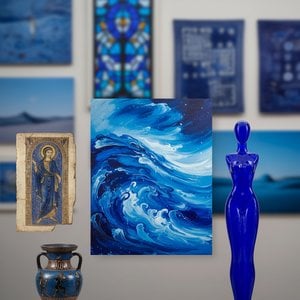
The Allure of Azure: Exploring the Symbolic & Aesthetic Depths of Blue in Art History
Explore the rich history of blue in art! Discover its symbolism, from ancient pigments to modern masterpieces by Kandinsky & Seurat. Uncover the psychological impact and cultural meanings behind this captivating hue.

Grant Wood & American Regionalism: Identity, Myth & the Rural Landscape
Explore the world of Grant Wood & American Regionalism with ArtsDot. Discover the symbolism behind 'American Gothic', recurring themes, and the movement's lasting impact on art history. High-quality reproductions available.

