


 Aperçu en situation
 Partager
 Partager
 Détails
 Guide imprimable

 Télécharger
 Articles similaires
 Radiographie
 Voir le diaporama
 Statistiques
Two Eagle Dancers


 Afficher la suite
L’œuvre d'art présentée sur cette page est protégée par le droit d'auteur, ce qui signifie que nous ne pouvons légalement créer ou vendre de reproduction identique. Cette protection est appliquée en vertu d'accords internationaux tels que la Convention de Berne et par les lois nationales, notamment celles énoncées par le Loi américaine sur le droit d'auteur - Titre 17.
Cette méthode est pleinement conforme aux réglementations sur le droit d'auteur car elle ne repose pas sur la copie ou la duplication de l'œuvre protégée. Il s'agit plutôt d'une réinterprétation créative — une nouvelle peinture qui s'inspire de l'original sans pour autant lui être identique.
Giclées et impressions d'art
Impressions giclées ou sur toile de qualité musée, avec une production rapide et des finitions au choix. ( Acheter la peinture faite à la main Passer au format image numérique)




P118B €10

P118H €10

P118W €10

P438Z €10

P508JH €12

P508YH €12

P805H €10

P805Z €10

P919BZ €10

P919G €10

P919XJ €10

P959ZH €10

P968JZ €12

W106C €8

W218G €10

W218JH €8

W218Y €10

W307PJ €10

W316G €10

W316PJ €8

W316Y €10

W398PJ €8

W4111J €10

W500HY €15

W500JH €15

W692G €12

W849H €8

W940BG €15

W953PJ €8




Choisissez parmi nos formats prédéfinis qui respectent les proportions originales de l’œuvre.

Saisissez la largeur et la hauteur souhaitées pour qu'elles s'adaptent à votre cadre ou à votre mur. Une impression ne peut être que découpée, elle ne peut jamais être agrandie au-delà de l'image originale ; ainsi, un format de forme différente entraînera la perte d'une partie de l'image. Nous vous envoyons une maquette numérique pour approbation avant toute impression. L'image présentée sur cette page ne montre pas le recadrage réel — seule la maquette le permet.
Livraison dans le monde entier () en 2 semaines au lieu des 4/5 semaines habituelles. (18 octobre)

Livraison express gratuite dans le monde entier

Toile de lin de haute qualité

Assurance transport complète

Garantie de remboursement des droits de douane

Garantie de fidélité des couleurs

Garantie de retour de 100 jours (uniquement en cas de défaut)

Garantie de remboursement à 100%

Tarifs dégressifs sur quantité
 L'option verre n'est disponible que pour les dimensions inférieures à 110 cm.

Two Eagle Dancers
Giclées et impressions d'art
Format de la reproduction
-


Prix total final
€ 54
Questions et réponses
Où devrait être accrochée une reproduction de «Two Eagle Dancers» de Stephen Mopope ?
Le format Panoramic de «Two Eagle Dancers» de Stephen Mopope est recommandé pour une Restaurant. Le format et l'espace guident ensemble l'emplacement d'une reproduction.
Quelle technique a été utilisée pour «Two Eagle Dancers» de Stephen Mopope ?
Le médium de «Two Eagle Dancers» de Stephen Mopope est Painting. Les reproductions visent à restituer l'aspect de cette technique.
Puis-je prévisualiser «Two Eagle Dancers» de Stephen Mopope avant de commander ?
La page Aperçu de « Two Eagle Dancers » vous permet de prévisualiser l'œuvre avant de passer commande.
Œuvres similaires


Biographie de l'artiste
**jeunesse et formation**
stephen mopope, également connu sous le nom de qued koi, était un peintre kiowa, danseur et joueur de flûte amérindien originaire d'oklahoma. Né le 27 août 1898, près de la mission baptiste de redstone sur la réserve kiowa dans le territoire indien, le voyage artistique de mopope a commencé dès son plus jeune âge. Sous l'influence de sa famille, il apprit de ses proches l'art de peindre sur des peaux de bêtes selon les méthodes traditionnelles. Son parcours s'est ensuite enrichi par une éducation formelle à la st. patrick's indian mission school d'anadarko, en oklahoma, avant qu'il ne poursuive ses études à la school of art de l'université de oklahoma.**contributions artistiques et style**
mopope fut le membre le plus prolifique du groupe célèbre connu sous le nom des kiowa six. Son œuvre se distingue par l'utilisation de couleurs vibrantes, reflets fidèles de son héritage et des paysages d'oklahoma, ainsi que par des thèmes dynamiques illustrant souvent des scènes de la vie amérindienne, des cérémonies et la beauté sauvage de la nature.- two eagle dancers (smithsonian's national postal museum, washington, états-unis), une murale démontrant le talent de mopope à capturer l'essence même de la culture kiowa.
- apache ben (national cowboy & western heritage museum, oklahoma city, états-unis), une aquarelle mettant en lumière sa polyvalence et l'étendue de son talent.
**héritage et impact**
En tant qu'artiste prolifique, l'œuvre foisonnante de mopope a fait de lui une figure pivot de l'histoire de l'art amérindien. Son style et sa technique uniques ont exercé une influence profonde sur les générations futures d'artistes, garantissant ainsi la pérennité de son héritage.- explorez le mouvement des peintres de skagen et son influence sur l'art amérindien.
- découvrez-en plus sur antoine wiertz, peintre et sculpteur belge, sur [https://ArtsDot.com/@@/a@d3apat-discover-the-musee-wiertz-museum-brussels](https://ArtsDot.com/@@/a@d3apat-discover-the-musee-wiertz-museum-brussels)
**conclusion**
la vie et l'œuvre de stephen mopope sont un vibrant témoignage de la richesse de la culture et de l'art amérindiens. à travers ses peintures, il a laissé une empreinte indélébile dans le monde des beaux-arts, s'imposant comme l'un des peintres kiowa les plus prolifiques de sa génération.
Stephen Mopope
1898 - 1974 , États-Unis d'Amérique
En bref
- Artistic Movement Or Style: Art graphique, Gravure
- Artists Or Movements Influenced By This Artist:
- Rene Magritte
- Martin Gardner
- Artists Who Influenced This Artist:
- George Arnold Escher
- Frank Reaugh
- Date Of Birth: 17 juin 1898
- Date Of Death: 27 mars 1972
- Full Name: Maurits Cornelis Escher
- Nationality: Néerlandais
- Notable Artworks:
- Main avec sphère réfléchissante
- Mains dessinantes
- Relativité
- Cascade
- Ascendant et descendant
- Place Of Birth: Leeuwarden, Pays-Bas
Articles similaires
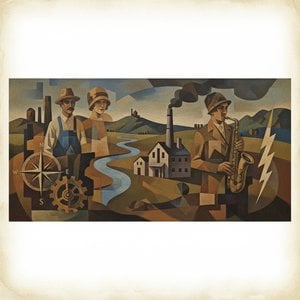
James Otto Lewis: Navigating American Modernism Through Regional Identity & Stylistic Innovation
Explore the captivating portraits of James Otto Lewis, a pivotal figure bridging 19th-century realism & American Modernism. Discover his groundbreaking work documenting Native American culture and regional identity.

Henry Farny: Romantic Visions of the American West & Indigenous Life
Explore the evocative paintings of Henry Farny, renowned for his romantic realism & depictions of Native American life in the 19th-century West. Discover his legacy and key artworks at ArtsDot.

Le Régionalisme Américain : Identité, Espace et Commentaire Social dans la Peinture du XXe Siècle
Explorez le régionalisme américain : un mouvement artistique majeur du XXe siècle capturant l'identité rurale et les réalités sociales de l'Amérique. Analyse approfondie, artistes clés & héritage durable sur ArtsDot.

Réalisme Américain : 10 Chefs-d'œuvre Incontournables pour une Déco Inspirée
Plongez au cœur du Réalisme Américain avec 10 chefs-d'œuvre d'Edward Hopper, Andrew Wyeth et plus. Découvrez l'histoire et les techniques de ces artistes emblématiques. Reproductions de tableaux de qualité musée sur ArtsDot.com !

Grant Wood & American Regionalism: Identity, Myth & the Rural Landscape
Explore the world of Grant Wood & American Regionalism with ArtsDot. Discover the symbolism behind 'American Gothic', recurring themes, and the movement's lasting impact on art history. High-quality reproductions available.