


 Aperçu en situation
 Envoyer
 Partager
 Détails de l'œuvre

 Télécharger
 Articles similaires
 Radiographie
 Diaporama
Portrait de Jan de Leeuw
 Huile sur toile
- Art mural
- This artwork exemplifies the hallmarks of Early Ne
 1436
1436- Renaissance
 24.0 x 19.0 cm
 Kunsthistorisches Museum
 Lire la suite
Reproduction à l'huile faite à la main
Huile sur toile peinte à la main, avec cadre et dimensions personnalisés, réalisée sur commande par nos artistes. ( Passer au tirage Passer à l'image)




P118B $10

P118H $10

P118W $10

P438Z $10

P508JH $12

P508YH $12

P805H $10

P805Z $10

P919BZ $10

P919G $10

P919XJ $10

P959ZH $10

P968JZ $12

W106C $8

W218G $10

W218JH $8

W218Y $10

W307PJ $10

W316G $10

W316PJ $8

W316Y $10

W398PJ $8

W4111J $10

W500HY $15

W500JH $15

W692G $12

W849H $8

W940BG $15

W953PJ $8




Choisissez parmi nos formats prédéfinis qui respectent les proportions originales de l’œuvre.

Vous pouvez saisir vos propres dimensions pour l'adapter à un cadre ou à un espace spécifique. Si la taille sélectionnée ne correspond pas aux proportions de l'image d'origine, nous recadrerons l'œuvre ou prolongerons la peinture avec des éléments peints à la main supplémentaires. Une maquette numérique vous sera envoyée pour approbation avant le début de la production.
Veuillez noter que l'aperçu à l'écran ne reflète pas le recadrage ou l'extension réels. Seule la maquette montrera fidèlement la composition finale.
Bien que des tailles personnalisées soient disponibles, nous vous recommandons de sélectionner une dimension dans la liste prédéfinie afin de préserver les proportions d'origine.
Après la commande, l’équipe ArtsDot.com contactera le client par e-mail pour recueillir ses instructions et lui fournira une maquette d’aperçu
Livraison dans le monde entier () en 3 à 4 semaines au lieu des 5 semaines habituelles. (6 août). Aucun compromis sur la qualité.

Livraison express gratuite dans le monde entier

Toile de lin de qualité supérieure

Assurance transport complète

Garantie de remboursement des droits de douane

Garantie de fidélité des couleurs

Politique de retour de 60 jours (uniquement en cas de défaut)

Garantie de remboursement à 100%

Offre de tarifs dégressifs
 L'option verre n'est disponible que pour les dimensions inférieures à 110 cm.

Portrait de Jan de Leeuw
Technique de reproduction
Format de la reproduction
-


Prix total
$ 263
Description de l'œuvre
Portrait of Jan de Leeuw : A Masterpiece of Early Netherlandish Realism
Jan van Eyck’s ‘Portrait of Jan de Leeuw’, completed in 1436, stands as an unparalleled achievement in the burgeoning artistic landscape of Early Netherlandish painting. More than just a depiction of a man—a goldsmith from Bruges—it embodies the revolutionary spirit of the era and represents a pinnacle of humanist observation and meticulous craftsmanship. At ArtsDot.com, we offer a stunning reproduction that captures not only the visual beauty but also the profound intellectual depth inherent in this iconic artwork.The Artistic Genius of Jan Van Eyck
Jan van Eyck (c. 1390 – 9 July 1441) emerged from Maastricht’s artistic milieu, studying at the Academy of Fine Arts alongside Johann Christian Brand and Jacob Matthias Schmutzer—a testament to his dedication to mastering the art form. His distinctive style quickly distinguished him from contemporaries, characterized by an astonishing vibrancy of color and an unparalleled level of detail. Unlike the stylized conventions of Gothic painting, Van Eyck embraced naturalism with fervor, striving to represent reality as faithfully as possible. This ambition would propel him to become one of the foremost figures in the Renaissance’s Northern wing.The Painting: A Window into the Past
Measuring 24 x 19 cm, ‘Portrait of Jan de Leeuw’ resides within the Kunsthistorisches Museum in Vienna, Austria—a location that allows for continuous scholarly study and appreciation. The painting portrays a man with a beard wearing a hat, gazing directly at the viewer with an intensity that transcends mere portraiture. This gaze is not passive; it conveys awareness and engagement, inviting contemplation about the sitter’s inner life. The masterful use of oil paint on wood—a technique pioneered by Van Eyck—allowed for unprecedented textural richness and luminosity, transforming a simple depiction into a complex interplay of light and shadow.Technique: Oil Paint – A Revolution in Artistic Expression
The brilliance of ‘Portrait of Jan de Leeuw’ lies fundamentally in its innovative application of oil paint. Prior to this period, artists predominantly utilized tempera—pigments bound in egg yolk—resulting in paler hues and less durable surfaces. Van Eyck's breakthrough involved diluting the pigment with linseed oil, creating a medium that adhered to the wood surface more effectively and permitted layering colors with remarkable precision. This technique enabled him to achieve astonishing realism, capturing subtle nuances of skin tone and fabric texture—a feat previously unattainable. The resulting image possesses an ethereal quality, reflecting Van Eyck’s mastery over light and color.Symbolism and Details: Layers of Meaning
The painting's palette is dominated by dark browns and blacks, punctuated by flashes of red—a deliberate choice that contributes to the overall mood of solemn seriousness. De Leeuw wears a black chaperon and fur-lined jacket, garments indicative of his social status and profession as a goldsmith. Crucially, he holds a gold ring band adorned with a ruby—a symbol deeply rooted in medieval symbolism. The ruby represented divine love and nobility, reflecting the sitter’s aspirations and reinforcing the painting's moral dimension. Furthermore, stylistic similarities to Van Eyck’s self-portrait at the National Gallery suggest a shared artistic vision and an understanding of humanist ideals prevalent during his time.Formal Resemblance: Echoes of Genius
The portrait shares striking formal characteristics with Van Eyck’s celebrated self-portrait—a deliberate decision that underscores the artist's preoccupation with capturing human psychology. Notably, the head occupies a disproportionately large area relative to the torso—a stylistic convention that was becoming increasingly common in Northern Renaissance art and signaled an evolving understanding of anatomical representation. The meticulous attention to detail—from the folds of fabric to the texture of hair—demonstrates Van Eyck’s unwavering commitment to realism and elevates ‘Portrait of Jan de Leeuw’ beyond mere likeness into a profound meditation on human dignity and contemplation.Œuvres similaires


Biographie de l'artiste
jeune vie et carrière
Jan van Eyck, figure prééminente du mouvement pictural néerlandais de début, est né vers 1390 à Maaseik, présent en Belgique. D’ici 1422, il s'était établi comme peintre maître avec un atelier et des assistants à La Haye. Notamment, il a servi Jean III le Cruel et plus tard Philippe le Beau, duc de Bourgogne, en tant que peintre de cour, jouissant d'une haute estime et s’engageant dans des activités diplomatiques.contributions artistiques
Les œuvres de Van Eyck, initialement ancrées dans le style gothique international, ont transcendé ses frontières grâce à son approche naturaliste améliorée et à l'utilisation innovante de la peinture à l'huile. Cela a établi une nouvelle norme en matière d’art, faisant de lui un pionnier du mouvement pictural néerlandais de début. Certaines de ses œuvres notables comprennent :- Le Dieu le Père (212 x 83 cm, renaissance du nord, huile sur panneau, voir sur ArtsDot.com)
- Portrait d'un jeune homme (33 x 19 cm, renaissance du nord, huile sur panneau, voir sur ArtsDot.com)
- Triptyque de Dresde (Vierge à l'enfant avec Saint Michel et Sainte Catherine et une donatrice) (28 x 38 cm, Gemäldegalerie alte meister, Dresde, Allemagne, renaissance du nord, bois, voir sur ArtsDot.com)
- Portrait de Giovanni Arnolfini et de sa femme (détail) (National Gallery, Londres, Royaume-Uni, huile, voir sur ArtsDot.com)
- Homme avec un turban bleu (17 x 23 cm, le musée national d'art de la Roumanie, Bucarest, Roumanie, renaissance du nord, bois, voir sur ArtsDot.com)
héritage et influence
L'influence de Van Eyck a été profonde, jetant les bases du développement de la tradition picturale néerlandaise de début. Son utilisation innovante de la peinture à l’huile a ajouté de la profondeur et du réalisme à ses œuvres, faisant de lui une figure renommée dans le monde de l'art. Pour explorer davantage les œuvres de Jan van Eyck et le mouvement pictural néerlandais de début, visitez la page de Jan van Eyck sur ArtsDot.com.relecture supplémentaire
* Wikipédia : [Jan van Eyck](https://en.wikipedia.org/wiki/jan_van_eyck) * ArtsDot.com : peintre néerlandais du nord * ArtsDot.com : le mouvement artistique néerlandais de début
Jan van Eyck
1390 - 1441 , Pays-Bas
L'essentiel de l'artiste
- Artistes Influents: ['Hubert van Eyck']
- Date De Décès: 1441
- Date De Naissance: c. 1390
- Influence Sur Les Artistes: ['École néerlandaise primitive']
- Lieu De Naissance: Maastricht, Pays-Bas
- Mouvement Artistique: École néerlandaise primitive
- Nationalité: Néerlandais
- Nom Complet: Jan van Eyck
- Oeuvres Notables:
- Retable de Gand
- Portrait d'Arnolfini
- Triptyque de Dresde
- Homme au turban bleu
Articles connexes
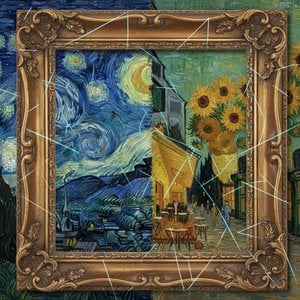
Van Gogh : 25 Chefs-d'Œuvres Iconiques - L'Âme et l'Émotion d'un Génie
Plongez au cœur de l'univers créatif de Van Gogh ! Découvrez 25 tableaux emblématiques, explorez ses couleurs vibrantes et son style unique. Reproductions d’art de qualité musée sur ArtsDot.com. Explorez la collection !

Les 10 Chefs-d'œuvre de la Peinture Primitif Néerlandaise : Art, Histoire & Décor
Plongez au cœur de la peinture flamande ! Découvrez les 10 chefs-d'œuvre de Jan van Eyck, Campin & Memling. Histoire, symbolisme et réalisme : trouvez l'inspiration déco et achetez des reproductions d'art exceptionnelles sur ArtsDot.com.

Demandes professionnelles
APS ofrece reproducciones de bellas artes y encargos personalizados desde 2004. Confían en nosotros corporaciones, hoteles y coleccionistas selectos para obras de arte de calidad museística, servicio discreto y soluciones artísticas completas. ¡Póngase en contacto con nosotros para obtener un presupuesto personalizado!

Jan van Eyck : Innovation technique, symbolisme subtil et aube de la peinture primitive flamande
Explorez le génie de Jan van Eyck et la révolution de la peinture flamande primitive. Découvrez ses techniques innovantes, son symbolisme subtil et l'impact durable de son œuvre sur l'histoire de l'art.

Goya : 25 Chefs-d'Œuvre Inoubliables d'un Maître de l'Âme
Plongez au cœur de l'œuvre inégalable de Goya ! Découvrez 25 chefs-d’œuvre emblématiques, des portraits saisissants aux scènes dramatiques. Explorez la vie et l'art du maître espagnol avec ArtsDot.com – reproductions d'art de qualité musée et inspirations déco.



