Aperçu en situation
 Partager
 Partager
 Détails
 Guide imprimable

 Télécharger
 Articles similaires
 Radiographie
 Voir le diaporama
 Statistiques
A Witch


 Afficher la suite
Giclées et impressions d'art
Impressions giclées ou sur toile de qualité musée, avec une production rapide et des finitions au choix. ( Acheter la peinture faite à la main Passer au format image numérique)




P118B €10

P118H €10

P118W €10

P438Z €10

P508JH €12

P508YH €12

P805H €10

P805Z €10

P919BZ €10

P919G €10

P919XJ €10

P959ZH €10

P968JZ €12

W106C €8

W218G €10

W218JH €8

W218Y €10

W307PJ €10

W316G €10

W316PJ €8

W316Y €10

W398PJ €8

W4111J €10

W500HY €15

W500JH €15

W692G €12

W849H €8

W940BG €15

W953PJ €8




Choisissez parmi nos formats prédéfinis qui respectent les proportions originales de l’œuvre.

Saisissez la largeur et la hauteur souhaitées pour qu'elles s'adaptent à votre cadre ou à votre mur. Une impression ne peut être que découpée, elle ne peut jamais être agrandie au-delà de l'image originale ; ainsi, un format de forme différente entraînera la perte d'une partie de l'image. Nous vous envoyons une maquette numérique pour approbation avant toute impression. L'image présentée sur cette page ne montre pas le recadrage réel — seule la maquette le permet.
Livraison dans le monde entier () en 2 semaines au lieu des 4/5 semaines habituelles. (19 octobre)

Livraison express gratuite dans le monde entier

Toile de lin de haute qualité

Assurance transport complète

Garantie de remboursement des droits de douane

Garantie de fidélité des couleurs

Garantie de retour de 100 jours (uniquement en cas de défaut)

Garantie de remboursement à 100%

Tarifs dégressifs sur quantité
 L'option verre n'est disponible que pour les dimensions inférieures à 110 cm.

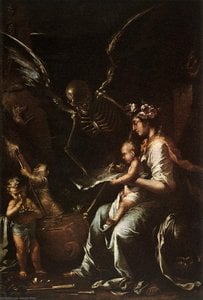
A Witch
Giclées et impressions d'art
Format de la reproduction
-


Prix total final
€ 54
A Dramatic Encounter with Darkness: Salvator Rosa’s “Witches’ Sabbath”
Salvator Rosa’s “Witches’ Sabbath,” executed in pen and ink on paper, stands as a testament to the Baroque period's fascination with dramatic realism and psychological intensity. Created around 1646, this drawing transcends mere depiction; it plunges viewers into a scene brimming with unsettling energy and symbolic resonance—a visual distillation of fear, superstition, and the confrontation between reason and primal instinct. Rosa’s masterful use of monochrome contributes powerfully to the artwork's emotive impact, stripping away color to amplify the starkness of the composition and heighten its psychological depth.- Subject Matter: The drawing portrays a chaotic gathering of figures engaged in what appears to be a ritualistic celebration – a witches’ sabbath. These individuals are depicted amidst a desolate landscape, emphasizing isolation and vulnerability against the backdrop of an ominous supernatural presence.
- Style & Technique: Rosa's style aligns perfectly with Baroque principles, prioritizing expressive gesture and dynamic movement over idealized beauty. The artist employs meticulous pen and ink detailing to capture the grotesque expressions and contorted postures of the participants. Visible brushstrokes—though subtle—lend texture to the paper surface, conveying a palpable sense of immediacy and capturing the frenzied atmosphere of the scene.
- Composition: Rosa skillfully arranges the figures within a confined space, creating a claustrophobic effect that underscores the characters’ predicament. The central group is positioned prominently against a dark, rocky outcrop, directing the viewer's gaze towards the unsettling core of the narrative.
Rosa Serrano Sánchez: Bridging Art and Civic Duty
Rosa Serrano Sánchez (1646-1708), born in Valencia, Spain, emerged as a prominent figure during the Baroque era—a period characterized by opulent grandeur and profound spiritual contemplation. Her artistic endeavors weren’t solely driven by aesthetic considerations; Sánchez actively engaged in political life, serving as a diplomat and advocating for reform within her homeland. This dual commitment informs her oeuvre, blending artistic innovation with intellectual engagement and social responsibility.- Notable Works: Sánchez's artistic legacy includes “No se puede ver lo que no se mira,” a captivating painting exploring themes of perception and illusion—a hallmark of Baroque visual culture. Her canvases often depict biblical narratives infused with humanist sensibilities, reflecting the era’s burgeoning interest in philosophical inquiry and moral reflection.
- Influence & Legacy: Sánchez's work resonates across centuries, demonstrating the enduring power of art to communicate complex ideas and emotions. She stands as an exemplar of Baroque artists who sought to elevate artistic expression beyond mere ornamentation, aiming instead for a transformative impact on viewers’ understanding of humanity and its relationship with divinity.
João Artur Rosa Alves: From Football Star to Painter's Vision
João Artur Rosa Alves (born 1983), Portugal—a former professional footballer—transformed his passion for sport into an equally compelling artistic vocation. Alves’s paintings explore themes of nature and emotion, blending abstract expressionism with vivid color palettes and evocative imagery. His artistic journey represents a fascinating intersection between personal experience and creative exploration—a testament to the transformative potential of pursuing multiple passions.- Distinctive Style: Alves's canvases are characterized by bold brushstrokes and textured surfaces, conveying dynamism and spontaneity. He draws inspiration from landscapes and natural forms, translating their beauty and grandeur into emotionally resonant compositions.
- Recognition & Exhibitions: Alves’s artwork has garnered critical acclaim and been showcased in prestigious UK museums—a remarkable achievement for an artist who embarked on his artistic pursuits after a successful career in professional football. His paintings exemplify the contemporary Baroque aesthetic, blending tradition with innovation to create visually arresting and intellectually stimulating experiences.
Salvator Rosa: A Baroque Master's Enduring Impact
Salvator Rosa’s influence extends far beyond his own lifetime—solidifying his position as one of the most significant figures in Baroque art history. His uncompromising artistic vision challenged conventions, prioritizing psychological realism and dramatic intensity over idealized beauty. He championed a humanist perspective that embraced both intellectual curiosity and emotional vulnerability—a legacy that continues to inspire artists today.- Key Characteristics: Rosa’s paintings are distinguished by their masterful use of chiaroscuro—creating striking contrasts between light and shadow—to heighten emotional impact and convey a sense of mystery. His landscapes capture the grandeur and sublime beauty of nature, reflecting the Baroque fascination with exploring the limits of human perception and confronting existential anxieties.
- Continuing Relevance: Rosa’s artistic principles resonate powerfully in contemporary art practice—demonstrating the enduring relevance of Baroque aesthetics to addressing fundamental questions about human experience and artistic expression. Reproductions of his masterpieces are available at ArtsDot, allowing viewers worldwide to appreciate his visionary artistry.
Questions et réponses
Les couleurs de «A Witch» de Salvator Rosa sont-elles saturées ou atténuées ?
«A Witch» de Salvator Rosa est présenté avec une saturation de Muted.
Quelle ambiance et quelle émotion «A Witch» de Salvator Rosa exprime-t-il ?
L'atmosphère qui se dégage de «A Witch» de Salvator Rosa est Dramatic, et sa tonalité émotionnelle est Melancholic.
En quelle année «A Witch» de Salvator Rosa a-t-il été créé ?
«A Witch» de Salvator Rosa a été créé en 1646.
Œuvres similaires


Biographie de l'artiste
La Jeunesse et la Formation
Salvator Rosa, peintre baroque italien, poète et graveur, est né à Arenella, près de Naples, soit le 20 juin, soit le 21 juillet 1615. Sa mère, Giulia Greca Rosa, était issue d'une famille grecque sicilienne. Malgré les aspirations de son père à ce qu’il devienne avocat ou prêtre, Salvator manifesta très tôt une préférence pour les arts.L'Ascension Artistique
La carrière artistique de Salvator Rosa se caractérisa par un style non conventionnel et extravagant qui le distinguait de ses contemporains. Il fut actif à Naples, Rome et Florence, son œuvre étant influencée par le naturalisme de Ribera et le classicisme de Poussin. Cependant, il refusa d'être lié à un style ou un mouvement particulier.- Pythagore émergeant des enfers (Kimbell Art Museum, Fort Worth, États-Unis), l’une de ses œuvres les plus célèbres, illustre son mélange unique de thèmes philosophiques et artistiques.
- Le Baptême de l'eunuque (Chrysler Museum of Art, Norfolk, États-Unis) témoigne de sa capacité à insuffler un drame intense même dans des récits bibliques mineurs.
Influences et Héritage
L’œuvre de Salvator Rosa eut une influence significative sur le développement de l'art baroque. Son impact se retrouve dans les œuvres d'artistes ultérieurs, tels que Luca Giordano, qui continuaient à repousser les limites de l'expression artistique. Liens importants : Profil de Salvator Rosa sur ArtsDot Wikipédia: Salvatore RosaUn Artiste Rebelle et Innovant
Rosa était un artiste profondément rebelle, défiant les conventions artistiques de son époque. Ses paysages sombres et sauvages, souvent peuplés de figures marginales, étaient une rupture avec les vues classiques et idéalisées de Claude Lorrain. Il est considéré comme un précurseur du romantisme, anticipant l'accent mis sur la puissance brute de la nature et l'exploration des émotions intenses. Son œuvre a connu un regain d’intérêt à la fin du XXe siècle, bien qu’il ne soit pas classé parmi les plus grands peintres baroques par les historiens de l'art contemporains, il est reconnu comme un peintre de paysages innovant et un pionnier du mouvement romantique.Conclusion
La vie et l'œuvre de Salvator Rosa continuent de fasciner les amateurs d’art et les historiens. Son style non conventionnel et sa rébellion constante contre les normes de son temps ont consolidé sa place dans l'histoire de l'art baroque. En tant que peintre, poète et graveur, il demeure une figure énigmatique, et son œuvre continue d'inspirer de nouvelles générations d’artistes et d’amateurs d’art. Musées : Kimbell Art Museum, Chrysler Museum of Art
Salvator Rosa
1615 - 1673 , Italie
En bref
- Artistic Movement Or Style: Baroque
- Artists Or Movements Influenced By This Artist:
- Luca Giordano
- Romantisme
- Artists Who Influenced This Artist:
- Ribera
- Poussin
- Date Of Birth: 20 juin ou 21 juillet 1615
- Date Of Death: 15 mars 1673
- Full Name: Salvator Rosa
- Nationality: Italien
- Notable Artworks:
- Pythagore sortant des enfers
- Le baptême de l'eunuque
- Place Of Birth (City And Country): Arénèlle, Italie
Articles connexes

Salvator Rosa: A Baroque Rebel's Vision of Landscape, Allegory & the Human Condition
Explore the captivating world of Salvator Rosa, a rebellious Baroque master. Discover his dramatic landscapes, allegorical paintings & lasting influence on Romanticism. Hand-painted reproductions available at ArtsDot.

The Enduring Legacy of Fine Art Prints: Technique, History & Aesthetic Impact
Explore the rich history & techniques of fine art prints. Discover investment potential, assess authenticity, and learn how to preserve your collection with expert guidance. Trusted insights for discerning collectors.

Echoes of Time: Exploring the Enduring Appeal & Historical Context of Vintage Art Prints
Explore the captivating world of vintage art prints! Discover their history, collecting tips & enduring appeal. Expert insights on chromolithography and building a legacy collection with ArtsDot.

Giclée Prints: Archival Quality & Aesthetic Nuances for the Discerning Collector
Explore the world of giclée prints with ArtsDot. Learn about archival quality, aesthetic nuances & investment potential. Expert guidance for discerning art collectors seeking museum-quality reproductions and lasting value.

Le Drame Baroque : L'Art qui Apporte la Splendeur dans Votre Intérieur
Plongez dans l'univers somptueux du baroque ! Découvrez son histoire, comment l'intégrer à votre intérieur et les œuvres incontournables. : reproductions d'art de qualité supérieure.