
- Accueil

- Impression sur toile
- Roy Lichtenstein
- The Cowboy (Red)
 Commander la reproduction Acheter l'image haute résolution
 Partager
 Partager
 Détails de l'œuvre
 Ajouter aux favoris

 Télécharger
 Articles similaires
 Radiographie
 Diaporama
The Cowboy (Red)


 Afficher la suite
Giclée / Impression d'art
Impression giclée ou sur toile de qualité musée, avec une production rapide et des finitions au choix.




P118B $10

P118H $10

P118W $10

P438Z $10

P508JH $12

P508YH $12

P805H $10

P805Z $10

P919BZ $10

P919G $10

P919XJ $10

P959ZH $10

P968JZ $12

W106C $8

W218G $10

W218JH $8

W218Y $10

W307PJ $10

W316G $10

W316PJ $8

W316Y $10

W398PJ $8

W4111J $10

W500HY $15

W500JH $15

W692G $12

W849H $8

W940BG $15

W953PJ $8




Choisissez parmi nos formats prédéfinis qui respectent les proportions originales de l’œuvre.

Vous pouvez saisir vos propres dimensions pour vous adapter à un cadre ou à un espace spécifique. Si la taille sélectionnée ne correspond pas aux proportions de l'image originale, nous recadrerons l'œuvre ou étendrons l'image avec une bordure en miroir ou une couleur unie. Une maquette numérique vous sera envoyée pour approbation avant le début de la production.
Veuillez noter que l'aperçu à l'écran ne reflète pas le recadrage ou l'extension réelle. Seule la maquette montrera avec précision la composition finale.
Bien que des tailles personnalisées soient disponibles, nous vous recommandons de choisir une dimension dans la liste prédéfinie afin de préserver les proportions originales.
Livraison dans le monde entier () en 2 semaines au lieu des 4/5 semaines habituelles. (22 juillet)

Livraison express gratuite dans le monde entier

Toile de lin de haute qualité

Assurance transport complète

Garantie de remboursement des frais de douane

Garantie de fidélité des couleurs

Politique de retour de 60 jours (uniquement en cas de défaut)

Garantie de remboursement à 100%

Réduction sur les achats groupés
 L'option verre n'est disponible que pour les dimensions inférieures à 110 cm.

The Cowboy (Red)
Giclée / Impression d'art
Format de reproduction
-


Prix total final
-
Description de l'œuvre
A Bold Statement of Pop and the American West
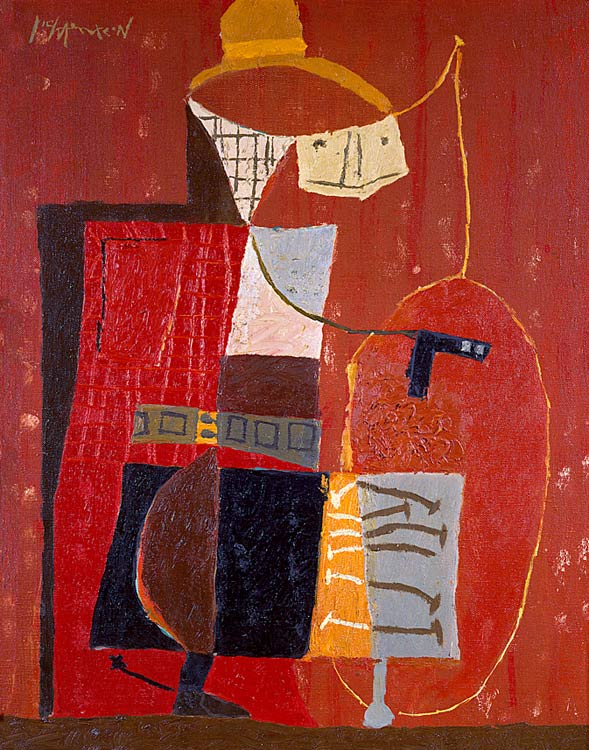
Roy Lichtenstein’s “The Cowboy (Red)” isn't merely a painting; it’s an explosion of color, a deliberate provocation, and a masterful distillation of the Pop Art movement’s core tenets. Completed in 1951, this work immediately establishes Lichtenstein’s signature style – a vibrant collision of comic book aesthetics with a distinctly American subject matter. The image depicts a lone cowboy, rendered in bold black outlines against a field of intense red, holding a gun and a bottle, all framed by the stark geometry of a crimson door. It's a scene both familiar and unsettling, instantly recognizable yet imbued with an underlying tension.
Lichtenstein’s technique is crucial to understanding the painting’s impact. He eschews traditional brushwork in favor of Ben-Day dots – tiny, colored circles meticulously applied to create shading and tonal variations. This method, borrowed from commercial printing processes, lends a mechanical quality to the image, mimicking the look of mass-produced advertisements and comic strips. The red dominates, not just as a background but as an active element, pulsating with energy and demanding attention. It’s a deliberate choice, referencing both the fiery sunsets of the American West and the bold, eye-catching colors favored by advertisers of the era.
The Genesis of a Pop Visionary
Born in Manhattan in 1923, Roy Fox Lichtenstein's artistic journey was shaped by a unique confluence of influences. His early training focused on realistic drawing and painting, reflecting a traditional academic sensibility. However, his exposure to museums – particularly the works of Reginald Marsh, who taught him at the Art Students League – and the vibrant energy of jazz music ignited a desire to break free from conventional artistic boundaries. This period coincided with the rise of Abstract Expressionism, but Lichtenstein quickly recognized the potential of incorporating popular imagery into his work. His upbringing in an upper-middle-class Jewish family fostered both a cultural awareness and an early appreciation for visual culture – a key ingredient in his later exploration of consumerism and mass media.
Symbolism and Context: Cowboy, Door, and Red
The central figures—the cowboy and the door—are laden with symbolic weight. The cowboy, a quintessential American archetype, represents rugged individualism, frontier spirit, and often, a romanticized vision of the West. However, Lichtenstein’s depiction is far from sentimental; the gun in his hand suggests danger, violence, and perhaps even a certain isolation. The red door acts as a framing device, simultaneously inviting and rejecting entry – a visual metaphor for the complexities of American identity. The color red itself carries significant connotations: passion, aggression, warning, and the raw energy of the landscape.
Furthermore, “The Cowboy (Red)” emerged during a period of rapid social and cultural change in America. The post-war era witnessed an explosion of consumerism, fueled by mass media and advertising. Lichtenstein’s work directly engages with this phenomenon, using comic book imagery – a product of the same culture – to critique its impact on American values. It's a commentary on how images are consumed and interpreted, raising questions about authenticity and representation.
A Reproduction for Your Space
ArtsDot offers meticulously crafted hand-painted reproductions of “The Cowboy (Red)” that capture the essence of Lichtenstein’s original masterpiece. We utilize archival-quality materials and skilled artisans to faithfully recreate the painting's vibrant colors, dynamic composition, and distinctive Ben-Day dot technique. Whether you’re a seasoned art collector or seeking a striking addition to your interior design scheme, our reproduction provides an authentic and engaging representation of this iconic work. Explore the options available on our website – each reproduction is a testament to Lichtenstein’s enduring legacy and a vibrant celebration of American Pop Art.
Œuvres apparentées


Biographie de l'artiste
jeune vie et éducation
roy fox lichtenstein, un artiste pop américain de premier plan, est né le 27 octobre 1923 à New York. Il a grandi dans une famille juive de milieu-classe supérieur, son père étant courtier en immobilier et sa mère femme au foyer. L'intérêt de Lichtenstein pour l'art et le design a commencé comme un passe-temps pendant ses années scolaires.carrière artistique
Après avoir terminé sa scolarité secondaire au Dwight School en 1940, Lichtenstein a étudié à l’Art Students League of New York sous la tutelle de Reginald Marsh. Il a ensuite obtenu une licence en arts plastiques de l'Ohio State University, interrompue par un service militaire de trois ans pendant la Seconde Guerre mondiale.- look mickey (1961, National Gallery of Art, Washington, D.C.), l'une des premières œuvres pop de Lichtenstein, a marqué le début de sa carrière influente.
- Son travail était fortement influencé par la publicité et les styles de bandes dessinées populaires, avec des œuvres notables telles que Wham!, drowning girl et oh, jeff...i love you, too...but...
- La pièce la plus chère de Lichtenstein, Masterpiece, a été vendue pour 165 millions de dollars en janvier 2017.
enseignement et influences
Lichtenstein a enseigné dans diverses institutions, notamment l'université d'État de New York à Oswego et l'université Rutgers. Son travail a été influencé par Allan Kaprow, un collègue professeur à Rutgers, ce qui a ravivé son intérêt pour les images proto-pop. Expositions notables :- the museum chambre de commerce (Toulouse, France), présentant diverses œuvres d'art, y compris celles du mouvement pop art.
- Le travail de Lichtenstein a été exposé à la Leo Castelli Gallery à New York, avec sa première exposition personnelle en 1962 ayant été entièrement achetée par des collectionneurs influents avant l'ouverture.
héritage et impact
Roy Lichtenstein est décédé le 29 septembre 1997, laissant derrière lui un héritage en tant que figure de proue du mouvement pop art. Son œuvre continue d’être célébrée pour son mélange innovant d’art haut et d’art populaire, ce qui la rend accessible à un public plus large.- Explorez davantage l'œuvre de Lichtenstein sur ArtsDot.com
- Découvrez le monde de l'art pop et de ses artistes influents sur pop art and beyond: navigating contemporary styles with ArtsDot.com

Roy Lichtenstein
1923 - 1997 , États-Unis d'Amérique
En bref
- Artistes Influents:
- Reginald Marsh
- Allan Kaprow
- Date De Décès: 29 septembre 1997
- Date De Naissance: 27 octobre 1923
- Lieu De Naissance: Manhattan, États-Unis
- Mouvement Artistique: Pop Art
- Nationalité: Américaine
- Nom Complet: Roy Lichtenstein
- Oeuvres Notables:
- Look Mickey
- Whaam!
- Drowning Girl
- Masterpiece
Articles connexes

L'Élégance du Fandom : Intégrer l'Art Pop Culture dans un Décor Sophistiqué
Transformez votre intérieur avec l'art pop culture ! Découvrez nos conseils d'experts pour intégrer subtilement vos passions dans un décor élégant et raffiné. Guide complet & inspiration déco.

Défis aux Conventions : Pop Art, Origines, Évolution et Héritage Durable
Explorez l'histoire fascinante du Pop Art : de ses origines à son influence durable. Découvrez les œuvres emblématiques d'Andy Warhol et des artistes clés. Guide expert pour collectionneurs.

De la Passion à la Toile : Guide Complet pour Commander une Peinture Pop Culture Personnalisée
Créez votre peinture pop art personnalisée avec ArtsDot ! Artistes experts, qualité musée, livraison mondiale. Transformez vos passions en œuvres uniques. Demandez un devis gratuit !

Pop Art : Les 10 Œuvres Maîtresses Qui Ont Révolutionné l'Art Moderne |
Plongez dans l'univers vibrant du Pop Art ! Découvrez les 10 œuvres maîtresses d'Andy Warhol, Roy Lichtenstein et autres artistes iconiques. Histoire, techniques & inspiration déco. Explorez la collection sur .

Transformez Votre Photo en Icône Pop Art : Une Analyse de l'Esthétique Urbaine et de la Réinterprétation Numérique par ArtsDot
Transformez vos photos en œuvres Pop Art uniques avec ArtsDot ! Qualité musée, artistes qualifiés et satisfaction garantie. Immortalisez vos souvenirs avec style.



