Aperçu en situation
 Partager
 Partager
 Détails
 Guide imprimable

 Télécharger
 Articles similaires
 Radiographie
 Voir le diaporama
 Statistiques
Landscape Mural
 Oil On Canvas
- WallArt
- Hudson River School
 1852
1852 277.0 x 232.0 cm
 Taft Museum of Art
 Afficher la suite
Giclées et impressions d'art
Impressions giclées ou sur toile de qualité musée, avec une production rapide et des finitions au choix. ( Acheter la peinture faite à la main Passer au format image numérique)




P118B €10

P118H €10

P118W €10

P438Z €10

P508JH €12

P508YH €12

P805H €10

P805Z €10

P919BZ €10

P919G €10

P919XJ €10

P959ZH €10

P968JZ €12

W106C €8

W218G €10

W218JH €8

W218Y €10

W307PJ €10

W316G €10

W316PJ €8

W316Y €10

W398PJ €8

W4111J €10

W500HY €15

W500JH €15

W692G €12

W849H €8

W940BG €15

W953PJ €8




Choisissez parmi nos formats prédéfinis qui respectent les proportions originales de l’œuvre.

Saisissez la largeur et la hauteur souhaitées pour qu'elles s'adaptent à votre cadre ou à votre mur. Une impression ne peut être que découpée, elle ne peut jamais être agrandie au-delà de l'image originale ; ainsi, un format de forme différente entraînera la perte d'une partie de l'image. Nous vous envoyons une maquette numérique pour approbation avant toute impression. L'image présentée sur cette page ne montre pas le recadrage réel — seule la maquette le permet.
Livraison dans le monde entier () en 2 semaines au lieu des 4/5 semaines habituelles. (21 octobre)

Livraison express gratuite dans le monde entier

Toile de lin de haute qualité

Assurance transport complète

Garantie de remboursement des droits de douane

Garantie de fidélité des couleurs

Garantie de retour de 100 jours (uniquement en cas de défaut)

Garantie de remboursement à 100%

Tarifs dégressifs sur quantité
 L'option verre n'est disponible que pour les dimensions inférieures à 110 cm.

Landscape Mural
Giclées et impressions d'art
Format de la reproduction
-


Prix total final
€ 54
A Serene Vision of the Hudson Valley: Robert Seldon Duncanson’s “Landscape Mural”
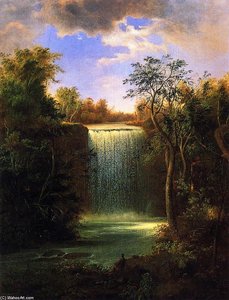
Robert Seldon Duncanson's "Landscape Mural," painted in 1852, isn’t merely a depiction of a river valley; it’s a carefully constructed meditation on nature, memory, and the burgeoning American identity. This monumental work, now residing within the Taft Museum of Art in Cincinnati, Ohio, stands as a pivotal piece of the Hudson River School—a movement that sought to capture the sublime beauty of America's landscapes with scientific precision and Romantic fervor. Duncanson, an African-American artist navigating a deeply segregated society, imbued this painting with layers of meaning, subtly reflecting on themes of race, spirituality, and the relationship between humanity and the natural world.
The scene unfolds beneath a brooding, yet ultimately benevolent, sky – a classic Hudson River School motif. A gently flowing river dominates the composition, its surface mirroring the clouds above in a delicate dance of reflection. The foreground is anchored by a cluster of trees, their branches reaching upwards like supplicating arms, while a distant bridge arches gracefully across the valley, hinting at civilization’s presence without overwhelming the scene's tranquility. Notice the meticulous detail with which Duncanson renders each element – the texture of bark, the ripples in the water, the subtle gradations of color in the foliage. This commitment to realism was paramount for the Hudson River School artists, who sought to elevate landscape painting to a level of scientific accuracy and artistic merit.
The Painter’s Palette: Technique and Materials
Duncanson employed the traditional technique of *fresco secco*, applying his pigments directly onto dry plaster. This method, favored by Renaissance masters, demanded both skill and speed – the artist had to work quickly before the plaster dried and the colors set. The resulting surface is remarkably durable, allowing the painting to retain its vibrancy across centuries. The color palette is predominantly cool—greens, blues, and grays—creating a sense of atmospheric depth and distance. Duncanson masterfully utilizes *chiaroscuro*, the dramatic contrast between light and shadow, to sculpt the forms and heighten the emotional impact of the scene. The subtle variations in tone suggest a soft, diffused light, characteristic of an overcast day – a common occurrence in the Ohio Valley during that period.
A Symbol of Progress and Identity
Beyond its aesthetic beauty, “Landscape Mural” carries significant historical weight. Duncanson’s work emerged during a time of profound social change in America—the abolitionist movement was gaining momentum, and discussions about race and equality were becoming increasingly urgent. While the painting itself doesn't explicitly address these issues, scholars have interpreted it as a subtle commentary on the African-American experience. The river, often associated with journeys and transitions, can be seen as a metaphor for the arduous path to freedom and self-determination. The bridge, representing connection and progress, symbolizes the hope for a more just and equitable future. Furthermore, Duncanson’s decision to depict a serene landscape—a departure from the often-grim realities of life in 19th-century America—suggests a yearning for spiritual renewal and harmony with nature.
Emotional Resonance: A Legacy of Tranquility
Looking at “Landscape Mural” today, one is immediately struck by its profound sense of tranquility. The painting invites the viewer to step into the scene, to breathe in the fresh air, and to lose oneself in the beauty of the natural world. It’s a testament to Duncanson's skill as an artist—his ability to capture not just the appearance of a landscape, but also its emotional essence. The painting’s enduring appeal lies in its capacity to evoke feelings of peace, contemplation, and connection to something larger than oneself. It remains a powerful reminder of the transformative power of art and the importance of preserving our natural heritage.
Questions et réponses
Quelle nuance dominante traverse «Landscape Mural» de Robert Seldon Duncanson ?
«Landscape Mural» tend vers une nuance Green to Violet Spectrum.
De quoi est fait « Landscape Mural » ?
« Landscape Mural » est réalisé en Oil On Canvas.
À quel point la palette de "Landscape Mural" est-elle saturée ?
Les couleurs de «Landscape Mural» de Robert Seldon Duncanson présentent une saturation Balanced Soft. La saturation décrit si les couleurs sont vives ou atténuées.
Œuvres similaires


Biographie de l'artiste
Robert Seldon Duncanson : Une Vie et un Héritage
- Né: Fayetteville, New York (vers 1821)
- Décédé: 21 décembre 1872
- Origine: ArtsDot
Première Vie et Développement Artistique
- La famille de Duncanson était d'ascendance européenne et africaine. Son père, John Dean Duncanson, un commerçant noir libre, a inculqué à ses enfants la valeur du travail acharné et de l'éducation.
- La famille déménagea à Monroe, dans le Michigan, où Robert fit son apprentissage en menuiserie et en peinture. Il a démontré un talent précoce pour l'art, ce qui l'a conduit à se consacrer au portrait.
- En 1840, il s'installa à Cincinnati, Ohio, un centre culturel florissant connu sous le nom d'"Athènes de l'Ouest". Cet environnement a offert des opportunités de croissance artistique et d'exposition.
- Duncanson était largement autodidacte, étudiant les gravures et les estampes, esquissant à partir de la nature et copiant les œuvres d'autres artistes. Il n'a pas reçu de formation formelle mais a développé un œil aiguisé et une compétence technique.
Style Artistique et Influences
- Influence de l’École du fleuve Hudson : Le style de Duncanson était fortement influencé par l'École du fleuve Hudson, connue pour ses représentations romantiques des régions sauvages américaines. Des artistes comme Thomas Cole ont été une source d'inspiration importante.
- Concentration sur le paysage : Il s’est tourné vers les paysages, capturant des scènes de la vallée de l'Ohio et au-delà.
- Romantisme : Ses œuvres transmettaient souvent un sentiment de grandeur, de tranquillité et de connexion spirituelle avec la nature, caractéristique du romantisme.
- Palette de couleurs et technique : Duncanson employait une palette de couleurs riches et des détails méticuleux dans ses peintures, démontrant une maîtrise de la technique.
Réalisations Majeures et Reconnaissance
- Premières expositions : Ses œuvres ont été exposées à l'Académie des beaux-arts de Cincinnati dès 1842, ce qui lui a valu une reconnaissance au sein de la communauté artistique locale.
- Tournée européenne (1853-1854) : Un tournant important dans sa carrière fut un voyage en Europe où il étudia les maîtres européens et élargit ses horizons artistiques.
- Acclamation internationale : Duncanson a obtenu une reconnaissance internationale, exposant ses œuvres en Angleterre, en Écosse, au Canada et aux États-Unis. Il est devenu le premier artiste afro-américain à obtenir un tel éloge généralisé.
- Tradition de la vallée de l'Ohio : Il a joué un rôle clé dans le développement de la tradition du paysage de la vallée de l'Ohio, contribuant de manière significative à son identité artistique.
Signification Historique et Héritage
- Pionnier pour les artistes noirs : Le succès de Duncanson a brisé les barrières pour les artistes afro-américains à une époque de préjugés raciaux et de discrimination. Il a servi d'inspiration aux générations futures.
- Identité raciale dans l’art : Les historiens de l'art débattent de la mesure dans laquelle sa race a influencé son expression artistique, certains suggérant des représentations symboliques subtiles de thèmes raciaux au sein de ses paysages.
- Figure oubliée redécouverte : Pendant de nombreuses années, le travail de Duncanson a été largement négligé. Des recherches et expositions récentes ont permis de porter une nouvelle attention à ses contributions à l'histoire de l'art américain.
- Témoignage de résilience : Son histoire est un témoignage de la résilience et du talent des Afro-Américains face à l'adversité, démontrant leur capacité à atteindre l'excellence artistique malgré les défis systémiques.

Robert Seldon Duncanson
1821 - 1872 , États-Unis d'Amérique
En bref
- Artistes Influents: ['Thomas Cole']
- Date De Décès: 21 décembre 1872
- Date De Naissance: c. 1821
- Lieu De Naissance: Fayetteville, États-Unis
- Mouvement Artistique: École du fleuve Hudson
- Nationalité: Américain
- Nom Complet: Robert Seldon Duncanson
- Oeuvres Notables:
- Roses Still Life
- Waterfall...
- Vulture and Its Prey
- Minnenopa Falls
Articles connexes

Robert Spencer: Luminism, Narrative & the American Landscape Tradition
Explore the captivating world of Luminism & the Hudson River School with our expert analysis. Discover the history, artists, and enduring beauty of 19th-century American landscape painting. Find museum-quality reproductions at ArtsDot.

Échos de l'Arcadie : Nostalgie et Transformation dans l'Art Paysager Vintage
Explorez l'École du Hudson : un mouvement artistique américain emblématique. Découvrez les maîtres romantiques, leur quête du sublime et l'influence durable de leurs paysages exceptionnels. ArtsDot vous guide.
Robert Seldon Duncanson: Landscape, Abolitionism & Shaping American Identity
Discover Robert Seldon Duncanson, the first internationally acclaimed African American landscape artist. Explore his connection to the Hudson River School, abolitionism, and enduring legacy through serene vistas & powerful symbolism.

L'École du fleuve Hudson : 10 chefs-d'œuvre incontournables pour sublimer votre intérieur
Plongez dans l'univers grandiose de l'École du fleuve Hudson ! Découvrez 10 chefs-d'œuvre emblématiques de Thomas Cole, Frederic Church et Albert Bierstadt. Inspirez votre décoration intérieure avec ces paysages américains romantiques. Explorez la collection complète sur ArtsDot.com.
L'École du fleuve Hudson : Romantisme américain et exploration d'un paysage national
Explorez l'École du fleuve Hudson : un mouvement artistique américain majeur célébrant la nature et le sublime. Découvrez ses peintres emblématiques, son histoire et son héritage durable avec ArtsDot.