


 Aperçu en situation
 Partager
 Partager
 Détails
 Guide imprimable

 Télécharger
 Articles similaires
 Radiographie
 Voir le diaporama
 Statistiques
The Virtues

 Afficher la suite
Giclées et impressions d'art
Impressions giclées ou sur toile de qualité musée, avec une production rapide et des finitions au choix. ( Acheter la peinture faite à la main Passer au format image numérique)




P118B €10

P118H €10

P118W €10

P438Z €10

P508JH €12

P508YH €12

P805H €10

P805Z €10

P919BZ €10

P919G €10

P919XJ €10

P959ZH €10

P968JZ €12

W106C €8

W218G €10

W218JH €8

W218Y €10

W307PJ €10

W316G €10

W316PJ €8

W316Y €10

W398PJ €8

W4111J €10

W500HY €15

W500JH €15

W692G €12

W849H €8

W940BG €15

W953PJ €8




Choisissez parmi nos formats prédéfinis qui respectent les proportions originales de l’œuvre.

Vous pouvez saisir vos propres dimensions pour vous adapter à un cadre ou à un espace spécifique. Si la taille sélectionnée ne correspond pas aux proportions de l'image originale, nous recadrerons l'œuvre ou étendrons l'image avec une bordure en miroir ou une couleur unie. Une maquette numérique vous sera envoyée pour approbation avant le début de la production.
Veuillez noter que l'aperçu à l'écran ne reflète pas le recadrage ou l'extension réelle. Seule la maquette montrera avec précision la composition finale.
Bien que des tailles personnalisées soient disponibles, nous vous recommandons de choisir une dimension dans la liste prédéfinie afin de préserver les proportions originales.
Livraison dans le monde entier () en 2 semaines au lieu des 4/5 semaines habituelles. (3 octobre)

Livraison express gratuite dans le monde entier

Toile de lin de haute qualité

Assurance transport complète

Garantie de remboursement des droits de douane

Garantie de fidélité des couleurs

Garantie de retour de 100 jours (uniquement en cas de défaut)

Garantie de remboursement à 100%

Tarifs dégressifs sur quantité
 L'option verre n'est disponible que pour les dimensions inférieures à 110 cm.

The Virtues
Giclées et impressions d'art
Format de la reproduction
-


Prix total final
€ 53
A Symphony of Virtue: Exploring Raphael’s “The Virtues” Fresco
The fresco "The Virtues," painted by Raphael Sanzio da Urbino between 1509 and 1511 as part of the Stanza della Segnatura in Vatican City, stands as an unparalleled achievement of High Renaissance art. More than just a decorative embellishment of papal chambers, it’s a profound meditation on moral philosophy—a visual embodiment of Christian virtues designed to inspire contemplation and guide spiritual understanding. Commissioned by Pope Julius II during a period of ambitious artistic patronage, Raphael undertook this monumental task with unwavering dedication, transforming an unremarkable hallway into a breathtaking panorama of humanist ideals.The Compositional Harmony: Michelangelo’s Influence
Raphael's masterful handling of perspective and spatial arrangement owes considerable debt to the pioneering work of Michelangelo Buonarroti on the Sistine Chapel ceiling. Like Michelangelo’s depiction of biblical figures soaring across the vault, Raphael employs dramatic diagonals and expansive curves to draw the viewer’s eye into the scene. The careful positioning of the figures—particularly Fortitude's lion—echoes Michelangelo’s monumental sculptures, demonstrating a shared artistic lineage and reflecting the broader Renaissance fascination with grandeur and anatomical accuracy. This deliberate stylistic kinship elevates “The Virtues” beyond mere aesthetic beauty; it speaks to a deeper engagement with the intellectual currents shaping European culture at the time.Symbolism Rooted in Classical Tradition
The fresco’s symbolism is intricately interwoven with classical humanist thought, reflecting Raphael's exposure to the philosophical ideas circulating amongst intellectuals of his era. Each virtue—Fortitude, Charity, Prudence, Hope and Temperance—is represented by a female figure, embodying abstract concepts rather than literal representations. The mirror held aloft by Prudence symbolizes wisdom and discernment, prompting viewers to examine their own moral compass. Fortitude’s lion represents courage and resilience, while Temperance's reins symbolize moderation and self-control. Crucially, the depiction of Faith points upwards towards heaven, emphasizing the importance of spiritual devotion and belief—a cornerstone of Christian theology. The central tondo depicting Justice reinforces this thematic core, symbolizing righteousness and moral accountability.Technique: Fresco Painting – A Legacy of Brilliance
Raphael’s technique exemplifies the mastery of fresco painting achieved during the High Renaissance. This method involves applying pigment onto wet plaster—a process demanding meticulous planning and execution. The durability of fresco ensures that “The Virtues” continues to captivate audiences centuries later, preserving Raphael's vibrant colors and nuanced detailing with remarkable fidelity. Unlike oil paint, which allows for reworking and blending, fresco necessitates a decisive approach, resulting in an image that is both timeless and powerfully expressive. The subtle gradations of color achieved through layering pigments contribute to the fresco’s luminous quality—a testament to Raphael’s artistic skill and his unwavering commitment to capturing the essence of humanist ideals.Emotional Resonance: Inspiration for Generations
“The Virtues” transcends its formal artistry, resonating with viewers on an emotional level. Its serene beauty and harmonious composition convey a sense of moral upliftment—inviting contemplation and fostering reflection upon ethical conduct. Raphael’s masterpiece serves as a poignant reminder of the enduring power of art to communicate profound philosophical concepts and inspire spiritual aspiration. It remains a cornerstone of High Renaissance art, continuing to inspire artists and collectors alike who seek to emulate its elegance and imbue their own creations with similar moral depth.Questions et réponses
À quelle étape de la carrière de Raphaël « The Virtues » appartient-elle ?
Au cours de la carrière de Raphaël, « The Virtues » s'inscrit dans la période Mature. Cette phase permet de le comparer aux autres œuvres de l'artiste.
Qui vend des reproductions peintes à la main de «The Virtues» de Raphaël ?
Vous pouvez commander une reproduction peinte à la main de «The Virtues» de Raphaël directement sur cette page : une reproduction à l'huile peinte à la main sur toile de lin, réalisée sur commande.
Puis-je voir «The Virtues» de Raphaël sur mon propre mur avant de l'acheter ?
« The Virtues » dispose d'un aperçu en réalité augmentée : la page Aperçu RA de l'œuvre vous permet de la visualiser dans votre propre espace sur un appareil compatible.
À quel artiste est attribuée l'œuvre "The Virtues" ?
« The Virtues » est attribué à Raphaël.
De quel pays provient l'œuvre High Renaissance « The Virtues » ?
L'œuvre High Renaissance « The Virtues » a été réalisée par un artiste né en Italie.
Quelle est la luminosité perçue de «The Virtues» de Raphaël ?
Dans l'ensemble, « The Virtues » présente une luminosité de équilibré. La luminosité perçue décrit si l'œuvre paraît claire ou sombre.
Où puis-je acheter une impression de «The Virtues» de Raphaël ?
Une impression de «The Virtues» de Raphaël peut être commandée directement sur cette page : une impression d'art sur toile de coton ou sur papier canvas d'archive.
Œuvres similaires


Biographie de l'artiste
**Jeunesse et formation**
Raphaël (Raffaello Sanzio da Urbino), un peintre et architecte italien renommé, est né entre le 28 mars et le 6 avril 1483, dans la petite mais culturellement significative ville d'Urbino. Son père, Giovanni Santi, était peintre de cour du duc, lui offrant une exposition précoce au monde artistique. Après le décès de son père à l’âge de onze ans, Raphaël a vraisemblablement géré l’atelier familial, consolidant ainsi sa base artistique.**Carrière artistique et influences**
Le parcours artistique de Raphaël peut être divisé en trois phases distinctes, chacune marquée par un style unique :- Premières années à Umbrie : caractérisée par l'influence de son père et l'ambiance culturelle d’Urbino.
- Période florentine (1504-1508) : absorbant les traditions artistiques de Florence, qui a considérablement façonné son style.
- Période romaine (1508-1520) : travaillant pour deux papes et leurs associés, produisant certaines de ses œuvres les plus célèbres, notamment l’école des Athènes dans la stanza della segnatura du Vatican.
**Œuvres notables et héritage**
Certaines des œuvres notables de Raphaël comprennent :- Le jugement de Salomon (voir sur ArtsDot)
- La madone d’Esterházy (voir sur ArtsDot)
- Les Stanze Vaticanes - Vue de la stanza della segnatura (voir sur ArtsDot)
- Saint Sébastien (voir sur ArtsDot)
- La femme voilée (voir sur ArtsDot)
**Influence et héritage**
L'influence de Raphaël sur l'art est profonde, avec son œuvre constituant un pilier du grand Siècle. Son style serein et harmonieux a servi de modèle à la peinture néoclassique, comme le note l’historien d’art Johann Joachim Winckelmann. Malgré l'influence ultérieure du style de Michel-Ange, Raphaël reste l'un des artistes les plus vénérés de l'histoire. Voir le profil de Raphaël sur ArtsDot
Raphaël
1483 - 1520 , Italie
En bref
- Artistes Influents:
- Giovanni Santi
- Pietro Perugino
- Date De Décès: 6 avril 1520
- Date De Naissance: 28 mars 1483
- Influences Artistiques: Peinture néoclassique
- Lieu De Naissance: Urbino, Italie
- Mouvement Artistique: Haute Renaissance
- Nationalité: Italienne
- Nom Complet: Raphaël (Raffaello Sanzio)
- Œuvres Notables:
- L'École d'Athènes
- Madone Esterházy
- La Transfiguration
- Les Stanze Vaticanes
Articles similaires
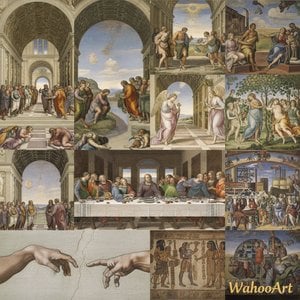
Les 10 Fresques Légendaires Qui Ont Révolutionné l'Art – ArtsDot
Plongez dans l'univers des 10 fresques les plus légendaires de l'histoire de l'art ! Découvrez Michel-Ange, Raphaël et Botticelli. Inspirez votre décoration intérieure avec ArtsDot : reproductions de qualité muséale en ligne.

Raphaël : Les 25 Chefs-d'œuvre Incontournables pour une Décoration d'Exception
Plongez dans l'univers de Raphaël avec les 25 œuvres incontournables du maître italien. Découvrez l'histoire, la technique et la beauté intemporelle de ses chefs-d'œuvre Renaissance. Reproductions de qualité muséale sur ArtsDot.com.
La Fresque Familiale : Un Héritage Peint sur les Murs –
Créez une fresque familiale unique et intemporelle ! Découvrez comment immortaliser votre histoire sur vos murs avec . Expertise, qualité & personnalisation garanties.

The Enduring Legacy of Fresco: Technique, History & Artistic Expression Across Cultures
Explore the rich history & enduring legacy of fresco painting! Discover ancient techniques, Giotto's masterpieces, and modern applications. Expert insights for art lovers & professionals.

The Enduring Legacy of Fresco Painting: Techniques, History & Contemporary Relevance
Explore the rich history & enduring artistry of fresco painting – from Giotto to Michelangelo! Discover techniques, conservation efforts, & modern applications. Learn how ArtsDot brings this timeless art form to your home.


