


 Aperçu en situation
 Partager
 Partager
 Détails
 Guide imprimable

 Télécharger
 Articles similaires
 Radiographie
 Voir le diaporama
 Statistiques
School of Athens

 Afficher la suite
Reproduction à l'huile faite à la main
Huile sur toile peinte à la main, avec cadre et dimensions personnalisés, réalisée sur commande par nos artistes. ( Passer au format impression Passer au format image numérique)




P118B $10

P118H $10

P118W $10

P438Z $10

P508JH $12

P508YH $12

P805H $10

P805Z $10

P919BZ $10

P919G $10

P919XJ $10

P959ZH $10

P968JZ $12

W106C $8

W218G $10

W218JH $8

W218Y $10

W307PJ $10

W316G $10

W316PJ $8

W316Y $10

W398PJ $8

W4111J $10

W500HY $15

W500JH $15

W692G $12

W849H $8

W940BG $15

W953PJ $8




Choisissez parmi nos formats prédéfinis qui respectent les proportions originales de l’œuvre.

Vous pouvez saisir vos propres dimensions pour l'adapter à un cadre ou à un espace spécifique. Si la taille sélectionnée ne correspond pas aux proportions de l'image d'origine, nous recadrerons l'œuvre ou prolongerons la peinture avec des éléments peints à la main supplémentaires. Une maquette numérique vous sera envoyée pour approbation avant le début de la production.
Veuillez noter que l'aperçu à l'écran ne reflète pas le recadrage ou l'extension réels. Seule la maquette montrera fidèlement la composition finale.
Bien que des tailles personnalisées soient disponibles, nous vous recommandons de sélectionner une dimension dans la liste prédéfinie afin de préserver les proportions d'origine.
Après la commande, l’équipe ArtsDot.com contactera le client par e-mail pour recueillir ses instructions et lui fournira une maquette d’aperçu
Livraison dans le monde entier () en 3 à 4 semaines au lieu des 5 semaines habituelles. (27 septembre). Aucun compromis sur la qualité.

Livraison express gratuite dans le monde entier

Toile de lin de haute qualité

Assurance transport complète

Garantie de remboursement des droits de douane

Garantie de fidélité des couleurs

Garantie de retour de 100 jours (uniquement en cas de défaut)

Garantie de remboursement à 100%

Tarifs dégressifs sur quantité
 L'option verre n'est disponible que pour les dimensions inférieures à 110 cm.

School of Athens
Technique de reproduction
Format de la reproduction
-


Prix total final
$ 263
The School of Athens: A Timeless Dialogue with Genius
Raphael’s “School of Athens” is more than just a painting; it's an architectural embodiment of human thought, a vibrant testament to the enduring power of philosophy and reason. Completed between 1509 and 1511 as part of Pope Julius II’s ambitious decoration of the Stanza della Segnatura within the Vatican Palace, this fresco immediately establishes itself as a cornerstone of High Renaissance art. It depicts a gathering of the greatest Greek philosophers and scientists – Plato, Aristotle, Socrates, Pythagoras – engaged in animated discussion, their figures rendered with an unprecedented level of realism and intellectual depth.
- A Gathering of Giants: The composition itself is masterful. Raphael skillfully arranges his subjects within a vast, imagined architectural space, drawing heavily on classical Roman models to create a sense of monumental grandeur. The central focus is undeniably Plato, gesturing towards the heavens with an outstretched hand, while Aristotle, seated and engaged in debate, represents earthly knowledge.
- Linear Perspective & Chiaroscuro: Raphael’s technical prowess is immediately apparent. He employs linear perspective with breathtaking precision, creating a believable three-dimensional space that draws the viewer into the scene. The use of chiaroscuro – the dramatic interplay of light and shadow – adds depth and emotional intensity to the figures, emphasizing their intellectual fervor.
- Symbolism Woven Within: Scattered throughout the fresco are symbolic elements. Books represent knowledge and learning, while the architectural details—columns, arches, and statues—echo the grandeur of ancient Greece and Rome, reinforcing the theme of classical wisdom.
The Renaissance Ideal: Humanism and Representation
“School of Athens” represents a pivotal moment in art history, marking a shift away from the stylized representations prevalent in earlier periods. Raphael’s approach aligns perfectly with the humanist ideals of the High Renaissance – an emphasis on human potential, reason, and the rediscovery of classical learning. Unlike previous depictions of philosophers as aloof or idealized figures, Raphael presents them as dynamic individuals engaged in passionate debate, reflecting a belief in the power of intellectual inquiry to shape humanity.
The painting’s influence extends far beyond its immediate context. It served as an inspiration for countless artists who followed, including Leonardo da Vinci and Michelangelo, solidifying Raphael's position as a leading figure of the era. His meticulous attention to detail, his mastery of perspective, and his ability to imbue his subjects with both intellectual depth and human emotion set a new standard for artistic representation.
A Window into the Soul of an Era
More than just a beautiful image, “School of Athens” offers a profound glimpse into the intellectual climate of 16th-century Rome. It’s a celebration of reason, knowledge, and the pursuit of truth – values that were central to the Renaissance worldview. The painting's enduring appeal lies in its ability to resonate with viewers across centuries, prompting us to contemplate our own place within the grand narrative of human thought.
A hand-painted reproduction captures not only the visual splendor of this masterpiece but also the spirit of intellectual curiosity that fueled its creation. It’s an investment in art history, a tangible connection to one of the most influential works ever conceived.
Œuvres similaires


![La School Of Athens (détail) [03] — Raphaël, Renaissance](/media/artworks/images-thumb/30/f3/30f39c600ce9f8eb336752926431690e.jpg)
![Stanze Vaticane - La École D'athènes (détail) [08] — Raphaël, Renaissance](/media/artworks/images-thumb/6c/b3/6cb3f1285155086a03ef9e38aadda04f.jpg)

Biographie de l'artiste
**Jeunesse et formation**
Raphaël (Raffaello Sanzio da Urbino), un peintre et architecte italien renommé, est né entre le 28 mars et le 6 avril 1483, dans la petite mais culturellement significative ville d'Urbino. Son père, Giovanni Santi, était peintre de cour du duc, lui offrant une exposition précoce au monde artistique. Après le décès de son père à l’âge de onze ans, Raphaël a vraisemblablement géré l’atelier familial, consolidant ainsi sa base artistique.**Carrière artistique et influences**
Le parcours artistique de Raphaël peut être divisé en trois phases distinctes, chacune marquée par un style unique :- Premières années à Umbrie : caractérisée par l'influence de son père et l'ambiance culturelle d’Urbino.
- Période florentine (1504-1508) : absorbant les traditions artistiques de Florence, qui a considérablement façonné son style.
- Période romaine (1508-1520) : travaillant pour deux papes et leurs associés, produisant certaines de ses œuvres les plus célèbres, notamment l’école des Athènes dans la stanza della segnatura du Vatican.
**Œuvres notables et héritage**
Certaines des œuvres notables de Raphaël comprennent :- Le jugement de Salomon (voir sur ArtsDot)
- La madone d’Esterházy (voir sur ArtsDot)
- Les Stanze Vaticanes - Vue de la stanza della segnatura (voir sur ArtsDot)
- Saint Sébastien (voir sur ArtsDot)
- La femme voilée (voir sur ArtsDot)
**Influence et héritage**
L'influence de Raphaël sur l'art est profonde, avec son œuvre constituant un pilier du grand Siècle. Son style serein et harmonieux a servi de modèle à la peinture néoclassique, comme le note l’historien d’art Johann Joachim Winckelmann. Malgré l'influence ultérieure du style de Michel-Ange, Raphaël reste l'un des artistes les plus vénérés de l'histoire. Voir le profil de Raphaël sur ArtsDot
Raphaël
1483 - 1520 , Italie
En bref
- Artistes Influents:
- Giovanni Santi
- Pietro Perugino
- Date De Décès: 6 avril 1520
- Date De Naissance: 28 mars 1483
- Influences Artistiques: Peinture néoclassique
- Lieu De Naissance: Urbino, Italie
- Mouvement Artistique: Haute Renaissance
- Nationalité: Italienne
- Nom Complet: Raphaël (Raffaello Sanzio)
- Œuvres Notables:
- L'École d'Athènes
- Madone Esterházy
- La Transfiguration
- Les Stanze Vaticanes
Articles similaires

The Enduring Legacy of Fresco Painting: Techniques, History & Contemporary Relevance
Explore the rich history & enduring artistry of fresco painting – from Giotto to Michelangelo! Discover techniques, conservation efforts, & modern applications. Learn how ArtsDot brings this timeless art form to your home.
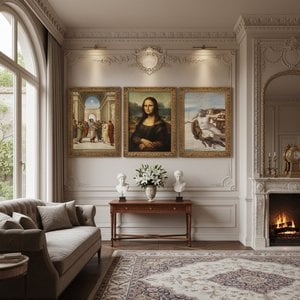
Les 10 Chefs-d'œuvre de la Haute Renaissance : Artistes et Décor d'Exception
Plongez au cœur de la Haute Renaissance avec les 10 chefs-d'œuvre incontournables de Léonard de Vinci, Michel-Ange et Raphaël. Découvrez l'histoire fascinante de ces tableaux emblématiques et trouvez l'inspiration pour une décoration intérieure d'exception sur .
La Fresque Familiale : Un Héritage Peint sur les Murs –
Créez une fresque familiale unique et intemporelle ! Découvrez comment immortaliser votre histoire sur vos murs avec . Expertise, qualité & personnalisation garanties.

The Enduring Legacy of Fresco: Technique, History & Artistic Expression Across Cultures
Explore the rich history & enduring legacy of fresco painting! Discover ancient techniques, Giotto's masterpieces, and modern applications. Expert insights for art lovers & professionals.

Raphaël : Les 25 Chefs-d'œuvre Incontournables pour une Décoration d'Exception
Plongez dans l'univers de Raphaël avec les 25 œuvres incontournables du maître italien. Découvrez l'histoire, la technique et la beauté intemporelle de ses chefs-d'œuvre Renaissance. Reproductions de qualité muséale sur ArtsDot.com.


