
Saint Michel Hand-painted in oil, just for your walls


The picture follows your choices: , .
Description de la pièce
Magnifique reproduction de Saint Michel combattant Satan par Raphaël ! Cette œuvre emblématique du Renaissance italien témoigne d'une maîtrise artistique exceptionnelle et d'une richesse symbolique.
 Lire la suite
Biographie de l'artiste
Découvrez Raphaël (1483-1520), le maître de la Renaissance italienne réputé pour son élégance, sa clarté et ses compositions harmonieuses. Explorez les œuvres emblématiques telles que 'La Scuola di Atene', les Madones et les fresques qui définissent la beauté classique. #ArtRenaissance #Italie
Reproduction à l'huile faite à la main
Huile sur toile peinte à la main, avec cadre et dimensions personnalisés, réalisée sur commande par nos artistes. ( Passer au format impression Passer au format numérique)
Order your painting in four simple steps
Take your time. You can change any answer; the price in your order card follows each choice.
1 Step one of four
Which size would you like?
These sizes keep the proportions of the original painting. The drawing shows your choice on a wall, above a two-metre sofa.
Or give your own measurements
Choisissez parmi nos formats prédéfinis qui respectent les proportions originales de l’œuvre.

Saisissez la largeur et la hauteur souhaitées, pour s'adapter à votre cadre ou à votre mur. Cette œuvre est peinte à la main ; ainsi, pour un format de forme différente, l'artiste peut peindre un peu plus autour du tableau ou réduire légèrement les bords — c'est vous qui choisissez. Nous vous envoyons une maquette numérique pour approbation avant que la peinture ne commence. L'image présentée sur cette page ne reflète pas le résultat réel — seule la maquette le fait.
2 Step two of four
How should it be prepared: rolled, stretched or framed?
The prices below are for the size you chose in step one.
Choose the edges of the stretched canvas
Choose your frame

White €1

Blurside €1

Extended €1

P118B €10

P118H €10

P118W €10

P438Z €10

P508JH €12

P508YH €12

P805H €10

P805Z €10

P919BZ €10

P919G €10

P919XJ €10

P959ZH €10

P968JZ €12

W106C €8

W218G €10

W218JH €8

W218Y €10

W307PJ €10

W316G €10

W316PJ €8

W316Y €10

W398PJ €8

W4111J €10

W500HY €15

W500JH €15

W692G €12

W849H €8

W940BG €15

W953PJ €8

H24-GOLD €30

H24-SILVER €30

H36-GOLD €45

H36-SILVER €45
Sous cadre
Moulding: . Overall size with the frame: .
3 Step three of four
Would you like anything changed in the painting?
Most people answer no. Because each painting is made by hand, our artist can also adapt it for you.
After order, ArtsDot.com team will email client for instructions and provide a mockup preview
4 Step four of four
A few finishing options
All of them are optional. The answers already selected cost nothing extra.
Who paints it?
Livraison dans le monde entier () en 3 à 4 semaines au lieu des 5 semaines habituelles. (29 octobre). Aucun compromis sur la qualité.
A nameplate, as in a museum?
Détails de la plaque en bronze gravée
This elegant plaque features the artist's name and the title of the artwork, finely engraved for a timeless presentation.
It is made from bronze with a refined, elegant finish. The text is precisely laser-engraved for a sharp and permanent result. Measuring 9x2 cm, the plaque is compact yet easy to read. It's built to be durable and scratch-resistant, offering a professional, museum-quality look. Mounting is simple thanks to the included adhesive backing.
Détails de la plaque en acrylique transparent
The plaque includes essential engraved details such as the artist's name, the title of the artwork, the date it was created, the type of media used-like oil on canvas or watercolor-a brief description of the piece, and a QR code that links to the complete artwork information.
It is crafted from clear acrylic, offering a sleek, modern appearance. The text is UV-engraved in black to ensure strong visual contrast. With a size of 10x15 cm, it ensures optimal readability. It comes equipped with two metal hooks for secure wall mounting. The plaque is designed to be weather-resistant, making it suitable for various environments, and it includes interactive features that work seamlessly with smartphone scanning.
Détails de la plaque en acrylique noir
This elegant plaque includes engraved information such as the artist's name, the title of the artwork, the date it was created, the type of media used (like oil on canvas or watercolor), a short description of the artwork, and a QR code for quick access to more information.
The plaque itself is made from refined black acrylic with a premium finish. The text is laser-engraved in white for high contrast and readability. Its size is 10x15 cm, designed to be easy to read. It comes with two metal hooks for professional mounting. The design is sleek and fits any interior style. It is also weather-resistant and durable, with built-in digital integration for mobile compatibility.
A protective varnish?
When do you need it?
✓ Check and order
Your painting, as you ordered it

Saint Michel
Technique de reproduction
Format de la reproduction
-

Artiste de prestige
Plus de détails, de finesse et un temps de production accru
-

Cadre de reproduction
-
-
Pour les œuvres ou reproductions dont un côté mesure plus de 105 cm (environ 41 pouces), le cadre sera expédié sous forme de kit démonté. Cette méthode garantit une livraison sécurisée et prévient tout dommage pendant le transport.
Assemblage professionnel requis - ce produit n'est pas destiné au bricolage (DIY).
Le kit doit être assemblé et la toile tendue par un encadreur professionnel expérimenté, en utilisant de la colle à bois (non fournie), une pince à tendre la toile et des serre-joints pour maintenir les traverses d'équerre pendant le séchage de la colle. Un assemblage incorrect ou une tension inégale de la toile peut endommager l'œuvre de manière irréversible et n'est pas couvert par notre garantie.
 Pour les œuvres ou reproductions dont un côté mesure plus de 105 cm (environ 41 pouces), le cadre sera expédié sous forme de kit démonté. Cette méthode garantit une livraison sécurisée et prévient tout dommage pendant le transport.
Toutes les baguettes en bois massif sont incluses, découpées avec précision à la taille requise.
À assembler avec les vis fournies, ainsi qu'avec de la colle à bois pour les assemblages d'angles (non fournie), à prévoir par votre encadreur.
L'utilisation d'outils professionnels est requise et non incluse : une pince à tendre la toile (tendeur) et des serre-joints pour maintenir les baguettes bien d'équerre pendant le séchage de la colle.
Important :
L'assemblage des angles nécessite de la colle à bois, les barres doivent être maintenues avec des serre-joints jusqu'au séchage complet de la colle, et le tendage de la toile sur le châssis assemblé nécessite une pince à tendre la toile. Aucun de ces éléments n'est inclus dans le kit. Veuillez consulter un encadreur professionnel expérimenté avant de commander ce format.

Cartel
-
-

Vernis de protection
Vernis brillant (intensifie les couleurs, protège de la lumière et de l'humidité)
-

Personnaliser mon œuvre
Exemples de personnalisation : remplacer le visage par une photo du client ; ajouter un animal de compagnie (par exemple, remplacer un chat par un chien) ; inclure un message caché en arrière-plan ; modifier le paysage ou les éléments d'arrière-plan.
-

Livraison urgente
Livraison dans le monde entier () en 3 à 4 semaines au lieu des 5 semaines habituelles. (29 octobre). Aucune concession sur la qualité.
-
Livraison express
Livraison dans le monde entier () sous 5 semaines. (5 novembre).
Inclus
Prix total
€ 232
L'option verre n'est disponible que pour les dimensions inférieures à 110 cm.
Included with every order
- Livraison express gratuite dans le monde entier
- Toile de lin de qualité supérieure
- Assurance transport complète
- Garantie de remboursement des droits de douane
- Garantie de fidélité des couleurs
- Politique de retour de 100 jours (uniquement en cas de défaut)
- Garantie de remboursement à 100%
- Offre de tarifs dégressifs


Saint Michael Vanquishing Satan – A Renaissance Triumph
The painting “Saint Michael Vanquishing Satan,” attributed to Raphael Sanzio da Urbino and executed around 1504-1505, stands as a cornerstone of High Renaissance art—a testament to humanist ideals fused with profound religious symbolism. Commissioned by Pope Julius II for the Vatican Stanza della Segnatura, it’s more than just an image; it's a carefully crafted narrative designed to convey a powerful message about divine victory over evil.
- Subject Matter: The scene depicts Saint Michael the Archangel engaged in mortal combat with Satan—a depiction of Lucifer—who attempts to drag St. Michael into Hell. This iconography draws heavily from biblical narratives concerning the struggle between God and demonic forces, central to Christian theology.
- Style & Technique: Raphael’s masterful handling of oil paint on panel exemplifies the Renaissance preoccupation with realism combined with idealized beauty. Linear perspective creates a convincing illusion of depth, anchoring the figures within a dramatic landscape—a stark contrast between heaven and hell. The artist employs meticulous detail in portraying St. Michael's armor and Satan’s grotesque form, reflecting Leonardo da Vinci’s influence on Raphael’s approach to anatomical accuracy.
- Historical Context: Created during the papal patronage of Julius II—who commissioned numerous monumental artworks to glorify God—the painting reflects the broader humanist revival of classical ideals prevalent in Rome at the time. Raphael's work aligns with the philosophical currents of Neoplatonism, which sought to reconcile Christian faith with pagan wisdom.
- Symbolism: The dragon represents Satan’s dominion over earthly evil and symbolizes temptation—a challenge to St Michael’s unwavering devotion. The sword wielded by St Michael signifies divine righteousness and is instrumental in vanquishing the adversary. The birds circling above represent angels, symbolizing God's watchful care and protection.
- Emotional Impact: “Saint Michael Vanquishing Satan” evokes a palpable sense of drama and tension—capturing the essence of spiritual conflict. Raphael’s serene composition contrasts sharply with the turbulent landscape, emphasizing St Michael’s fortitude and conveying an enduring message about triumph over adversity.
This painting continues to inspire awe and admiration for its artistic brilliance and profound theological significance. Its influence can be seen in subsequent Baroque art—particularly in depictions of angelic warfare—demonstrating Raphael's lasting legacy as one of the most influential artists of his era.
Explore reproductions of “Saint Michael Vanquishing Satan” at WGA and discover the beauty of Renaissance art!
Questions et réponses
À quel courant artistique «Saint Michel» de Raphaël appartient-il ?
«Saint Michel» de Raphaël appartient au mouvement Renaissance. Ce mouvement apporte le contexte stylistique de l'œuvre.
Où peut-on acheter des reproductions peintes à la main de «Saint Michel» de Raphaël ?
«Saint Michel» est disponible en tant que une reproduction à l'huile peinte à la main sur toile de lin. Vous pouvez passer commande sur sa page Reproduction peinte à la main, avec un choix de formats disponibles.
Dans quel mouvement et à quelle époque s'inscrit «Saint Michel» de Raphaël ?
Dans «Saint Michel» de Raphaël, le mouvement Renaissance rencontre l'époque Renaissance.

Raphaël
1483 - 1520, Italie
Biographie de l'artiste
**Jeunesse et formation**
Raphaël (Raffaello Sanzio da Urbino), un peintre et architecte italien renommé, est né entre le 28 mars et le 6 avril 1483, dans la petite mais culturellement significative ville d'Urbino. Son père, Giovanni Santi, était peintre de cour du duc, lui offrant une exposition précoce au monde artistique. Après le décès de son père à l’âge de onze ans, Raphaël a vraisemblablement géré l’atelier familial, consolidant ainsi sa base artistique.**Carrière artistique et influences**
Le parcours artistique de Raphaël peut être divisé en trois phases distinctes, chacune marquée par un style unique :- Premières années à Umbrie : caractérisée par l'influence de son père et l'ambiance culturelle d’Urbino.
- Période florentine (1504-1508) : absorbant les traditions artistiques de Florence, qui a considérablement façonné son style.
- Période romaine (1508-1520) : travaillant pour deux papes et leurs associés, produisant certaines de ses œuvres les plus célèbres, notamment l’école des Athènes dans la stanza della segnatura du Vatican.
**Œuvres notables et héritage**
Certaines des œuvres notables de Raphaël comprennent :- Le jugement de Salomon (voir sur ArtsDot)
- La madone d’Esterházy (voir sur ArtsDot)
- Les Stanze Vaticanes - Vue de la stanza della segnatura (voir sur ArtsDot)
- Saint Sébastien (voir sur ArtsDot)
- La femme voilée (voir sur ArtsDot)
**Influence et héritage**
L'influence de Raphaël sur l'art est profonde, avec son œuvre constituant un pilier du grand Siècle. Son style serein et harmonieux a servi de modèle à la peinture néoclassique, comme le note l’historien d’art Johann Joachim Winckelmann. Malgré l'influence ultérieure du style de Michel-Ange, Raphaël reste l'un des artistes les plus vénérés de l'histoire. Voir le profil de Raphaël sur ArtsDotQuick facts about Raphaël
- Artistes Influents:
- Giovanni Santi
- Pietro Perugino
- Date De Décès: 6 avril 1520
- Date De Naissance: 28 mars 1483
- Influences Artistiques: Peinture néoclassique
- Lieu De Naissance: Urbino, Italie
- Mouvement Artistique: Haute Renaissance
- Nationalité: Italienne
- Nom Complet: Raphaël (Raffaello Sanzio)
- Œuvres Notables:
- L'École d'Athènes
- Madone Esterházy
- La Transfiguration
- Les Stanze Vaticanes
Œuvres similaires


Articles connexes

The Enduring Legacy of Fresco Painting: Techniques, History & Contemporary Relevance
Explore the rich history & enduring artistry of fresco painting – from Giotto to Michelangelo! Discover techniques, conservation efforts, & modern applications. Learn how ArtsDot brings this timeless art form to your home.

L'Art Mural Intérieur : Reflet de l'Âme et Témoin d'une Histoire Familiale
Explorez l'art mural intérieur : histoire, styles, conseils d'experts pour sublimer votre espace. Découvrez comment créer un récit familial unique et intemporel.

The Enduring Legacy of Fresco: Technique, History & Artistic Expression Across Cultures
Explore the rich history & enduring legacy of fresco painting! Discover ancient techniques, Giotto's masterpieces, and modern applications. Expert insights for art lovers & professionals.

L'Art de l'Équilibre : Les 25 Plus Grands Chefs-d'œuvre de Raphaël
Explorez les 25 chefs-d'œuvre de Raphaël et l'harmonie de la Renaissance. Découvrez ces trésors sur ArtsDot.com.
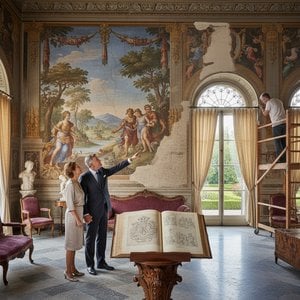
La Fresque Familiale : Un Héritage Peint sur les Murs –
Créez une fresque familiale unique et intemporelle ! Découvrez comment immortaliser votre histoire sur vos murs avec . Expertise, qualité & personnalisation garanties.
 Aperçu en situation
 Envoyer
 Partager
 Détails de l'œuvre
 Guide
Guide

 Télécharger l'image
 Articles similaires
 Radiographie
 Diaporama
 Q&A
Q&A Statistiques