


 Aperçu en situation
 Envoyer
 Partager
 Détails de l'œuvre
 Guide
Guide

 Télécharger l'image
 Articles similaires
 Radiographie
 Diaporama
 Statistiques
Les Sibylles

 Lire la suite
Reproduction à l'huile faite à la main
Huile sur toile peinte à la main, avec cadre et dimensions personnalisés, réalisée sur commande par nos artistes. ( Passer au format impression Passer au format numérique)




P118B €10

P118H €10

P118W €10

P438Z €10

P508JH €12

P508YH €12

P805H €10

P805Z €10

P919BZ €10

P919G €10

P919XJ €10

P959ZH €10

P968JZ €12

W106C €8

W218G €10

W218JH €8

W218Y €10

W307PJ €10

W316G €10

W316PJ €8

W316Y €10

W398PJ €8

W4111J €10

W500HY €15

W500JH €15

W692G €12

W849H €8

W940BG €15

W953PJ €8




Choisissez parmi nos formats prédéfinis qui respectent les proportions originales de l’œuvre.

Saisissez la largeur et la hauteur souhaitées, pour s'adapter à votre cadre ou à votre mur. Cette œuvre est peinte à la main ; ainsi, pour un format de forme différente, l'artiste peut peindre un peu plus autour du tableau ou réduire légèrement les bords — c'est vous qui choisissez. Nous vous envoyons une maquette numérique pour approbation avant que la peinture ne commence. L'image présentée sur cette page ne reflète pas le résultat réel — seule la maquette le fait.
Après la commande, l’équipe ArtsDot.com contactera le client par e-mail pour recueillir ses instructions et lui fournira une maquette d’aperçu
Livraison dans le monde entier () en 3 à 4 semaines au lieu des 5 semaines habituelles. (28 octobre). Aucun compromis sur la qualité.

Livraison express gratuite dans le monde entier

Toile de lin de qualité supérieure

Assurance transport complète

Garantie de remboursement des droits de douane

Garantie de fidélité des couleurs

Politique de retour de 100 jours (uniquement en cas de défaut)

Garantie de remboursement à 100%

Offre de tarifs dégressifs
 L'option verre n'est disponible que pour les dimensions inférieures à 110 cm.

Les Sibylles
Technique de reproduction
Format de la reproduction
-


Prix total
€ 232
La Sibylle et les Anges : Une Symphonie de Lumière et d'Harmonie Renaissance
La peinture intitulée « La Sibylle et les Anges », attribuée à Raphaël Sanzio Da Urbino, est bien plus qu’une simple représentation artistique ; elle incarne l’esprit même du Siècle des Lumières italiennes et témoigne de la maîtrise exceptionnelle d'un artiste considéré comme l'un des trois grands maîtres de la Renaissance. Créée en 1514 pour décorer la Chapelle Chigi à Rome, cette œuvre monumentale est une véritable célébration de la beauté idéale et une profonde réflexion sur les mystères de la création.
- L'artiste : Raphaël Sanzio Da Urbino (1483-1520) était un peintre italien né à Urbino, dans le duché parmesien. Fils d’un poète et artiste renommé, Giovanni Santi, il bénéficia d’une éducation raffinée et fut initié aux idées humanistes de son temps, une influence déterminante pour son œuvre artistique ultérieure.
- Le contexte historique : La peinture est née au cœur du Haut Moyen Âge italiennes, une période marquée par la Renaissance artistique et intellectuelle. Elle reflète les préoccupations esthétiques et philosophiques de l’époque, notamment l'intérêt pour la philosophie néoplatonique et la recherche d'une harmonie parfaite entre forme et contenu.
- La technique : Raphaël maîtrisait parfaitement la peinture à l’huile sur toile, une méthode innovante qui lui permettait d’obtenir une profondeur remarquable et une luminosité exceptionnelle. Chaque nuance de couleur est soigneusement étudiée pour créer une atmosphère envoûtante et renforcer le caractère sacré du sujet représenté.
- Le style : Cette œuvre appartient au style italiennes, caractérisé par une précision anatomique inégalée, une recherche constante de la beauté idéale et une maîtrise parfaite des proportions classiques. Elle témoigne d’une esthétique élégante et raffinée qui continue d'inspirer les artistes contemporains.
Les anges représentés dans « La Sibylle et les Anges » sont disposés avec une précision remarquable, chacun ayant une fonction spécifique au sein de la scène. Leur mouvement gracieux et leurs expressions sereines évoquent une présence divine et invitent à la contemplation. Les instruments de musique qu’ils tiennent symbolisent la musique céleste et contribuent à créer une atmosphère harmonieuse et pleine d'énergie.
La lumière joue un rôle essentiel dans cette œuvre, illuminant les personnages et les objets avec une douceur particulière. Cette lumière douce et chaleureuse crée une ambiance mystique et renforce le caractère sacré du sujet représenté. Elle rappelle les œuvres majeures de Michel Ange et Léonard Davinci.
La Chapelle Chigi est un lieu chargé d’histoire et de signification religieuse, où « La Sibylle et les Anges » occupe une place prépondérante. Cette fresque exceptionnelle constitue un témoignage précieux de l'art italiennes du XVIe siècle et continue de fasciner les visiteurs du monde entier.
Les Symbolismes Cachés : Une Réflexion Philosophique Profonde
Au-delà de sa beauté esthétique, « La Sibylle et les Anges » renferme des symbolismes complexes qui invitent à une interprétation plus poussée. Les sibylles représentent les prophètes féminins antiques, chargés de transmettre les messages divins aux hommes. Leur présence dans cette œuvre souligne l’importance de la sagesse et de la connaissance pour atteindre la compréhension du monde.
Une Reproduction Exceptionnelle : Capturer la Lumière et la Couleur Originales
Pour apprécier pleinement la beauté et la richesse artistique de « La Sibylle et les Anges », il est essentiel de découvrir une reproduction haute qualité. ArtsDot propose des reproductions originales réalisées avec soin par des artistes talentueux, utilisant les mêmes matériaux et techniques que Raphaël lui-même. Une véritable opportunité pour enrichir votre intérieur d'une œuvre emblématique de l’histoire de l’art.
Découvrez Votre Œuvre Idéale : Visitez ArtsDot.com
Questions et réponses
Où puis-je acheter une impression de «Les Sibylles» de Raphaël ?
« Les Sibylles » est disponible en tant que une impression d'art sur toile de coton ou sur papier canvas d'archive. Les commandes s'effectuent sur sa page Tirage d'art fine art, dans le format de votre choix.
Quelle est la technique utilisée pour «Les Sibylles» de Raphaël ?
«Les Sibylles» de Raphaël est réalisé en Huile sur toile. Les reproductions visent à restituer l'aspect de cette technique.
À quel courant artistique «Les Sibylles» de Raphaël appartient-il ?
Le mouvement associé à «Les Sibylles» de Raphaël est Italian Renaissance. Cette classification situe l'œuvre parmi des artistes et des œuvres d'art apparentés.
Œuvres similaires


![Stanze Vaticane - La Disputa (detail) [02] — Raphaël, Renaissance](/media/artworks/images-thumb/55/c5/55c5db1a88764a9697fe9eb0ea9d43c9.jpg)

![Stanze Vaticane - Le Parnasse (détail) [07] — Raphaël, High Renaissance](/media/artworks/images-thumb/3c/a1/3ca1620e84d3f2fe4e94d9bb954e0eca.jpg)
Biographie de l'artiste
**Jeunesse et formation**
Raphaël (Raffaello Sanzio da Urbino), un peintre et architecte italien renommé, est né entre le 28 mars et le 6 avril 1483, dans la petite mais culturellement significative ville d'Urbino. Son père, Giovanni Santi, était peintre de cour du duc, lui offrant une exposition précoce au monde artistique. Après le décès de son père à l’âge de onze ans, Raphaël a vraisemblablement géré l’atelier familial, consolidant ainsi sa base artistique.**Carrière artistique et influences**
Le parcours artistique de Raphaël peut être divisé en trois phases distinctes, chacune marquée par un style unique :- Premières années à Umbrie : caractérisée par l'influence de son père et l'ambiance culturelle d’Urbino.
- Période florentine (1504-1508) : absorbant les traditions artistiques de Florence, qui a considérablement façonné son style.
- Période romaine (1508-1520) : travaillant pour deux papes et leurs associés, produisant certaines de ses œuvres les plus célèbres, notamment l’école des Athènes dans la stanza della segnatura du Vatican.
**Œuvres notables et héritage**
Certaines des œuvres notables de Raphaël comprennent :- Le jugement de Salomon (voir sur ArtsDot)
- La madone d’Esterházy (voir sur ArtsDot)
- Les Stanze Vaticanes - Vue de la stanza della segnatura (voir sur ArtsDot)
- Saint Sébastien (voir sur ArtsDot)
- La femme voilée (voir sur ArtsDot)
**Influence et héritage**
L'influence de Raphaël sur l'art est profonde, avec son œuvre constituant un pilier du grand Siècle. Son style serein et harmonieux a servi de modèle à la peinture néoclassique, comme le note l’historien d’art Johann Joachim Winckelmann. Malgré l'influence ultérieure du style de Michel-Ange, Raphaël reste l'un des artistes les plus vénérés de l'histoire. Voir le profil de Raphaël sur ArtsDot
Raphaël
1483 - 1520 , Italie
L'essentiel de l'artiste
- Artistes Influents:
- Giovanni Santi
- Pietro Perugino
- Date De Décès: 6 avril 1520
- Date De Naissance: 28 mars 1483
- Influences Artistiques: Peinture néoclassique
- Lieu De Naissance: Urbino, Italie
- Mouvement Artistique: Haute Renaissance
- Nationalité: Italienne
- Nom Complet: Raphaël (Raffaello Sanzio)
- Œuvres Notables:
- L'École d'Athènes
- Madone Esterházy
- La Transfiguration
- Les Stanze Vaticanes
Articles connexes
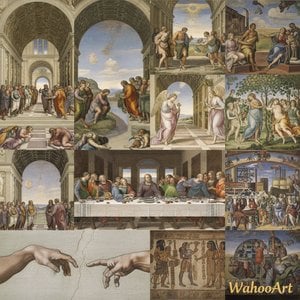
Les 10 Fresques Légendaires Qui Ont Révolutionné l'Art – ArtsDot
Plongez dans l'univers des 10 fresques les plus légendaires de l'histoire de l'art ! Découvrez Michel-Ange, Raphaël et Botticelli. Inspirez votre décoration intérieure avec ArtsDot : reproductions de qualité muséale en ligne.
La Fresque Familiale : Un Héritage Peint sur les Murs –
Créez une fresque familiale unique et intemporelle ! Découvrez comment immortaliser votre histoire sur vos murs avec . Expertise, qualité & personnalisation garanties.

Raphaël : Les 25 Chefs-d'œuvre Incontournables pour une Décoration d'Exception
Plongez dans l'univers de Raphaël avec les 25 œuvres incontournables du maître italien. Découvrez l'histoire, la technique et la beauté intemporelle de ses chefs-d'œuvre Renaissance. Reproductions de qualité muséale sur ArtsDot.com.

The Enduring Legacy of Fresco Painting: Techniques, History & Contemporary Relevance
Explore the rich history & enduring artistry of fresco painting – from Giotto to Michelangelo! Discover techniques, conservation efforts, & modern applications. Learn how ArtsDot brings this timeless art form to your home.

The Enduring Legacy of Fresco: Technique, History & Artistic Expression Across Cultures
Explore the rich history & enduring legacy of fresco painting! Discover ancient techniques, Giotto's masterpieces, and modern applications. Expert insights for art lovers & professionals.


