


 Aperçu en situation
 Partager
 Partager
 Détails
 Guide imprimable

 Télécharger
 Articles similaires
 Radiographie
 Voir le diaporama
 Statistiques
Composition 1916


 Afficher la suite
Giclées et impressions d'art
Impressions giclées ou sur toile de qualité musée, avec une production rapide et des finitions au choix. ( Acheter la peinture faite à la main Passer au format image numérique)




P118B €10

P118H €10

P118W €10

P438Z €10

P508JH €12

P508YH €12

P805H €10

P805Z €10

P919BZ €10

P919G €10

P919XJ €10

P959ZH €10

P968JZ €12

W106C €8

W218G €10

W218JH €8

W218Y €10

W307PJ €10

W316G €10

W316PJ €8

W316Y €10

W398PJ €8

W4111J €10

W500HY €15

W500JH €15

W692G €12

W849H €8

W940BG €15

W953PJ €8




Choisissez parmi nos formats prédéfinis qui respectent les proportions originales de l’œuvre.

Saisissez la largeur et la hauteur souhaitées pour qu'elles s'adaptent à votre cadre ou à votre mur. Une impression ne peut être que découpée, elle ne peut jamais être agrandie au-delà de l'image originale ; ainsi, un format de forme différente entraînera la perte d'une partie de l'image. Nous vous envoyons une maquette numérique pour approbation avant toute impression. L'image présentée sur cette page ne montre pas le recadrage réel — seule la maquette le permet.
Livraison dans le monde entier () en 2 semaines au lieu des 4/5 semaines habituelles. (21 octobre)

Livraison express gratuite dans le monde entier

Toile de lin de haute qualité

Assurance transport complète

Garantie de remboursement des droits de douane

Garantie de fidélité des couleurs

Garantie de retour de 100 jours (uniquement en cas de défaut)

Garantie de remboursement à 100%

Tarifs dégressifs sur quantité
 L'option verre n'est disponible que pour les dimensions inférieures à 110 cm.

Composition 1916
Giclées et impressions d'art
Format de la reproduction
-


Prix total final
€ 54
Composition 1916: A Prelude to Neoplasticism – Exploring Mondrian’s Vision
Piet Mondrian's ‘Composition 1916’ stands as an undeniable cornerstone of modern art, marking a decisive shift from representational painting towards the radical simplification that would define his groundbreaking Neoplastic style. More than just an arrangement of geometric forms and primary colors; it embodies Mondrian’s profound intellectual and spiritual convictions—a quest for universal harmony rooted in Theosophy's belief in underlying order. This artwork isn’t merely aesthetically pleasing; it’s a manifesto of artistic philosophy, reflecting the artist’s unwavering commitment to distilling reality into its purest essence.Deconstructing Reality: Style & Technique
The painting firmly establishes itself within Constructivism and De Stijl movements, prioritizing pure abstraction and universal forms. However, ‘Composition 1916’ diverges subtly from Mondrian's later grid system—a deliberate choice that underscores the dynamism inherent in its visual language. The technique is meticulous, suggesting careful planning and precise application of oil paint on canvas. Layers of pigment create a palpable depth, achieved not through traditional perspective but by manipulating form and color relationships. Masking techniques likely ensured sharp edges and overlapping planes, contributing to the artwork’s distinctive textural quality. Despite appearing flat at first glance, this illusion of depth speaks volumes about Mondrian's mastery of visual perception.A Journey Towards Universal Harmony
Born in 1872, Piet Mondrian was deeply influenced by Theosophy—a spiritual movement seeking universal truths beyond the material world. He believed that art should transcend the mundane and represent the fundamental structure of existence. ‘Composition 1916’ powerfully articulates this belief. The absence of recognizable objects isn't a mere stylistic decision; it’s a conscious effort to liberate the viewer from superficial distractions, revealing instead the underlying geometric framework—the building blocks of reality itself. The interplay of vertical and horizontal lines, combined with the restrained palette of red, blue, yellow, grey, and black, symbolizes balance and harmony – core tenets of Mondrian's artistic worldview.Symbolism & Emotional Resonance
While abstract in appearance, ‘Composition 1916’ is imbued with symbolic significance. The intersecting lines can be interpreted as representing interconnectedness—the fundamental unity of all things—while the geometric shapes embody elemental principles. Notably, the artwork possesses a palpable tension between order and chaos—control and freedom—creating a visual energy that stimulates contemplation alongside serenity. These colors carry profound emotional weight: red signifies vitality; blue embodies spirituality; yellow represents earthly energy. Together, they evoke an intellectual rigor tempered by spiritual aspiration.Historical Significance & Legacy
Created around 1916, ‘Composition 1916’ precedes the formal establishment of De Stijl in 1917 but foreshadows its core principles—a deliberate step towards Mondrian's revolutionary artistic vision. Co-founder of De Stijl alongside Theo van Doesburg, Mondrian sought to create a “universal style” applicable to all forms of art and design. Its impact reverberates throughout the 20th century and continues to inspire contemporary artists and designers alike. Consider pairing it with furniture featuring clean lines and geometric forms for a cohesive aesthetic—a testament to Mondrian’s enduring influence on visual culture. Owning a reproduction of ‘Composition 1916’ is more than acquiring art; it's embracing a legacy of innovation and upholding the pursuit of universal beauty.Questions et réponses
Quelle taille et quel format sont recommandés pour un tirage de «Composition 1916» de Piet Mondrian ?
Format Format standard, orientation Format très allongé : voilà la configuration d'impression suggérée pour «Composition 1916» de Piet Mondrian.
Est-ce que Piet Mondrian, créateur de « Composition 1916 », est connu sous d'autres noms ?
Piet Mondrian apparaît sous les noms alternatifs Pieter Cornelis Mondriaan.
De quel pays provient l'œuvre Néo-plasticisme « Composition 1916 » ?
«Composition 1916» a été créé par Piet Mondrian, né en Pays-Bas, au sein du mouvement Néo-plasticisme. L'origine de l'artiste lie l'œuvre au Néo-plasticisme tel que pratiqué par les artistes de Pays-Bas.
Œuvres similaires


Biographie de l'artiste
**Je jeunesse et sa carrière aux Pays-Bas (1872-1911)**
pieter cornelis mondriaan, connu depuis 1911 sous le nom de piet mondrian, était un peintre et théoriciens de l'art néerlandais né le 7 mars 1872 à Amersfoort, aux Pays-Bas. Il a commencé sa carrière comme enseignant dans l'enseignement primaire tout en pratiquant la peinture, initialement dans le style impressionniste néerlandais de l'École de La Haye.- Ses premières œuvres, caractérisées par des paysages naturalistes, peuvent être vues dans des peintures telles que The Red Mill et Trees in Moonrise, exposées au Kunstmuseum Den Haag.
- La recherche de Mondrian d'un style personnel l'a conduit à explorer divers mouvements artistiques, notamment le pointillisme et le fauvisme.
- Sa première exposition en 1893 a marqué le début de sa carrière prolifique.
**L’évolution du style de Mondrian**
De la figure à l'abstraction La direction artistique de Mondrian s'est orientée vers un style de plus en plus abstrait, culminant dans une forme non-représentative qu'il a appelée néoplasticisme. Cette « art plastique pur » visait à créer « une beauté universelle », limitant son vocabulaire formel aux couleurs primaires (rouge, bleu et jaune), aux valeurs (noir, blanc et gris) et aux directions (horizontale et verticale).- Des exemples de ce style peuvent être vus dans des peintures telles que Composition with Yellow Patch (46 x 46 cm, néoplasticisme, huile sur toile).
- Le travail de Mondrian a eu une influence énorme sur l'art du XXe siècle, impactant non seulement la peinture abstraite mais aussi la conception, l'architecture et la mode.
**Héritage et influence**
L’héritage de Mondrian s’étend au-delà de son propre travail, influençant les grands styles et mouvements tels que la couleur field painting, l'expressionnisme abstrait et le minimalisme. L'historien d'art Stephen Bayley a noté que Mondrian est devenu un totem pour tout ce que le modernisme visait à être.- Découvrez davantage du travail de Mondrian sur ArtsDot.com.
- Apprenez-en plus sur le mouvement De Stijl et son influence sur l'art moderne à wikipedia.
- Découvrez d’autres artistes influents tels que Vincent van Gogh et leur impact sur le monde de l'art.
**Œuvres clés et expositions**
* Piet Mondrian: Apple Blossom (Cubisme) (voir sur ArtsDot.com) * Piet Mondrian: Still Life with Vase of Spices II (Cubisme) (voir sur ArtsDot.com) * Piet Mondrian: Passionflower (73 x 48 cm, Kunstmuseum Den Haag, post impressionisme, aquarelle) (voir sur ArtsDot.com)
Piet Mondrian
1872 - 1944 , Pays-Bas
En bref
- Artistes Influents:
- École de La Haye
- Pointillisme
- Fauvisme
- Cubisme
- Date De Naissance: 7 mars 1872
- Influences Artistiques:
- Color Field painting
- Expressionnisme abstrait
- Minimalisme
- Lieu De Naissance: Amersfoort, Pays-Bas
- Mouvement Artistique: De Stijl, Néoplasticisme
- Nationalité: Néerlandais
- Nom Complet: Piet Mondrian
- Oeuvres Notables:
- Composition avec Rouge, Jaune et Bleu
- Broadway Boogie Woogie
- Tableau n°2 Composition V
- Arbres sur le Gein. Lever de lune
Articles connexes

Abstraction Géométrique : Les 10 Chefs-d'œuvre qui ont Marqué l'Histoire de l'Art
Plongez au cœur de l'abstraction géométrique avec ArtsDot.com ! Découvrez les 10 œuvres majeures de Mondrian, Malevitch et Kandinsky qui ont révolutionné l'art moderne. Inspirez votre décoration intérieure avec des reproductions de tableaux exceptionnelles. Explorez la collection en ligne !

Piet Mondrian : Déconstruction de la réalité – Étude du Néoplasticisme et de l'harmonie universelle
Explorez le monde fascinant de Piet Mondrian et du Néoplasticisme. Découvrez les principes clés de ce mouvement artistique révolutionnaire, son influence durable et l'harmonie universelle qu'il recherche. Analyse approfondie et œuvres emblématiques.
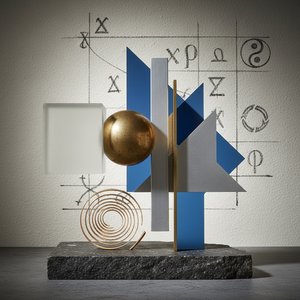
Au-Delà de la Forme : Explorer les Fondements Philosophiques de l'Abstraction Géométrique
Explorez les fondements philosophiques de l'abstraction géométrique avec ArtsDot. Découvrez Malevitch, Mondrian et Lissitzky. Analyse approfondie pour collectionneurs et amateurs d'art.

Beyond Form & Color: Geometric Abstraction's Evolution in 20th/21st Century Art
Explore the evolution of geometric abstraction from Cubism to contemporary art. Discover key artists like Malevich & Mondrian, investment insights, and expert collecting advice at ArtsDot.

Theo van Doesburg: Pioneering De Stijl & the Evolution of Neo-Plasticism
Explore the revolutionary De Stijl movement & Neo-Plasticism with our expert guide. Discover Piet Mondrian, Theo van Doesburg, and the lasting impact of this influential art style. Learn about collecting & investing in De Stijl masterpieces.


