- Accueil

- Impression sur toile
- Pierre Bonnard
- The Window

 Commander la reproduction Acheter l'image haute résolution
 Partager
 Partager
 Détails de l'œuvre
 Ajouter aux favoris

 Télécharger
 Articles similaires
 Radiographie
 Diaporama
The Window


 Afficher la suite
Giclée / Impression d'art
Impression giclée ou sur toile de qualité musée, avec une production rapide et des finitions au choix.




P118B $10

P118H $10

P118W $10

P438Z $10

P508JH $12

P508YH $12

P805H $10

P805Z $10

P919BZ $10

P919G $10

P919XJ $10

P959ZH $10

P968JZ $12

W106C $8

W218G $10

W218JH $8

W218Y $10

W307PJ $10

W316G $10

W316PJ $8

W316Y $10

W398PJ $8

W4111J $10

W500HY $15

W500JH $15

W692G $12

W849H $8

W940BG $15

W953PJ $8




Choisissez parmi nos formats prédéfinis qui respectent les proportions originales de l’œuvre.

Vous pouvez saisir vos propres dimensions pour vous adapter à un cadre ou à un espace spécifique. Si la taille sélectionnée ne correspond pas aux proportions de l'image originale, nous recadrerons l'œuvre ou étendrons l'image avec une bordure en miroir ou une couleur unie. Une maquette numérique vous sera envoyée pour approbation avant le début de la production.
Veuillez noter que l'aperçu à l'écran ne reflète pas le recadrage ou l'extension réelle. Seule la maquette montrera avec précision la composition finale.
Bien que des tailles personnalisées soient disponibles, nous vous recommandons de choisir une dimension dans la liste prédéfinie afin de préserver les proportions originales.
Livraison dans le monde entier () en 2 semaines au lieu des 4/5 semaines habituelles. (16 juillet)

Livraison express gratuite dans le monde entier

Toile de lin de haute qualité

Assurance transport complète

Garantie de remboursement des frais de douane

Garantie de fidélité des couleurs

Politique de retour de 60 jours (uniquement en cas de défaut)

Garantie de remboursement à 100%

Réduction sur les achats groupés
 L'option verre n'est disponible que pour les dimensions inférieures à 110 cm.

The Window
Giclée / Impression d'art
Format de reproduction
-


Prix total final
-
Description de l'œuvre
The Window by Pierre Bonnard: A Study in Light, Memory, and Intimacy
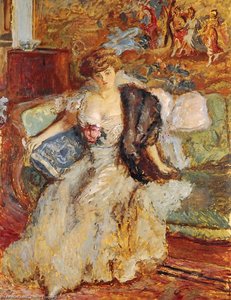
Pierre Bonnard’s “The Window,” painted in 1925, isn't merely a depiction of a domestic scene; it’s an exquisitely rendered meditation on light, memory, and the quiet beauty of everyday life. Housed within the Tate Gallery in London, this oil-on-canvas masterpiece invites us into a world of muted colors, subtle shifts in tone, and a profound sense of contemplative stillness. Bonnard, a key figure in the Nabis movement—a group of artists who sought to break from academic traditions and explore subjective experience—crafted “The Window” with a deliberate focus on capturing the *feeling* of a moment rather than a photographic representation.
Bonnard’s artistic journey was marked by a constant exploration of color and form. Initially influenced by Paul Gauguin's bold use of pigment and Japanese prints, he gradually developed his own distinctive style—characterized by flattened perspectives, simplified forms, and an almost obsessive attention to the interplay of light and shadow. “The Window” exemplifies this approach perfectly. The scene unfolds within a modestly furnished room, dominated by a large window that serves as both a visual anchor and a source of profound atmospheric effect. Notice how Bonnard doesn’t strive for realistic representation; instead, he uses color—a delicate blend of blues, greens, yellows, and browns—to evoke the *impression* of light filtering through the glass, casting soft shadows across the table and illuminating the objects within.
A Symphony of Color and Light
Bonnard’s technique is remarkably subtle yet powerfully effective. He employs a broken brushstroke, layering colors in thin washes to create a sense of depth and luminosity. The light itself isn't sharply defined; it’s diffused and atmospheric, suggesting a hazy afternoon or the gentle glow of twilight. Observe how he uses complementary colors—such as blue and orange—to heighten the visual impact and create a dynamic tension within the composition. The arrangement of objects on the table – books, bottles, and a vase – is deliberately understated, serving primarily to frame the window and contribute to the overall sense of tranquility. It’s not about showcasing possessions; it's about capturing the *feeling* of being present in that space.
The painting’s historical context is crucial to understanding its significance. “The Window” was created during a period of personal upheaval for Bonnard, as he and his wife, Marthe de Méligny, were navigating an increasingly complex relationship. Despite the potential for emotional turmoil, Bonnard managed to imbue this scene with a remarkable sense of serenity and intimacy. The woman seated at the window—her face partially obscured by shadow—appears lost in thought, seemingly detached from the world outside. This suggests a state of introspection or perhaps a longing for something beyond the confines of the room.
Symbolism and Emotional Resonance
While Bonnard’s work is often characterized by its apparent simplicity, “The Window” is rich with symbolic meaning. The window itself represents a portal—a connection between the interior world of the subject and the external environment. It also symbolizes memory and reflection, as the woman's gaze seems to be directed inward, contemplating her past or perhaps anticipating the future. The books on the table could represent knowledge, wisdom, or simply the comfort of familiar companions. The bottles might hint at a shared moment of relaxation or contemplation.
Ultimately, “The Window” is more than just a painting; it’s an invitation to slow down and appreciate the beauty of the ordinary. It's a testament to Bonnard’s ability to capture the essence of human experience—the quiet moments of reflection, the subtle shifts in light and color, and the enduring power of memory. Reproductions of this work offer a remarkable opportunity to bring this evocative scene into your own home, allowing you to share in its timeless appeal.
Technical Details & Reproduction Considerations
The original painting measures approximately 73 x 92 cm (28.7 x 36.2 inches). Bonnard’s masterful use of color and texture is particularly evident when viewed at close range, revealing the delicate layering of brushstrokes that create such a luminous effect. When considering reproductions, it's important to select high-quality prints that accurately capture the nuances of Bonnard’s palette and technique. Archival inks and fine art paper are essential for ensuring long-lasting color fidelity and preventing fading or discoloration.
ArtsDot offers meticulously crafted hand-painted reproductions of “The Window” in a variety of sizes and formats, allowing you to experience the beauty of this iconic artwork in your own space. Our skilled artists carefully replicate Bonnard’s unique style, ensuring that each reproduction is a faithful representation of the original masterpiece.
Œuvres apparentées


Biographie de l'artiste
Premières années et formation
Pierre Bonnard, né à Fontenay-aux-Roses le 3 octobre 1867, a grandi dans un environnement privilégié grâce à la position de son père au sein du ministère de la Guerre. Son enfance fut marquée par une alternance entre Fontenay-aux-Roses et la propriété familiale du Grand-Lemps en Isère. Il manifeste très tôt des talents pour le dessin et l'aquarelle, ainsi qu’un penchant pour les caricatures. Malgré les aspirations de son père à ce qu'il suive une carrière dans la fonction publique, Bonnard choisit de se consacrer à l'art. Il étudie le droit pour satisfaire sa famille, mais s'inscrit également à l'Académie Julian où il rencontre des artistes qui deviendront ses amis et collaborateurs, tels que Paul Sérusier, Maurice Denis et Édouard Vuillard.L’influence des Nabis et les premières œuvres
Au début des années 1890, Bonnard s'engage dans le mouvement des Nabis (le mot hébreu signifiant "prophètes"), un groupe d'artistes avant-gardistes qui cherchaient à renouveler la peinture. Influencé par l’art japonais et les estampes, il explore une esthétique décorative et stylisée. Ses premières œuvres, comme « Femme au carnet » (1890), témoignent de cette influence japonaise et d'une recherche de simplification des formes et de couleurs vives. Il participe activement aux expositions du Salon des Indépendants et collabore avec la revue *La Revue Blanche*, illustrant ses pages avec Vuillard, contribuant ainsi à diffuser les idées novatrices du groupe.L’intimisme et les scènes domestiques
À partir du tournant du siècle, Bonnard se consacre principalement aux scènes intimes de la vie quotidienne. Il préfère peindre d'après mémoire plutôt que sur le motif, ce qui confère à ses œuvres une atmosphère onirique et personnelle. Ses tableaux représentent souvent sa femme, Marthe de Meligny, ainsi que des moments simples comme les repas, les bains ou les promenades dans le jardin. Cette focalisation sur l’intimité et la vie domestique lui vaut d'être qualifié d'"intimist". Il utilise une palette chromatique riche et vibrante pour traduire ses émotions et créer une ambiance particulière.Évolution du style et reconnaissance tardive
Au fil des années, le style de Bonnard évolue vers une plus grande liberté dans l’utilisation de la couleur et une simplification progressive des formes. Il s'installe à Vernonnet en 1912, où il découvre un paysage luxuriant qui devient une source d'inspiration constante. Son amitié avec Claude Monet, son voisin, influence sa perception de la lumière et de la nature. Bien que reconnu par quelques critiques dès le début de sa carrière, Bonnard connaît une reconnaissance plus large dans les années 1920. Il continue à peindre jusqu’à la fin de sa vie, laissant derrière lui un œuvre considérable qui témoigne d'une sensibilité unique et d'un talent exceptionnel pour capturer l'essence de l'intimité et de la beauté du quotidien. Il décède le 23 janvier 1947 à Le Cannet, laissant une rétrospective posthume organisée par le Museum of Modern Art à New York en 1948.Héritage et importance historique
Pierre Bonnard est aujourd'hui considéré comme l’un des maîtres du Post-Impressionnisme et un précurseur de l'art moderne. Son œuvre, caractérisée par sa palette chromatique audacieuse, son atmosphère intime et sa sensibilité poétique, a influencé de nombreux artistes. Il a su créer un univers pictural unique où la couleur est reine et où les émotions sont subtilement traduites. Son approche personnelle et intuitive de la peinture en fait une figure majeure de l'histoire de l'art du XXe siècle.
Pierre Bonnard
1867 - 1947 , France
En bref
- Artistes Influents:
- Paul Gauguin
- Édouard Vuillard
- Hokusai
- Date De Décès: 23 janvier 1947
- Date De Naissance: 3 octobre 1867
- Influences Artistiques:
- Impressionnisme
- Symbolisme
- Lieu De Naissance: Fontenay-aux-Roses, France
- Mouvement Artistique: Post-Impressionnisme, Nabi
- Nationalité: Française
- Nom Complet: Pierre Bonnard
- Œuvres Notables:
- Femme à la robe à carreaux
- L'Arbre aux amandes en fleurs
Articles connexes

L'Impressionnisme et le Post-Impressionnisme : Une Évolution Artistique Française
Explorez l'évolution de l'impressionnisme et du post-impressionnisme : histoire, artistes clés (Monet, Van Gogh…), techniques et héritage. Un guide expert pour les passionnés d'art.

L'Impressionnisme : Une Révolution de la Lumière et de la Couleur qui a Changé l'Histoire de l'Art
Explorez l'histoire fascinante de l'impressionnisme ! Découvrez les artistes clés, les techniques révolutionnaires et l'héritage durable de ce mouvement artistique majeur. Expertise .

Manuel Benedito Vives: A Study of Light, Color & Emotional Resonance in Contemporary Spanish Painting
Explore the captivating world of Manuel Benedito Vives, a celebrated Spanish painter influenced by Sorolla. Discover his masterful portraits, luminous landscapes & enduring legacy – a favorite of the Spanish Royal Family. Art collectors will appreciate this in-depth study.

Anna Ancher: Capturing Light & Domesticity in the Skagen Tradition
Discover Anna Ancher (1859-1935), a leading figure of the Skagen Painters. Explore her captivating depictions of domestic life, masterful use of light, and lasting legacy in Danish Impressionism. Learn more at ArtsDot.
Les 10 Chefs-d'œuvre à l'Huile qui ont Révolutionné l'Art |
Plongez dans l'univers des 10 chefs-d'œuvre à l'huile qui ont marqué l'histoire de l'art ! Découvrez les secrets de Van Gogh, Monet, Rembrandt et autres artistes emblématiques. Trouvez l'inspiration déco & achetez des reproductions de qualité sur .