

 Aperçu en situation
 Envoyer
 Partager
 Détails de l'œuvre
 Guide
Guide

 Télécharger l'image
 Articles similaires
 Radiographie
 Diaporama
 Questions et réponses
 Statistiques
Telecommunications

- 52.0 x 65.0 cm


 Lire la suite
Giclées et impressions d'art
Impressions giclées ou sur toile de qualité musée, avec une production rapide et des finitions au choix. ( Commander la reproduction peinte à la main Passer au format numérique)




P118B €10

P118H €10

P118W €10

P438Z €10

P508JH €12

P508YH €12

P805H €10

P805Z €10

P919BZ €10

P919G €10

P919XJ €10

P959ZH €10

P968JZ €12

W106C €8

W218G €10

W218JH €8

W218Y €10

W307PJ €10

W316G €10

W316PJ €8

W316Y €10

W398PJ €8

W4111J €10

W500HY €15

W500JH €15

W692G €12

W849H €8

W940BG €15

W953PJ €8




Choisissez parmi nos formats prédéfinis qui respectent les proportions originales de l’œuvre.

Saisissez la largeur et la hauteur souhaitées pour qu'elles s'adaptent à votre cadre ou à votre mur. Une impression peut être recadrée, mais jamais agrandie au-delà de l'image originale ; ainsi, un format de forme différente entraînera la perte d'une partie de l'image. Nous vous envoyons une maquette numérique pour approbation avant toute impression. L'image présentée sur cette page ne montre pas le recadrage réel — seule la maquette le permet.
Livraison dans le monde entier () en 2 semaines au lieu des 4/5 semaines habituelles. (4 novembre)

Livraison express gratuite dans le monde entier

Toile de lin de qualité supérieure

Assurance transport complète

Garantie de remboursement des droits de douane

Garantie de fidélité des couleurs

Politique de retour de 100 jours (uniquement en cas de défaut)

Garantie de remboursement à 100%

Offre de tarifs dégressifs
 L'option verre n'est disponible que pour les dimensions inférieures à 110 cm.

Telecommunications
Giclées et impressions d'art
Format de la reproduction
-


Prix total
€ 56
A Static Symphony: Unpacking Paul Nash's "Telecommunications"
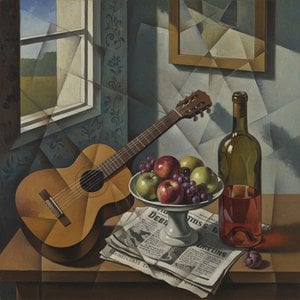
Paul Nash’s 1934 painting, “Telecommunications,” isn’t merely a still life; it’s a carefully constructed visual argument about the burgeoning anxieties and promises of modernity. Rendered in a restrained palette of greys, blacks, whites, and muted reds – colors that evoke both industrial austerity and a subtle, melancholic beauty – the work immediately draws the viewer into a world where familiar objects are fractured, rearranged, and imbued with an unsettling sense of detachment. It’s a piece that speaks volumes about the era's fascination with technology while simultaneously hinting at its potential to alienate us from nature and ourselves.
The composition itself is deliberately asymmetrical, creating a dynamic tension that mirrors the rapid changes occurring in society during the 1930s. A table dominates the foreground, supporting a bowl, an apple (a potent symbol of temptation and knowledge), and a draped cloth – objects rendered with a Cubist sensibility; their forms are broken down into geometric shapes, overlapping and receding from view as if viewed through a distorted lens. The central element, a towering telecommunications tower, acts as both the focal point and the unsettling anchor of the piece. It’s not depicted realistically but rather as a rigid, almost menacing structure, its sharp angles cutting across the otherwise muted tones.
Cubism Meets Constructivism: A Hybrid Style
Nash's style is a fascinating blend of Cubist and Constructivist influences. The fragmentation of forms, reminiscent of Picasso and Braque, is combined with a deliberate emphasis on geometric shapes – rectangles, triangles, and lines – echoing the principles of Constructivism, which sought to reduce art to its essential elements. This fusion creates an image that feels both familiar and strangely alienating, reflecting the anxieties of a world grappling with rapid industrialization and technological advancement. The flattened perspective, characteristic of Cubism, further contributes to this sense of detachment, as if the objects are suspended in a timeless void.
The technique employed is remarkably controlled. Nash utilizes a brushstroke-based approach, creating a surface that appears smooth and almost graphic. However, closer inspection reveals subtle variations in texture and tone, suggesting a deliberate layering of paint – a testament to his skill as a painter. The limited color palette reinforces the painting’s overall mood, contributing to its sense of quiet intensity and underlying unease. The choice of materials—likely oil paints on canvas or board—adds to the work's durability and timeless quality.
Echoes of Blake and the British Landscape
To understand Nash’s artistic vision fully, it’s crucial to consider his early influences. Like William Blake before him, Nash was deeply fascinated by mythology and folklore, often incorporating symbolic elements into his work. His childhood spent in Buckinghamshire instilled a profound love for the English landscape, particularly ancient burial mounds and Iron Age hill forts – motifs that frequently appear in his paintings. “Telecommunications” can be interpreted as a meditation on this relationship between the natural world and the encroaching forces of modernity. The tower, a symbol of technological progress, stands in stark contrast to the implied tranquility of the surrounding landscape, suggesting a potential loss or disruption of connection.
A Timeless Reflection: Reproduction Possibilities
Reproductions of “Telecommunications” offer a remarkable opportunity to bring this evocative artwork into your home or office. ArtsDot’s high-quality reproductions capture the painting's nuanced details and atmospheric mood with exceptional fidelity. Whether you choose a canvas print, a framed giclée, or a metal print, you can experience the power of Nash’s vision firsthand. This piece is more than just decoration; it’s a conversation starter – a visual reminder of our complex relationship with technology and the enduring beauty of the natural world. Consider this artwork as an investment in both artistic appreciation and a thoughtful reflection on the modern condition.
Questions et réponses
Quelle est la technique utilisée pour "Telecommunications" et quel en est le style ?
Dans « Telecommunications », la technique du Oil On Canvas rencontre le mouvement Cubism.
Quelle est la taille d'impression recommandée pour «Telecommunications» de Paul Nash ?
La taille d'impression recommandée pour «Telecommunications» de Paul Nash est Medium.
Quel est le rapport entre le sujet de « Telecommunications » et les thèmes habituels de Paul Nash ?
Parmi les thèmes récurrents de Paul Nash — war propaganda imagery, symbolic british art, early modernist style, cubism & constructivism, geometric abstraction, early 20th century art, modernity & technology, industrial age concerns — « Telecommunications » met l'accent sur geometric abstraction, modern composition, minimalist still life, cubist forms, abstract objects, graphic design art, 20th century art.
Œuvres similaires


Biographie de l'artiste
Première Vie et Influences
- Né : Kensington, Royaume-Uni (1889)
- Décédé : 1946
- Paul Nash est né le 11 mai 1889 à Londres. Son père, William Harry Nash, était avocat et sa mère, Caroline Maude, présentait des signes de maladie mentale dès son plus jeune âge. La famille déménagea à Iver Heath, Buckinghamshire, lorsque Paul était jeune, un déménagement destiné à améliorer la santé de sa mère.
- Formation : Il fréquenta la Parsons School of Art puis la Slade School of Fine Art. Bien qu'il fût compétent en peinture de paysage, il avait du mal avec le dessin de figures.
- Influences initiales : Nash fut fortement influencé par William Blake et J.M.W. Turner, ce qui se reflète dans ses premières œuvres. Il puisait également son inspiration dans des paysages présentant des éléments historiques anciens tels que les tumulus funéraires et les forts de l'âge du fer.
Style Artistique et Développement
- Style : Le style de Paul Nash mêlait le modernisme aux techniques traditionnelles. Il utilisait des couleurs vives, des formes géométriques et des formes abstraites, ce qui le distinguait de ses contemporains.
- Influences surréalistes : Bien qu'il ne soit pas strictement un surréaliste, Nash fut influencé par ce mouvement, en particulier après avoir vu une exposition de Giorgio de Chirico en 1928. Son œuvre incorporait des paysages symboliques avec des objets du quotidien.
- Art de guerre : Pendant la Première et la Seconde Guerre mondiale, Nash a servi d'artiste de guerre officiel. Ses représentations des champs de bataille étaient remarquables pour leur beauté poignante et leur exploration de l'impact du conflit sur le paysage. Œuvre notable : "The Menin Road".
- "Créatures aériennes" : Une série produite pendant la Seconde Guerre mondiale présentant des représentations anthropomorphes d'avions en panne dans des paysages, démontrant son style et sa symbolique en évolution.
Réalisations Majeures et Reconnaissance
- Pionnier du modernisme britannique : Nash a joué un rôle crucial dans la formation de l'art moderne britannique, reliant la peinture traditionnelle de paysage à l'esthétique moderniste.
- Héritage artistique de guerre : Ses peintures de guerre sont considérées comme des représentations emblématiques de l'impact du conflit sur les soldats et l'environnement.
- Groupe Unit One : Il a cofondé Unit One en 1933 avec Ben Nicholson et Barbara Hepworth, un groupe important au sein de la scène artistique britannique.
- Écrivain et designer : Au-delà de la peinture, Nash était également un écrivain respecté sur l'art et concevait des arts appliqués tels que des décors de théâtre, des tissus et des affiches.
Influences et Héritage
- Influence sur les artistes ultérieurs : Le style unique de Nash et son utilisation de la couleur ont influencé des générations d'artistes qui l'ont suivi.
- Connexion au romantisme : Son œuvre est souvent liée à la tradition romantique anglaise, notamment par sa connexion avec William Blake et J.M.W. Turner.
- Exploration de l'homme contre la nature : Un thème récurrent dans les œuvres ultérieures de Nash était la relation entre l'humanité et la nature, explorée à travers une imagerie symbolique.
- Pertinence continue : Ses peintures continuent d'être célébrées pour leur beauté, leur symbolisme et leur importance historique, restant pertinentes pour le public contemporain.
Expositions et Collections
- Ruskin Gallery : Les œuvres de Nash ont été exposées à la Ruskin Gallery au Royaume-Uni.
- Tate Britain : Ses œuvres se trouvent dans la collection du Tate Britain.
- Imperial War Museum : Plusieurs de ses œuvres d'art de guerre sont conservées à l'Imperial War Museum.
- York Art Gallery : Son œuvre fait également partie de la collection de la York Art Gallery.
- Government Art Collection : Une sélection des œuvres de Nash est exposée dans la Government Art Collection.

Paul Nash
1889 - 1946 , Royaume-Uni
L'essentiel de l'artiste
- Artistes Influencés: ['Artistes modernes']
- Artistes Influents:
- William Blake
- J.M.W. Turner
- Date De Décès: 11 juillet 1946
- Date De Naissance: 11 mai 1889
- Lieu De Naissance: Kensington, Royaume-Uni
- Mouvement Artistique: Modernisme, Surréalisme
- Nationalité: Britannique
- Nom Complet: Paul Nash
- Oeuvres Notables: ['The Menin Road']
Articles connexes
Deconstructing Reality: A Comprehensive Exploration of Cubist Still Life
Explore the revolutionary world of Cubist Still Life with ArtsDot. Discover Picasso & Braque's groundbreaking techniques, its philosophical roots, and lasting impact on modern art. Expert insights for collectors.

Abstraction Géométrique : Les 10 Chefs-d'œuvre qui ont Marqué l'Histoire de l'Art
Plongez au cœur de l'abstraction géométrique avec ArtsDot.com ! Découvrez les 10 œuvres majeures de Mondrian, Malevitch et Kandinsky qui ont révolutionné l'art moderne. Inspirez votre décoration intérieure avec des reproductions de tableaux exceptionnelles. Explorez la collection en ligne !

Les 25 chefs-d'œuvre de Paul Cézanne : l'architecte de la forme
Explorez les 25 chefs-d'œuvre de Paul Cézanne et l'essence du postimpressionnisme. Découvrez ces trésors sur ArtsDot.com.

L'Âge d'Or Réinventé : Esthétique et Héritage Durable de l'Art Déco
Explorez l'histoire fascinante de l'Art Déco : influences, artistes emblématiques, matériaux luxueux et héritage durable. Découvrez comment ce style révolutionnaire continue d'inspirer le design contemporain.

Maîtriser l'Abstraction : Les 25 Œuvres Incontournables de Paul Klee
Explorez les 25 chefs-d'œuvre de Paul Klee, entre abstraction et lyrisme. Trouvez votre reproduction d'art sur ArtsDot.com.
