


 Aperçu en situation
 Partager
 Partager
 Détails
 Guide imprimable

 Télécharger
 Articles similaires
 Radiographie
 Voir le diaporama
 Statistiques
Conqueror


 Afficher la suite
Giclées et impressions d'art
Impressions giclées ou sur toile de qualité musée, avec une production rapide et des finitions au choix. ( Acheter la peinture faite à la main Passer au format image numérique)




P118B €10

P118H €10

P118W €10

P438Z €10

P508JH €12

P508YH €12

P805H €10

P805Z €10

P919BZ €10

P919G €10

P919XJ €10

P959ZH €10

P968JZ €12

W106C €8

W218G €10

W218JH €8

W218Y €10

W307PJ €10

W316G €10

W316PJ €8

W316Y €10

W398PJ €8

W4111J €10

W500HY €15

W500JH €15

W692G €12

W849H €8

W940BG €15

W953PJ €8




Choisissez parmi nos formats prédéfinis qui respectent les proportions originales de l’œuvre.

Vous pouvez saisir vos propres dimensions pour vous adapter à un cadre ou à un espace spécifique. Si la taille sélectionnée ne correspond pas aux proportions de l'image originale, nous recadrerons l'œuvre ou étendrons l'image avec une bordure en miroir ou une couleur unie. Une maquette numérique vous sera envoyée pour approbation avant le début de la production.
Veuillez noter que l'aperçu à l'écran ne reflète pas le recadrage ou l'extension réelle. Seule la maquette montrera avec précision la composition finale.
Bien que des tailles personnalisées soient disponibles, nous vous recommandons de choisir une dimension dans la liste prédéfinie afin de préserver les proportions originales.
Livraison dans le monde entier () en 2 semaines au lieu des 4/5 semaines habituelles. (10 octobre)

Livraison express gratuite dans le monde entier

Toile de lin de haute qualité

Assurance transport complète

Garantie de remboursement des droits de douane

Garantie de fidélité des couleurs

Garantie de retour de 100 jours (uniquement en cas de défaut)

Garantie de remboursement à 100%

Tarifs dégressifs sur quantité
 L'option verre n'est disponible que pour les dimensions inférieures à 110 cm.

Conqueror
Giclées et impressions d'art
Format de la reproduction
-


Prix total final
€ 53
A Symphony of Geometric Forms: The Soul of Paul Klee’s “Conqueror”
In the vast landscape of twentieth-century abstraction, few works possess the rhythmic tension and symbolic depth found in Paul Klee’s 1937 masterpiece, “Conqueror.” To encounter this painting is to step into a realm where the boundaries between music and vision dissolve, leaving behind a visual melody composed of sharp edges and vibrant hues. Klee, a master who viewed the canvas as a stage for cosmic movement, presents us with a narrative that feels both ancient and avant-garde. At its heart, the work depicts a solitary figure poised with a bow and arrow, standing in defiant confrontation against a monumental cube. This is not merely a depiction of a hunter; it is an exploration of the human spirit’s encounter with the overwhelming, structured forces of existence.
The composition is a masterclass in balanced tension. Klee utilizes a tripartite arrangement, placing the central figure before a colossal geometric monolith, flanked by two smaller cubes that anchor the scene. This deliberate structuring creates a sense of contained energy, as if the very air around the figure is vibrating with the potential for action. The figure’s posture, bolstered by a shield visible upon his back, speaks to a profound resilience—a visual metaphor for the courage required to face life's most daunting obstacles. For the collector or interior designer, this piece offers a sophisticated focal point that commands attention through its structural integrity and its ability to anchor a room with both weight and whimsy.
The Alchemy of Color and Expressionist Technique
Klee’s technique in “Conqueror” eschews the sterile precision often associated with geometric abstraction, opting instead for an expressionist vitality that breathes life into every shape. His brushstrokes are bold and textured, defining the contours of the human form and the massive cubes with a dynamism that suggests movement even within static forms. The artist’s palette is a carefully orchestrated clash of primary energies; vibrant yellows, deep reds, and piercing blues interact to create a visual richness that transcends mere decoration. These colors do not simply sit upon the surface; they evoke an emotional temperature, ranging from the warmth of sunlight to the urgent apprehension of a looming shadow.
This interplay of color and texture invites a tactile engagement with the work. The surface of the painting possesses a rhythmic quality, mirroring Klee’s lifelong fascination with musical arrangement. As one observes the way the light seems to catch the layered pigments, the painting reveals itself as a "visual music"—a term often used by scholars to describe Klee's ability to translate auditory harmony into graphic form. For those seeking to adorn a space with art that inspires deep contemplation, “Conqueror” provides an inexhaustible well of detail, rewarding the eye with new discoveries upon every viewing.
A Legacy of Abstraction for the Modern Collector
Understanding “Conqueror” requires acknowledging the historical weight Klee carried during its creation. Painted in 1937, a period of immense global upheaval, the painting’s themes of confrontation and protection resonate with a timeless psychological truth. Klee, a Swiss-born artist who navigated the complex movements of Cubism, Surrealism, and Expressionism, had reached a pinnacle of maturity where he could manipulate the most basic elements of art—line, dot, and plane—to communicate the most complex human emotions. The work stands as a testament to his ability to find the "hidden rhythms of the universe" within the simplest of shapes.
Integrating a high-quality reproduction of this masterpiece into a contemporary interior allows for a bridge between historical significance and modern aesthetic sensibilities. Whether placed in a minimalist gallery setting or a richly textured study, “Conqueror” brings with it an aura of intellectual depth and artistic prestige. It is more than a painting; it is an invitation to witness the triumph of form over chaos, making it an essential acquisition for anyone dedicated to the enduring power of fine art.
Questions et réponses
Puis-je commander une reproduction à l'huile de « Conqueror » ?
Vous pouvez commander une reproduction peinte à la main de «Conqueror» de Paul Klee directement sur cette page : une reproduction à l'huile peinte à la main sur toile de lin, réalisée sur commande.
Quel emplacement convient au format de «Conqueror» de Paul Klee ?
Le format (Portrait) et l'espace recommandé (Living Room) sont les deux caractéristiques de disposition enregistrées pour «Conqueror» de Paul Klee.
Qui a créé "Conqueror" ?
« Conqueror » est attribué à Paul Klee.
Comment puis-je obtenir une impression de «Conqueror» de Paul Klee ?
Une impression de «Conqueror» de Paul Klee peut être commandée directement sur cette page : une impression d'art sur toile de coton ou sur papier canvas d'archive.
Les couleurs de « Conqueror » paraissent-elles vives ou douces ?
«Conqueror» de Paul Klee présente une intensité de couleur Vivid.
Comment le style de « Conqueror » s'inscrit-il dans l'époque de son créateur ?
« Conqueror » appartient au mouvement Expressionist Abstraction, et son créateur a œuvré à l'époque Époque moderne.
Comment peut-on intégrer «Conqueror» de Paul Klee dans la décoration intérieure ?
«Conqueror» de Paul Klee est recommandé pour Accent, idéalement dans une Living Room. L'usage et l'espace permettent de déterminer où placer une reproduction.
Œuvres similaires


Biographie de l'artiste
Paul Klee : Une Vie en Couleur et en Forme
Jeunesse et Éducation
- Paul Klee est né le 18 décembre 1879 à Münchenbuchsee, en Suisse.
- Son père était professeur de musique allemand, et sa mère était chanteuse suisse, favorisant ainsi une appréciation précoce pour les arts.
- Klee a initialement poursuivi le dessin mais a finalement abandonné la représentation réaliste au profit de formes plus expressives.
- Il a étudié à l'Académie des Beaux-Arts de Munich entre 1898 et 1901.
Développement Artistique et Influences
- Les premières œuvres de Klee témoignent d'influences de l'Art Nouveau et du Symbolisme, mais il a rapidement commencé à développer son style unique.
- Un voyage déterminant en Tunisie en 1914 a profondément influencé son utilisation de la couleur et de l'abstraction – la lumière et l'atmosphère ont inspiré un passage vers des palettes plus audacieuses.
- Il a été profondément influencé par les mouvements tels que l'Expressionnisme, le Cubisme et le Surréalisme, bien qu'il ne s'aligne jamais pleinement sur l'un d'eux.
- Son intérêt pour la musique a fortement influencé son approche artistique, le comparant souvent à la composition de pièces musicales.
Les Années Bauhaus et Au-Delà
- De 1931 à 1933, Klee enseignait à l'école influente Bauhaus d'art, de conception et d'architecture aux côtés de Wassily Kandinsky.
- Cette période a vu une floraison de son travail abstrait, explorant la théorie des couleurs et les relations formelles.
- Avec la montée du nazisme en Allemagne, Klee a été renvoyé de Bauhaus en 1933 en raison de son « art dégénéré ».
- Il est retourné en Suisse et a continué à peindre, mais sa santé s'est détériorée pendant cette période.
Thèmes Majeurs et Style Artistique
- L'œuvre de Klee se caractérise par une exploration ludique mais profonde de la couleur, de la ligne et de la forme.
- Il employait souvent des images enfantines et des compositions fantaisistes, imprégnées de sens symbolique.
- Des thèmes récurrents incluent les jardins, les paysages, les portraits et les arrangements abstraits.
- Ses « Carnets de Paul Klee », publiés posthume, révèlent ses recherches théoriques approfondies sur la couleur et la conception.
Héritage et Importance Historique
- Paul Klee est décédé le 29 juin 1940 à Muralto, en Suisse.
- Il est considéré comme l'un des artistes les plus importants du XXe siècle, reliant la figurative et l'abstraction.
- Son utilisation innovante de la couleur et ses écrits théoriques continuent d'inspirer les artistes et les designers aujourd'hui.
- L'œuvre de Klee est très recherchée par les collectionneurs et les musées du monde entier, consolidant ainsi sa place en tant que figure emblématique de l'histoire de l'art moderne.

Paul Klee
1879 - 1940 , Suisse
En bref
- Artistes Influents: ['Wassily Kandinsky']
- Date De Décès: 29 juin 1940
- Date De Naissance: 18 décembre 1879
- Lieu De Naissance: Münchenbuchsee, Suisse
- Nationalité: Suisse-Allemande
- Nom Complet: Paul Klee
- Oeuvres Notables:
- À Parnasse
- Rythmes Rougevert et Violet-Jaune
- Nuages sur Bor
- Le Festival des Astres
- Contemplation
- Siblings
- Lettre Fantôme
- Style Artistique: Expressionnisme, Cubisme, Surréalisme
Articles similaires

Paul Klee : Les 25 Œuvres Maîtresses d'un Génie de la Couleur | ArtsDot
Plongez dans l'univers coloré de Paul Klee ! Découvrez les 25 œuvres maîtresses du peintre suisse, figures clés de l'art abstrait et du Bauhaus. Inspirez votre décoration intérieure avec ArtsDot.com – reproductions de qualité muséale & collection exclusive.

Paul Cézanne : Les 25 Œuvres Maîtresses d'un Génie Révolutionnaire | ArtsDot
Plongez dans l'univers de Paul Cézanne avec les 25 œuvres incontournables du maître post-impressionniste. Découvrez l'histoire, la technique et l'émotion derrière ses tableaux iconiques comme 'Les Baigneuses' ou 'Mont Sainte-Victoire'. Reproductions d'art haute qualité sur ArtsDot.com.

Abstraction Géométrique : Les 10 Chefs-d'œuvre qui ont Marqué l'Histoire de l'Art
Plongez au cœur de l'abstraction géométrique avec ArtsDot.com ! Découvrez les 10 œuvres majeures de Mondrian, Malevitch et Kandinsky qui ont révolutionné l'art moderne. Inspirez votre décoration intérieure avec des reproductions de tableaux exceptionnelles. Explorez la collection en ligne !

Beyond Form & Color: Geometric Abstraction's Evolution in 20th/21st Century Art
Explore the evolution of geometric abstraction from Cubism to contemporary art. Discover key artists like Malevich & Mondrian, investment insights, and expert collecting advice at ArtsDot.
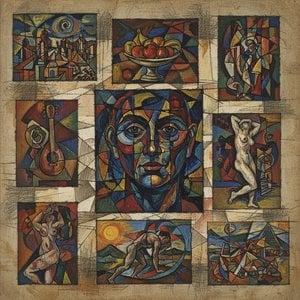
Cubisme Expressionniste : Les 10 Chefs-d'œuvre Révolutionnaires à Redécouvrir
Plongez au cœur du Cubisme Expressionniste ! Découvrez les 10 chefs-d'œuvre de Picasso, Braque et autres artistes majeurs. Histoire, techniques & émotions : trouvez l’inspiration déco sur ArtsDot.com


