


 Aperçu en situation
 Partager
 Partager
 Détails
 Guide imprimable

 Télécharger
 Articles similaires
 Radiographie
 Voir le diaporama
 Statistiques
La Naissance de Marie


 Afficher la suite
Reproduction à l'huile faite à la main
Huile sur toile peinte à la main, avec cadre et dimensions personnalisés, réalisée sur commande par nos artistes. ( Passer au format impression Passer au format image numérique)




P118B $10

P118H $10

P118W $10

P438Z $10

P508JH $12

P508YH $12

P805H $10

P805Z $10

P919BZ $10

P919G $10

P919XJ $10

P959ZH $10

P968JZ $12

W106C $8

W218G $10

W218JH $8

W218Y $10

W307PJ $10

W316G $10

W316PJ $8

W316Y $10

W398PJ $8

W4111J $10

W500HY $15

W500JH $15

W692G $12

W849H $8

W940BG $15

W953PJ $8




Choisissez parmi nos formats prédéfinis qui respectent les proportions originales de l’œuvre.

Vous pouvez saisir vos propres dimensions pour l'adapter à un cadre ou à un espace spécifique. Si la taille sélectionnée ne correspond pas aux proportions de l'image d'origine, nous recadrerons l'œuvre ou prolongerons la peinture avec des éléments peints à la main supplémentaires. Une maquette numérique vous sera envoyée pour approbation avant le début de la production.
Veuillez noter que l'aperçu à l'écran ne reflète pas le recadrage ou l'extension réels. Seule la maquette montrera fidèlement la composition finale.
Bien que des tailles personnalisées soient disponibles, nous vous recommandons de sélectionner une dimension dans la liste prédéfinie afin de préserver les proportions d'origine.
Après la commande, l’équipe ArtsDot.com contactera le client par e-mail pour recueillir ses instructions et lui fournira une maquette d’aperçu
Livraison dans le monde entier () en 3 à 4 semaines au lieu des 5 semaines habituelles. (25 septembre). Aucun compromis sur la qualité.

Livraison express gratuite dans le monde entier

Toile de lin de haute qualité

Assurance transport complète

Garantie de remboursement des droits de douane

Garantie de fidélité des couleurs

Garantie de retour de 100 jours (uniquement en cas de défaut)

Garantie de remboursement à 100%

Tarifs dégressifs sur quantité
 L'option verre n'est disponible que pour les dimensions inférieures à 110 cm.

La Naissance de Marie
Technique de reproduction
Format de la reproduction
-


Prix total final
$ 263
Birth Of The Virgin
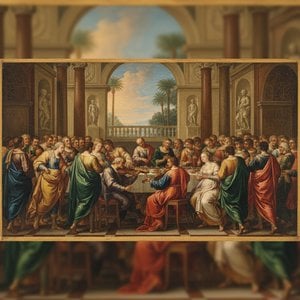
The Birth of the Virgin stands as a cornerstone of Early Renaissance art, embodying Paolo Uccello’s groundbreaking approach to perspective and establishing his distinctive visual language. Created in Florence around 1435, this monumental fresco adorning the Cappella Maggiore of Siena Cathedral transcends mere depiction; it's an intellectual triumph—a testament to Uccello’s unwavering dedication to mastering mathematical principles that govern spatial representation.
Introduction to Paolo Uccello and the Early Renaissance Movement
Paolo Uccello (1397-1475), born Paolo di Dono, was more than just a painter; he was a mathematician obsessed with unlocking the secrets of visual perception. His relentless pursuit of the vanishing point—a feat previously unattainable—fueled his artistic endeavors and propelled him to the forefront of the Early Renaissance movement. Influenced by Gothic architecture and sculpture, Uccello sought to elevate painting beyond mere imitation of nature, aiming instead for an illusionistic representation that captured the essence of depth and space.
The Painting's Composition and Style
The fresco’s composition is remarkably complex, utilizing a central perspective system—a technique pioneered by Uccello—that dramatically alters our perception of the scene. Observe how figures appear to recede into the background, creating an immersive experience for the viewer. The vibrant colors employed – predominantly reds, blues and golds – contribute to the painting’s grandeur and convey a sense of solemn reverence. Notably, Uccello's meticulous attention to detail—from the drapery folds to the facial expressions—reflects his mastery of artistic technique.
Historical Context and Artistic Significance
Painted during a period marked by significant cultural transformations in Italy – fueled by burgeoning humanist thought and papal patronage – The Birth of the Virgin exemplifies the spirit of its time. It reflects the ambition to portray biblical narratives with unprecedented realism, aligning with the broader Renaissance fascination for classical ideals and scientific observation. Siena Cathedral itself serves as a repository of artistic treasures from this era, showcasing Uccello’s legacy alongside masterpieces by Giotto and Simone Martini.
Notable Details & Symbolism
The scene depicts Mary receiving the announcement of Jesus's birth from Gabriel. The figures are arranged in a carefully calculated manner to emphasize depth and create an illusion of three-dimensionality. The use of geometric forms—particularly circles and squares—underscores Uccello’s mathematical precision, mirroring his belief that art should be grounded in rational principles. Furthermore, the luminous drapery folds contribute to the painting's ethereal atmosphere, conveying a sense of divine grace.
Where to Find More Information
To delve deeper into Paolo Uccello’s artistic achievements and explore his captivating artworks, visit ArtsDot.com for high-quality reproductions and scholarly insights.
Photo Description: The painting is a depiction of the birth of the Virgin Mary. The scene shows several people gathered around a bed where Mary is lying down. There are at least 12 people in the painting, including both men and women. Some of them are standing close to the bed while others are further away. A few individuals can be seen on the left side of the image, with one person closer to the foreground and another two people slightly farther back. On the right side of the image, there is a group of three people, with one person near the center and the other two people positioned towards the background. The bed occupies a significant portion of the painting, extending from the left edge to almost the entire width of the image. The people in the scene are engaged in various activities, such as looking at Mary or attending to her needs during this special moment.
Size: Unknown
Date: Unknown
Œuvres similaires


Biographie de l'artiste
jeunesse et formation
Paolo Uccello, né Paolo di Dono, était un peintre et mathématicien italien distingué de Florence. Il est connu pour ses travaux pionniers sur la perspective visuelle dans l’art. Né en 1397, la jeunesse d'Uccello n'est pas bien documentée, mais il est connu qu'il a été apprenti du célèbre sculpteur Lorenzo Ghiberti de 1412 à 1416.carrière et œuvres notables
La carrière d'Uccello s’est étendue sur plus de quatre décennies, au cours desquelles il a produit de nombreux œuvres d’art, notamment des peintures, des fresques et des altarpieces. Certaines de ses œuvres les plus notables comprennent :- La naissance de la Vierge (Renaissance primitive, huile), une peinture présentant son utilisation de la perspective pour créer un sentiment de profondeur.
- Fresques de San Miniato al Monte 03 (Renaissance primitive, huile), une fresque démontrant son utilisation innovante de la couleur et de la lumière.
- Adoration du bambino (Renaissance primitive, huile), une peinture présentant une représentation très détaillée et naturaliste de la forme humaine.
- Studio di cavaliere (Renaissance primitive, huile), un autoportrait présentant son utilisation confiante de sujets autonomes dans l’art.
influence et héritage
Le travail d'Uccello a eu un impact significatif sur le développement de l’art de la Renaissance. Son utilisation de la perspective et son accent sur la création d’un sentiment de profondeur dans ses peintures ont influencé de nombreux artistes, dont Albrecht Dürer, qui était également connu pour son travail pionnier dans le domaine de la perspective. principales mouvements artistiques :- l’art de la Renaissance primitive
- Renaissance italienne
- gothique tardif
- Paolo Uccello (1397-1475)
- Albrecht Dürer (1471-1528)
- Lorenzo Ghiberti (1379-1455)

Paolo Uccello
1397 - 1475 , Italie
En bref
- Artistes Influents:
- Lorenzo Ghiberti
- Donatello
- Date De Décès: 1475
- Date De Naissance: 1397
- Influence Sur Les Artistes: ['Albrecht Dürer']
- Lieu De Naissance: Pratovecchio, Italie
- Mouvement Artistique: Renaissance primitive
- Nationalité: Italienne
- Nom Complet: Paolo Uccello
- Oeuvres Notables:
- La Bataille de San Romano
- Naissance de la Vierge
- Saint Georges et le Dragon
Articles similaires
Paolo Veronese: A Renaissance Master of Color, Composition, and Venetian Splendor
Explore the vibrant world of Paolo Veronese, a Renaissance master renowned for his opulent compositions, masterful use of color, and dramatic Venetian scenes. Discover key artworks & legacy.

Jacob Henricus Maris: A Master of Dutch Atmospheric Realism & the Intimate Landscape
Explore the captivating world of Jacob Henricus Maris, a leading figure of the Dutch Hague School. Discover his atmospheric landscapes, signature brushstrokes & lasting influence on 19th-century art. Learn more at ArtsDot.

Giotto di Bondone : Les 25 Chefs-d'œuvre Incontournables pour Embellir Votre Intérieur
Plongez dans l'univers de Giotto di Bondone : découvrez les 25 fresques et chefs-d'œuvre qui ont révolutionné l'art médiéval italien. Explorez son style unique, ses couleurs vibrantes et l'histoire fascinante derrière chaque œuvre. Retrouvez des reproductions d'exception sur ArtsDot.com.

Paolo Uccello : La Perspective Révolutionnaire et la Quête de Vérité Visuelle dans la Renaissance Italienne
Explorez l'univers fascinant de Paolo Uccello et sa révolution de la perspective linéaire. Découvrez son œuvre unique, son influence sur la Renaissance italienne et les techniques qui ont marqué l'histoire de l'art.

Fra Angelico : Les 25 Chefs-d'œuvre Incontournables pour une Décoration Spirituelle
Plongez dans l'univers spirituel de Fra Angelico avec les 25 œuvres incontournables du maître italien. Découvrez l'histoire, la technique et la beauté intemporelle de ses fresques Renaissance. Reproductions d'art exceptionnelles sur ArtsDot.com.


