


 Aperçu en situation
 Partager
 Partager
 Détails
 Guide imprimable

 Télécharger
 Articles similaires
 Radiographie
 Voir le diaporama
 Statistiques
POEMS IN CURSIVE SCRIPT
 Ming Dynasty Art
 23.0 x 186.0 cm
 Afficher la suite
Giclées et impressions d'art
Impressions giclées ou sur toile de qualité musée, avec une production rapide et des finitions au choix. ( Acheter la peinture faite à la main Passer au format image numérique)




































Choisissez parmi nos formats prédéfinis qui respectent les proportions originales de l’œuvre.

Saisissez la largeur et la hauteur souhaitées pour qu'elles s'adaptent à votre cadre ou à votre mur. Une impression ne peut être que découpée, elle ne peut jamais être agrandie au-delà de l'image originale ; ainsi, un format de forme différente entraînera la perte d'une partie de l'image. Nous vous envoyons une maquette numérique pour approbation avant toute impression. L'image présentée sur cette page ne montre pas le recadrage réel — seule la maquette le permet.
Livraison dans le monde entier () en 2 semaines au lieu des 4/5 semaines habituelles. (24 octobre)

Livraison express gratuite dans le monde entier

Toile de lin de haute qualité

Assurance transport complète

Garantie de remboursement des droits de douane

Garantie de fidélité des couleurs

Garantie de retour de 100 jours (uniquement en cas de défaut)

Garantie de remboursement à 100%

Tarifs dégressifs sur quantité
 L'option verre n'est disponible que pour les dimensions inférieures à 110 cm.

POEMS IN CURSIVE SCRIPT
Giclées et impressions d'art
Format de la reproduction
-


Prix total final
€ 54
Œuvres similaires


Biographie de l'artiste
Ni Yuanlu: A Master of Ming Dynasty Calligraphy and the Echoes of a Turbulent Era
Ni Yuanlu (c. 1593 – 1644), a name often whispered in the halls of Chinese art history, was more than simply a calligrapher and painter; he was a man inextricably linked to the tumultuous final years of the Ming Dynasty. Born Ni Wenzhong in Shangyu, Zhejiang province, his life unfolded against a backdrop of political upheaval, rebellion, and ultimately, tragic suicide – an event that imbued his work with a profound sense of melancholy and quiet dignity. His art, particularly his semicursive script style, offers a poignant window into the era’s anxieties and the artist's own complex character.
Ni’s early life was marked by rigorous study and imperial examinations. He quickly established himself as a skilled scholar and calligrapher, earning the courtesy name Yuru (玉汝) and the art name Hongbao (鴻寶). His training emphasized traditional techniques, but it was his willingness to experiment with form and expression that distinguished him. Unlike many of his contemporaries who adhered rigidly to established conventions, Ni developed a distinctive style characterized by its fluidity, dynamism, and subtle emotional depth. This wasn’t merely aesthetic; it reflected a growing dissatisfaction with the corruption and inefficiency within the Ming court – a sentiment he would later embody in his final act.
The Semicurative Script: A Reflection of Character
Ni Yuanlu's most celebrated achievement lies in his mastery of the semicursive script, or kaishu (楷書). This style, a hybrid between the rigid formality of traditional calligraphy and the looseness of cursive writing, allowed for both precision and expressive freedom. He employed a unique technique – holding the brush at an oblique angle – to create strokes that were simultaneously sharp and graceful, conveying a sense of controlled energy. His work is often described as “angular,” reflecting his personality and the turbulent times he inhabited. Unlike the smoother, more rounded styles favored by some other masters, Ni’s script possessed a certain tension, a feeling of contained force.
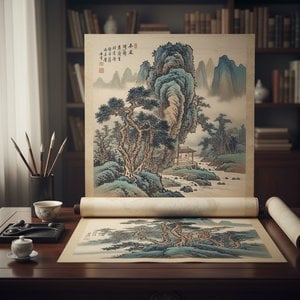
His paintings, frequently executed in monochrome ink wash (guohua), complemented this calligraphic style perfectly. He often depicted landscapes, birds, and flowers – subjects common to Chinese painting – but imbued them with a sense of quiet contemplation and subtle symbolism. A particularly striking example is “Cloud Rock,” where the dynamic brushstrokes capture the essence of a rocky outcrop against a vast expanse of sky, evoking both strength and vulnerability. Similarly, his inscription on a hanging scroll, "Poems in Cursive Script," demonstrates his ability to seamlessly blend calligraphy and painting, creating a unified artistic statement.
A Life Defined by Service and Disillusionment
Ni Yuanlu’s career was marked by a rise through the imperial bureaucracy. He served as a minister of revenue and lecturer to the emperor, gaining recognition for his intelligence and administrative skills. However, he became increasingly disillusioned with the corruption and decadence within the Ming court, particularly under the influence of the powerful eunuch Wei Zhongxian. He was a vocal critic of these abuses, advocating for reform and challenging the established order.
This opposition ultimately led to his tragic demise. As the rebel Li Zicheng seized Beijing in 1644, Ni Yuanlu, along with the emperor, chose to commit suicide rather than surrender to the enemy. This act of defiance – a refusal to compromise one’s principles – cemented his legacy as a symbol of integrity and resistance against tyranny. It's believed that this decision was driven by a deep sense of moral obligation and a profound disappointment in the state of affairs.
Legacy and Historical Significance
Despite his untimely death, Ni Yuanlu’s artistic legacy endures. His work is prized for its technical mastery, emotional depth, and unique stylistic innovations. He stands as a significant figure in Ming Dynasty art, representing a bridge between traditional techniques and a more expressive approach to calligraphy and painting. His life story – one of service, disillusionment, and ultimately, sacrifice – provides a powerful commentary on the political and social turmoil of his era.
Today, Ni Yuanlu’s works are housed in prestigious collections around the world, including the Metropolitan Museum of Art in New York and the Palace Museum in Beijing. His art continues to inspire artists and scholars alike, offering a glimpse into the soul of a man who sought to uphold his principles amidst a period of profound crisis.

Ni Yuanlu
1593 - 1644
En bref
- Full Name: Ni Yuanlu
- Nationality: Chinese
- Date Of Birth: 1593
- Date Of Death: 1644
- Place Of Birth: Shangyu, Zhejiang, China
- Notable Artworks:
- Poems in Cursive Script
- Cloud Rock
- Calligraphy Couplet
- Artistic Movement Or Style: Semicursive script
- Artists Who Influenced This Artist: ['None specified']
- Artists Or Movements Influenced By This Artist: ['None specified']
Articles connexes

Xie Zhiliu: A Legacy of Ink Wash Painting & Modern Chinese Literati Tradition
Explore the legacy of Xie Zhiliu, a master of Chinese ink wash painting & prominent figure in modern art. Discover his techniques, influences, and contributions to literati tradition. A guide for discerning collectors.

Timeless Elegance: Discovering the Soulful Beauty of Chinese Calligraphy for Sophisticated Home Interiors
Elevate your home with the serene beauty of Chinese calligraphy art. Explore our collection of hand-painted ink wash reproductions and bespoke commissions at ArtsDot.com. Discover museum-quality pieces designed to bring cultural elegance and tranquility to your modern interior.

Cy Twombly: Scribbles of Emotion – Deconstructing Post-War Expressionism Through Calligraphy & Abstraction
Explore the captivating world of Cy Twombly with ArtsDot. Discover the emotional depth & artistic significance behind his abstract calligraphy. Expert insights for collectors.

Ink & Inspiration: Discovering Timeless Artworks That Celebrate the Magic of the Written Word
Explore the enchanting intersection of literature and fine art. From ancient manuscripts to Japanese Shodo, discover exquisite hand-painted reproductions that celebrate the magic of writing. Elevate your home with meaningful, museum-quality pieces curated for every history lover.
Pu Xinyu's 'Puru': A Legacy of Literati Painting & Emotional Resonance
Explore the captivating world of Pu Xinyu (Puru), the last great literati painter. Discover his imperial heritage, masterful ink wash techniques & enduring legacy – a valuable addition to any discerning art collection.