


 Aperçu en situation
 Partager
 Partager
 Détails
 Guide imprimable

 Télécharger
 Articles similaires
 Radiographie
 Voir le diaporama
 Statistiques
Untitled 13


 Afficher la suite
L’œuvre d'art présentée sur cette page est protégée par le droit d'auteur, ce qui signifie que nous ne pouvons légalement créer ou vendre de reproduction identique. Cette protection est appliquée en vertu d'accords internationaux tels que la Convention de Berne et par les lois nationales, notamment celles énoncées par le Loi américaine sur le droit d'auteur - Titre 17.
Cette méthode est pleinement conforme aux réglementations sur le droit d'auteur car elle ne repose pas sur la copie ou la duplication de l'œuvre protégée. Il s'agit plutôt d'une réinterprétation créative — une nouvelle peinture qui s'inspire de l'original sans pour autant lui être identique.
Giclées et impressions d'art
Impressions giclées ou sur toile de qualité musée, avec une production rapide et des finitions au choix. ( Acheter la peinture faite à la main Passer au format image numérique)




P118B €10

P118H €10

P118W €10

P438Z €10

P508JH €12

P508YH €12

P805H €10

P805Z €10

P919BZ €10

P919G €10

P919XJ €10

P959ZH €10

P968JZ €12

W106C €8

W218G €10

W218JH €8

W218Y €10

W307PJ €10

W316G €10

W316PJ €8

W316Y €10

W398PJ €8

W4111J €10

W500HY €15

W500JH €15

W692G €12

W849H €8

W940BG €15

W953PJ €8




Choisissez parmi nos formats prédéfinis qui respectent les proportions originales de l’œuvre.

Vous pouvez saisir vos propres dimensions pour vous adapter à un cadre ou à un espace spécifique. Si la taille sélectionnée ne correspond pas aux proportions de l'image originale, nous recadrerons l'œuvre ou étendrons l'image avec une bordure en miroir ou une couleur unie. Une maquette numérique vous sera envoyée pour approbation avant le début de la production.
Veuillez noter que l'aperçu à l'écran ne reflète pas le recadrage ou l'extension réelle. Seule la maquette montrera avec précision la composition finale.
Bien que des tailles personnalisées soient disponibles, nous vous recommandons de choisir une dimension dans la liste prédéfinie afin de préserver les proportions originales.
Livraison dans le monde entier () en 2 semaines au lieu des 4/5 semaines habituelles. (13 octobre)

Livraison express gratuite dans le monde entier

Toile de lin de haute qualité

Assurance transport complète

Garantie de remboursement des droits de douane

Garantie de fidélité des couleurs

Garantie de retour de 100 jours (uniquement en cas de défaut)

Garantie de remboursement à 100%

Tarifs dégressifs sur quantité
 L'option verre n'est disponible que pour les dimensions inférieures à 110 cm.

Untitled 13
Giclées et impressions d'art
Format de la reproduction
-


Prix total final
€ 53
A Symphony of Quietude: Exploring Mark Rothko’s ‘Untitled 13’
This captivating work, designated ‘Untitled 13’, is a quintessential example of Mark Rothko's mature style – a deeply resonant exploration of color and its capacity to evoke profound emotional responses. Created sometime between 1949-1970, it embodies the core tenets of Abstract Expressionism and Color Field painting, movements that redefined American art in the post-war era.Deconstructing the Composition
The canvas is divided into three distinct horizontal bands, a hallmark of Rothko’s later work. These aren't merely blocks of color; they are carefully modulated fields of blue and grey, layered upon one another to create an atmospheric depth. The uppermost band presents a slightly brighter, more saturated blue, its surface alive with visible brushstrokes – evidence of the artist’s physical engagement with the canvas. This vibrancy gradually softens as the eye descends into the middle band, a muted blue-grey that feels almost ethereal in its smoothness. Finally, the composition is grounded by a pale, near-white grey at the bottom, providing a sense of stability and quietude. The absence of defined edges encourages the colors to bleed into one another, fostering a feeling of boundless space.Technique & Materials
Rothko’s technique in ‘Untitled 13’ is characterized by its deliberate simplicity and masterful control of oil paint. He employed layers of thin washes, building up luminosity and subtle tonal variations. The *impasto* brushwork, particularly noticeable in the upper band, adds a tactile quality to the painting, reminding us of its materiality. This isn't about precise representation; it’s about the expressive potential of paint itself – its texture, viscosity, and ability to capture light.Historical Context & Artistic Evolution
Born Marcus Rothkowitz in Latvia in 1903, Rothko immigrated to the United States as a child. His father, Jacob (Yakov) Rothkowitz, was a pharmacist and intellectual who initially provided his children with a secular and political upbringing. Despite Jacob Rothkowitz’s modest income, the family was highly educated (“We were a reading family”, Rothko's sister recalled), and Rothko spoke Lithuanian Yiddish (Litvish), Hebrew and Russian. Following his father’s return to the Orthodox Judaism of his own youth, Rothko, the youngest of four siblings, was sent to the cheder at age five, where he studied the Talmud, although his elder siblings had been educated in the public school system. He learned his fourth language, English, and became an active member of the Jewish community center, where he proved adept at political discussions. By the late 1940s, Rothko had arrived at his signature style: large-scale canvases featuring rectangular blocks of color. This period coincided with a broader shift in American art towards abstraction, as artists sought new ways to express universal human experiences in the wake of World War II. Rothko’s work stands alongside that of Barnett Newman and Clyfford Still as foundational examples of Color Field painting.Symbolism & Emotional Resonance
While Rothko resisted explicit interpretations of his work, it's undeniable that his paintings evoke powerful emotional responses. The large scale encourages viewers to become immersed in the color fields, experiencing them almost physically. ‘Untitled 13’ doesn’t depict a specific subject; rather, it *is* an experience – one of contemplation, serenity, and perhaps even melancholy. The subtle shifts in tone and texture create a sense of ambiguity, allowing each viewer to project their own feelings and associations onto the canvas. Rothko aimed to create paintings that were akin to religious experiences, offering moments of transcendence and self-discovery.Interior Design & Collecting Considerations
The minimalist aesthetic and calming color palette of ‘Untitled 13’ make it a versatile piece for interior design. It would serve as a striking focal point in a modern living room, bedroom, or office space. Its subdued tones complement a variety of décor styles, from Scandinavian minimalism to mid-century modern. As a collectible work by one of the most important artists of the 20th century, owning a high-quality reproduction of ‘Untitled 13’ is an investment in both artistic heritage and aesthetic beauty. It's a piece that invites quiet reflection and adds a touch of intellectual sophistication to any environment.Questions et réponses
Quelle taille est suggérée pour "Untitled 13" dans un(e) Salon ?
Dans une Salon, nous suggérons un format d'impression de Grand format pour « Untitled 13 ».
Quelle place occupe « Untitled 13 » dans l'œuvre de Mark Rothko ?
«Untitled 13» appartient à l'œuvre Expressionnisme Abstrait de Mark Rothko, dont les thèmes récurrents incluent influence de l'expressionnisme abstrait, tradition de la peinture des champs de couleur, art américain de l'après-guerre, thème de la contemplation spirituelle, exploration de la couleur et de la forme, style signature de rothko", héritage de l'installation de la chapelle, profondeur émotionnelle minimaliste".
À quel courant artistique «Untitled 13» de Mark Rothko appartient-il ?
Le mouvement associé à «Untitled 13» de Mark Rothko est Expressionnisme Abstrait. Cette classification situe l'œuvre parmi des artistes et des œuvres d'art apparentés.
Les couleurs de «Untitled 13» de Mark Rothko sont-elles vives ou feutrées ?
La couleur de « Untitled 13 » présente une saturation de Atténué et une intensité de Monochromatique.
À quelle période de la carrière de Mark Rothko se situe « Untitled 13 » ?
« Untitled 13 » représente la période Période Mature de Mark Rothko.
Quelle est la luminosité perçue de «Untitled 13» de Mark Rothko ?
En termes de luminosité perçue, «Untitled 13» de Mark Rothko est éclatant.
L'œuvre « Untitled 13 » est-elle disponible en tirage d'art ?
Une impression de «Untitled 13» de Mark Rothko peut être commandée directement sur cette page : une impression d'art sur toile de coton ou sur papier canvas d'archive.
Puis-je voir une vue aux rayons X de «Untitled 13» de Mark Rothko ?
« Untitled 13 » peut être examiné couche par couche sur la page Rayons X de l'œuvre, un visionneur inspiré d'un banc lumineux de restaurateur proposant onze lectures optiques de l'image.


Biographie de l'artiste
enfance et influences
Mark Rothko (Marcus Rothkowitz), un artiste américain renommé, est né le 25 septembre 1903 à Dvinsk, Lettonie. Sa famille a immigré aux États-Unis lorsqu'il n’avait que dix ans. Ce changement culturel aura influencé plus tard son style artistique.évolution artistique
Le travail précoce de Rothko était caractérisé par l’expressionnisme abstrait, un style qui mettait l’accent sur le processus de création d'une œuvre d'art plutôt que sur le produit final. Ses peintures, telles que No. 18 (1948) et Untitled (1948), mettaient en valeur son approche unique de la couleur et de la forme.- Champ de couleurs : L'utilisation par Rothko de champs de couleurs audacieux et rectangulaires, souvent en contraste saisissant les uns avec les autres, créait une sensation de profondeur et d’émotion.
- Structure organique : Ses peintures semblaient respirer la vie, comme si les couleurs étaient des entités vivantes.
œuvres notables et expositions
- No. 10 (1950), une peinture qui marquait un tournant significatif dans le style de Rothko, est maintenant au sein de la collection du Museum of Modern Art.
- Les Seagram Murals, une série de peintures commandées pour le restaurant Four Seasons, mettait en valeur la capacité de Rothko à adapter son style à différents environnements.
- No. 3 (1950), une peinture qui exemplifie l'utilisation par Rothko de champs de couleurs audacieux et rectangulaires.
vie tardive et héritage
La vie de Rothko a été marquée par des luttes contre la santé mentale et un mariage tumultueux. Il est décédé le 25 février 1970, à l'âge de 66 ans. Malgré ses difficultés, Rothko a laissé une marque indélébile sur le monde de l’art. Ochre et rouge sur rouge (champ de couleurs), une peinture qui met en valeur l'approche unique de Rothko à la couleur, peut être trouvée dans la collection ArtsDot.com. La page Wikipédia de Mark Rothko fournit des informations supplémentaires sur sa vie et son style artistique.
Mark Rothko
1903 - 1970 , Lettonie
En bref
- Artistes Influents:
- Sigmund Freud
- Marcel Proust
- Date De Décès: 25 février 1970
- Date De Naissance: 25 septembre 1903
- Influences Artistiques:
- Minimalisme
- Art contemporain
- Lieu De Naissance: Daugavpils, Lettonie
- Mouvement Artistique: Expressionnisme abstrait
- Nationalité: Américaine
- Nom Complet: Mark Rothko / Marcus Rothkowitz
- Œuvres Notables:
- No. 18 (1948)
- No. 10 (1950)
- Murals Seagram
- White Center (1957)
Articles similaires

Expressionnisme Abstrait : Les 10 Chefs-d'Œuvre Incontournables pour Décorer avec Art et Histoire
Plongez au cœur de l'Expressionnisme Abstrait avec ! Découvrez les 10 œuvres majeures de Pollock, Rothko et De Kooning. Histoire, techniques & inspiration déco. Explorez la collection complète en ligne.
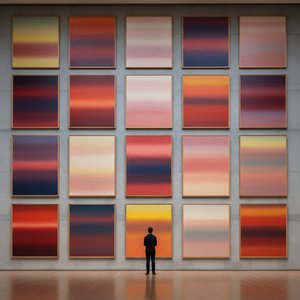
Mark Rothko : Les 25 Œuvres Maîtresses de l'Abstraction Coloriste | ArtsDot
Plongez dans l'univers émotionnel de Mark Rothko avec les 25 œuvres clés du maître de l'abstraction. Découvrez l'histoire, la technique et le pouvoir des couleurs de ces tableaux iconiques. Reproductions d'art de qualité musée sur ArtsDot.com

Les 10 Chefs-d'œuvre Dominés par le Bleu Ardoise : Art, Histoire & Décor
Plongez dans l'univers fascinant des 10 plus beaux tableaux dominés par le bleu ardoise. Découvrez l'histoire, les artistes et les techniques de ces chefs-d'œuvre impressionnistes et contemporains. Inspirez votre décoration intérieure avec !

Serene Blue Backgrounds: Discover Soulful Art to Transform Your Space with Timeless Elegance
Transform your home with soulful blue art. From serene Monet impressions to modern textured sculptures, discover curated masterpieces designed to inspire calm. Explore expert art consultations and bespoke hand-painted reproductions to create your personal sanctuary.

The Sublimity of Color: Exploring the Emotional Landscapes of Mark Rothko's Abstract Expressionism
Explore the profound emotional depth of Mark Rothko's abstract expressionism. Discover the history, techniques & lasting impact of this pivotal Color Field painter. Expert insights for collectors and art enthusiasts.


