


 Aperçu en situation
 Partager
 Partager
 Détails
 Guide imprimable

 Télécharger
 Articles similaires
 Radiographie
 Voir le diaporama
 Statistiques
Untitled (11)


 Afficher la suite
Reproduction à l'huile faite à la main
Huile sur toile peinte à la main, avec cadre et dimensions personnalisés, réalisée sur commande par nos artistes. ( Passer au format impression Passer au format image numérique)




P118B $10

P118H $10

P118W $10

P438Z $10

P508JH $12

P508YH $12

P805H $10

P805Z $10

P919BZ $10

P919G $10

P919XJ $10

P959ZH $10

P968JZ $12

W106C $8

W218G $10

W218JH $8

W218Y $10

W307PJ $10

W316G $10

W316PJ $8

W316Y $10

W398PJ $8

W4111J $10

W500HY $15

W500JH $15

W692G $12

W849H $8

W940BG $15

W953PJ $8




Choisissez parmi nos formats prédéfinis qui respectent les proportions originales de l’œuvre.

Vous pouvez saisir vos propres dimensions pour l'adapter à un cadre ou à un espace spécifique. Si la taille sélectionnée ne correspond pas aux proportions de l'image d'origine, nous recadrerons l'œuvre ou prolongerons la peinture avec des éléments peints à la main supplémentaires. Une maquette numérique vous sera envoyée pour approbation avant le début de la production.
Veuillez noter que l'aperçu à l'écran ne reflète pas le recadrage ou l'extension réels. Seule la maquette montrera fidèlement la composition finale.
Bien que des tailles personnalisées soient disponibles, nous vous recommandons de sélectionner une dimension dans la liste prédéfinie afin de préserver les proportions d'origine.
Après la commande, l’équipe ArtsDot.com contactera le client par e-mail pour recueillir ses instructions et lui fournira une maquette d’aperçu
Livraison dans le monde entier () en 3 à 4 semaines au lieu des 5 semaines habituelles. (25 septembre). Aucun compromis sur la qualité.

Livraison express gratuite dans le monde entier

Toile de lin de haute qualité

Assurance transport complète

Garantie de remboursement des droits de douane

Garantie de fidélité des couleurs

Garantie de retour de 100 jours (uniquement en cas de défaut)

Garantie de remboursement à 100%

Tarifs dégressifs sur quantité
 L'option verre n'est disponible que pour les dimensions inférieures à 110 cm.

Untitled (11)
Technique de reproduction
Format de la reproduction
-


Prix total final
$ 263
Mark Rothko’s Untitled (11): A Meditation on Color and Loss
This arresting artwork, tentatively titled “Untitled (11),” offers a profound glimpse into the heart of Mark Rothko's mature style – a realm where color transcends mere representation to become a vehicle for raw emotion. The composition is deceptively simple: a dominant field of deep blue punctuated by a stark, assertive red line. Yet, within this apparent minimalism lies an intensely layered exploration of themes central to Rothko’s oeuvre—loss, isolation, and the search for spiritual meaning in a world grappling with existential anxieties. The painting's power resides not in its depiction of a recognizable scene but in its ability to evoke a visceral response, inviting viewers into a contemplative space where personal experience and universal human concerns converge.
Color Field Painting and Emotional Resonance
Rothko was a pivotal figure in the development of Color Field painting, a movement that prioritized pure color as its primary subject matter. Unlike earlier abstract expressionists who employed gestural brushstrokes to convey emotion, Rothko utilized large, rectangular blocks of saturated color – often applied with thin, almost translucent layers – to create an immersive and meditative effect. The blue in “Untitled (11)” isn’t a cheerful azure; it's a somber, bruised tone, hinting at melancholy and perhaps even the weight of memory. This deliberate choice of hue is crucial to understanding Rothko’s intent: he sought to bypass the intellect and speak directly to the viewer’s emotions.
- Technique: The application of paint relies on a layering technique, building up color gradually to achieve depth and luminosity.
- Color Theory: Rothko masterfully employs complementary colors (red and blue) to create visual tension and dynamism within the seemingly static composition.
- Scale & Immersion: The large scale of the painting is designed to envelop the viewer, fostering a sense of intimacy and contemplation.
Symbolism and Historical Context
Born in Latvia in 1903, Mark Rothko’s life was marked by displacement and profound personal loss. His early experiences – including his father's death shortly after the family immigrated to Portland – instilled a deep sensitivity to human suffering, a theme that would permeate his work throughout his career. “Untitled (11)” can be interpreted as a visual representation of this ongoing struggle with mortality and the search for solace in the face of overwhelming emotion. The red line, a forceful intrusion into the blue expanse, could symbolize a moment of intense feeling, a flash of memory, or perhaps even a desperate plea for connection.
Created during the mid-1960s, this piece reflects the broader cultural anxieties of the Cold War era and the rise of existentialism. Rothko’s work resonated with a generation grappling with uncertainty and questioning traditional values. The painting's stark simplicity mirrors the minimalist aesthetic that was gaining prominence in design and architecture at the time.
A Legacy of Emotional Intensity
Mark Rothko’s influence on contemporary art is undeniable. His work continues to captivate viewers with its raw emotional power and its exploration of fundamental human concerns. “Untitled (11)” stands as a testament to his mastery of color and composition, offering a poignant reminder of the enduring capacity of art to evoke profound feelings and provoke deep reflection. This hand-painted reproduction captures not just an image but the very essence of Rothko’s artistic vision – a vision that continues to resonate with audiences worldwide.
Œuvres similaires


Biographie de l'artiste
enfance et influences
Mark Rothko (Marcus Rothkowitz), un artiste américain renommé, est né le 25 septembre 1903 à Dvinsk, Lettonie. Sa famille a immigré aux États-Unis lorsqu'il n’avait que dix ans. Ce changement culturel aura influencé plus tard son style artistique.évolution artistique
Le travail précoce de Rothko était caractérisé par l’expressionnisme abstrait, un style qui mettait l’accent sur le processus de création d'une œuvre d'art plutôt que sur le produit final. Ses peintures, telles que No. 18 (1948) et Untitled (1948), mettaient en valeur son approche unique de la couleur et de la forme.- Champ de couleurs : L'utilisation par Rothko de champs de couleurs audacieux et rectangulaires, souvent en contraste saisissant les uns avec les autres, créait une sensation de profondeur et d’émotion.
- Structure organique : Ses peintures semblaient respirer la vie, comme si les couleurs étaient des entités vivantes.
œuvres notables et expositions
- No. 10 (1950), une peinture qui marquait un tournant significatif dans le style de Rothko, est maintenant au sein de la collection du Museum of Modern Art.
- Les Seagram Murals, une série de peintures commandées pour le restaurant Four Seasons, mettait en valeur la capacité de Rothko à adapter son style à différents environnements.
- No. 3 (1950), une peinture qui exemplifie l'utilisation par Rothko de champs de couleurs audacieux et rectangulaires.
vie tardive et héritage
La vie de Rothko a été marquée par des luttes contre la santé mentale et un mariage tumultueux. Il est décédé le 25 février 1970, à l'âge de 66 ans. Malgré ses difficultés, Rothko a laissé une marque indélébile sur le monde de l’art. Ochre et rouge sur rouge (champ de couleurs), une peinture qui met en valeur l'approche unique de Rothko à la couleur, peut être trouvée dans la collection ArtsDot.com. La page Wikipédia de Mark Rothko fournit des informations supplémentaires sur sa vie et son style artistique.
Mark Rothko
1903 - 1970 , Lettonie
En bref
- Artistes Influents:
- Sigmund Freud
- Marcel Proust
- Date De Décès: 25 février 1970
- Date De Naissance: 25 septembre 1903
- Influences Artistiques:
- Minimalisme
- Art contemporain
- Lieu De Naissance: Daugavpils, Lettonie
- Mouvement Artistique: Expressionnisme abstrait
- Nationalité: Américaine
- Nom Complet: Mark Rothko / Marcus Rothkowitz
- Œuvres Notables:
- No. 18 (1948)
- No. 10 (1950)
- Murals Seagram
- White Center (1957)
Articles similaires

Expressionnisme Abstrait : Les 10 Chefs-d'Œuvre Incontournables pour Décorer avec Art et Histoire
Plongez au cœur de l'Expressionnisme Abstrait avec ! Découvrez les 10 œuvres majeures de Pollock, Rothko et De Kooning. Histoire, techniques & inspiration déco. Explorez la collection complète en ligne.

Serene Blue Backgrounds: Discover Soulful Art to Transform Your Space with Timeless Elegance
Transform your home with soulful blue art. From serene Monet impressions to modern textured sculptures, discover curated masterpieces designed to inspire calm. Explore expert art consultations and bespoke hand-painted reproductions to create your personal sanctuary.
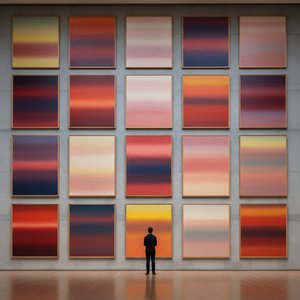
Mark Rothko : Les 25 Œuvres Maîtresses de l'Abstraction Coloriste | ArtsDot
Plongez dans l'univers émotionnel de Mark Rothko avec les 25 œuvres clés du maître de l'abstraction. Découvrez l'histoire, la technique et le pouvoir des couleurs de ces tableaux iconiques. Reproductions d'art de qualité musée sur ArtsDot.com

The Sublimity of Color: Exploring the Emotional Landscapes of Mark Rothko's Abstract Expressionism
Explore the profound emotional depth of Mark Rothko's abstract expressionism. Discover the history, techniques & lasting impact of this pivotal Color Field painter. Expert insights for collectors and art enthusiasts.

Kandinsky : Les 25 Œuvres Maîtresses d'un Pionnier de l'Art Abstrait | ArtsDot
Plongez dans l'univers vibrant de Kandinsky ! Découvrez les 25 œuvres majeures du pionnier de l'art abstrait. Explorez son expressionnisme, ses couleurs audacieuses et l'histoire fascinante derrière chaque tableau. Reproductions d'exception sur ArtsDot.com.


