

 Aperçu en situation
 Envoyer
 Partager
 Détails de l'œuvre
 Guide
Guide

 Télécharger l'image
 Articles similaires
 Radiographie
 Diaporama
 Questions et réponses
 Statistiques
Boy with Skull

- 95.0 x 66.0 cm


 Lire la suite
Giclées et impressions d'art
Impressions giclées ou sur toile de qualité musée, avec une production rapide et des finitions au choix. ( Commander la reproduction peinte à la main Passer au format numérique)




P118B €10

P118H €10

P118W €10

P438Z €10

P508JH €12

P508YH €12

P805H €10

P805Z €10

P919BZ €10

P919G €10

P919XJ €10

P959ZH €10

P968JZ €12

W106C €8

W218G €10

W218JH €8

W218Y €10

W307PJ €10

W316G €10

W316PJ €8

W316Y €10

W398PJ €8

W4111J €10

W500HY €15

W500JH €15

W692G €12

W849H €8

W940BG €15

W953PJ €8




Choisissez parmi nos formats prédéfinis qui respectent les proportions originales de l’œuvre.

Saisissez la largeur et la hauteur souhaitées pour qu'elles s'adaptent à votre cadre ou à votre mur. Une impression peut être recadrée, mais jamais agrandie au-delà de l'image originale ; ainsi, un format de forme différente entraînera la perte d'une partie de l'image. Nous vous envoyons une maquette numérique pour approbation avant toute impression. L'image présentée sur cette page ne montre pas le recadrage réel — seule la maquette le permet.
Livraison dans le monde entier () en 2 semaines au lieu des 4/5 semaines habituelles. (6 novembre)

Livraison express gratuite dans le monde entier

Toile de lin de qualité supérieure

Assurance transport complète

Garantie de remboursement des droits de douane

Garantie de fidélité des couleurs

Politique de retour de 100 jours (uniquement en cas de défaut)

Garantie de remboursement à 100%

Offre de tarifs dégressifs
 L'option verre n'est disponible que pour les dimensions inférieures à 110 cm.

Boy with Skull
Giclées et impressions d'art
Format de la reproduction
-


Prix total
€ 56
A Haunting Encounter with Mortality
In the quiet, somber depths of Magnus Enckell’s 1893 masterpiece, Boy with Skull, we are invited into a moment of profound and unsettling stillness. The painting presents a scene that feels pulled from the periphery of a dream or a dark folk tale, where the innocence of childhood meets the stark reality of death. A young boy sits grounded, his small frame positioned toward the edge of the composition, yet his focus is entirely consumed by the object in his hands: a human skull. There is no fear in his gaze, only a quiet, contemplative curiosity that bridges the gap between the living and the departed. This juxtaposition creates an eerie atmosphere, one that lingers in the mind long after the viewer has looked away, making it a piece that demands emotional engagement.
As a leading figure of the Finnish Symbolist movement, Enckell was a master at navigating the complexities of the human psyche. During this period of his career, his palette remained subdued and melancholic, eschewing the bright colorism he would later adopt with the Septem group. This restraint is vital to the impact of Boy with Skull; the muted tones and soft transitions allow the shadows to breathe, wrapping the subject in a shroud of mystery. The technique emphasizes texture and light in a way that feels almost tactile, as if one could feel the coldness of the bone and the weight of the boy's heavy thoughts. For the collector, this subtlety offers a sophisticated depth, providing a focal point that is both intellectually stimulating and visually serene.
Symbolism and the Weight of Existence
Beyond its surface-level strangeness, the painting serves as a powerful memento mori—a meditation on the inevitability of death. The skull, a universal symbol of mortality, acts as a mirror to the boy's burgeoning consciousness. In the hands of a child, the object loses its terror and becomes an instrument of inquiry, representing the moment when the human spirit begins to grapple with the concept of finitude. Enckell utilizes this symbolism to explore themes of transition and the cyclical nature of life. The composition, which places the boy slightly off-center, creates a sense of imbalance that mirrors the psychological tension inherent in contemplating one's own end.
For interior designers and curators of fine art, this piece offers an unparalleled opportunity to introduce narrative depth into a space. It is not merely a decoration but a conversation starter, a work that brings a sense of historical gravity and philosophical inquiry to a room. Whether placed in a dimly lit study or as a striking centerpiece in a contemporary gallery setting, the painting’s ability to evoke both unease and wonder makes it an extraordinary acquisition for those who appreciate art that challenges the boundaries of the seen and the unseen.
Questions et réponses
Que représente «Boy with Skull» de Magnus Enckell ?
L'œuvre « Boy with Skull » représente boy, skull, child, sitting, human figure.
Quelle émotion les couleurs de «Boy with Skull» de Magnus Enckell dégagent-elles ?
Dans « Boy with Skull », des couleurs Earthy accompagnent une sensation Mysterious.
Quelle origine nationale sous-tend le Symbolism de « Boy with Skull » ?
«Boy with Skull» lie le mouvement Symbolism à Finlande à travers le lieu de naissance de son créateur.
Œuvres similaires


Biographie de l'artiste
L'Émergence d'une Vision Symboliste
Né dans la ville côtière de Hamina en 1870, Knut Magnus Enckell était destiné à devenir l'un des piliers de l'Âge d'or finlandais. Son voyage initial fut celui d'une profonde transition, s'éloignant des paysages paisibles de sa jeunesse pour rejoindre les courants intellectuels et vibrants de Paris. Après des études primordiales à Helsinki sous la direction de Gunnar Berndtson, Enckell chercha la formation rigoureuse de l'Académie Julian, où l'influence de maîtres tels que Jules-Joseph Lefebvre et Jean-Joseph Benjamin-Constant commença à façonner son regard artistique. Bien que sa formation initiale fût ancrée dans le Naturalisme prédominant de l'époque, une impulsion plus profonde et introspective commença bientôt à s'éveiller dans son œuvre, l'éloignant de la simple représentation pour le porter vers les royaumes énigmatiques et évocateurs du Symbolisme.Une Transformation de la Lumière et de la Couleur
La trajectoire de la carrière d'Enckiente est marquée par une métamorphose esthétique remarquable qui reflétait les marées changeantes du modernisme européen. Durant ses années de formation, ses toiles étaient caractérisées par une palette sobre, presque sombre, capturant les profondeurs mélancoliques de la psyché humaine. Cependant, à partir de 1902, un changement spectaculaire s'opéra ; les ombres reculèrent pour laisser place à un colorisme de plus en plus éclatant et lumineux. En tant que figure de proue du groupe Septem, Enckell adopta un nouveau langage de la lumière, repoussant les limites de l'art finlandais par des teintes audacieuses et vibrantes. Cette évolution n'était pas seulement technique mais spirituelle, car son usage de couleurs radiantes lui permit d'explorer des thèmes qui étaient auparavant enveloppés de tons assourdis, apportant une vitalité nouvelle au mouvement symboliste.La Tapisserie du Mythe et de la Psyché
L'œuvre d'Enckell est une exploration captivante de l'invisible, où la mythologie, le théâtre et l'âme humaine convergent sur la toile. Ses œuvres ressemblent souvent à des rêves fiévreux ou à des légendes murmurées, capturant des moments de profonde tension psychologique et de beauté éthérée. Il possédait une capacité unique à mêler le monde tangible au subconscient, créant des scènes qui résonnent de mystère et de grâce. Parmi ses contributions les plus évocatrices, on trouve :- Fantasia (1895) : Une aquarelle d'une beauté envoûtante qui utilise une touche impressionniste pour dépeindre une figure mythologique immergée dans l'eau, évoquant les thèmes de la nature et d'une profonde mélancolie.
- Midsummer Day Service in Lohja Church (1899) : Une peinture à l'huile atmosphérique qui capture la solennité de la cérémonie religieuse finlandaise à travers des tons chauds et des détails gothiques complexes.
- Boy with Skull : Une exploration poignante de la mortalité et des facettes plus sombres et existentielles de ses explorations symbolistes.
Un Héritage Durable dans l'Art Finlandais
Au-delà de sa maîtrise technique, Magnus Enckell demeure une figure d'une immense importance historique. Il était bien plus qu'un simple peintre ; il était un influenceur culturel qui a aidé à redéfinir l'identité de l'art finlandais sur la scène internationale. Sa capacité à osciller entre le rôle de traditionaliste et celui de réformateur radical lui a permis de laisser une marque indélébile sur le paysage de l'art européen du début du XXe siècle. Aujourd'hui, son héritage est préservé dans les grandes institutions de Finlande, témoignant d'une vie passée à poursuivre la lumière à travers les ombres de l'esprit humain.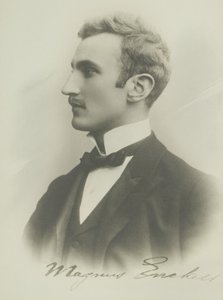
Magnus Enckell
1870 - 1925 , Finlande
L'essentiel de l'artiste
- Date De Décès: 27 novembre 1925
- Date De Naissance: 9 novembre 1870
- Lieu De Naissance: Hämeenlinna, Finlande
- Mouvement Ou Style Artistique: Symbolisme
- Nationalité: Finnois
- Nom Complet: Knut Magnus Enckell
- Œuvres Notables:
- Fantasia
- Culte de la Saint-Jean à l'église de Lohja
- Garçon au crâne
Articles connexes

Akseli Gallen-Kallela: Shaping Finnish Identity Through National Romanticism & Symbolism
Explore the captivating world of Akseli Gallen-Kallela, Finland's iconic National Romantic painter. Discover his symbolic landscapes, Kalevala illustrations & lasting impact on Finnish identity. Expert analysis & high-quality reproductions at ArtsDot.

La Palette Apaisée : Résonance Émotionnelle et Impact Esthétique des Tons Sourds dans l'Art
Explorez l'art des tons sourds : du tonalisme américain à la psychologie de la couleur avec Goethe. Découvrez comment créer harmonie et émotion dans vos propres œuvres.

The Subdued Resonance: Exploring Emotional Depth & Artistic Nuance within Muted Color Palettes
Explore the captivating world of muted colors in art & design! Discover historical context, psychological effects, techniques, and inspiration for creating serene spaces. Elevate your aesthetic with ArtsDot.
Albert Edelfelt: A Pioneer of Finnish Realism & International Impressionist Circles
Explore the life & work of Albert Edelfelt, a pioneering Finnish Realist painter who bridged Impressionism & national identity. Discover his masterpieces and lasting influence on art history.

The Subdued Palette: Exploring Emotional Resonance & Aesthetic Impact in Muted Artworks
Explore the power of muted colors in art! Discover the history, psychology & techniques behind serene palettes. Find inspiration & expert advice for creating emotionally resonant spaces with ArtsDot.