


 Aperçu en situation
 Partager
 Partager
 Détails
 Guide
Guide

 Télécharger
 Articles similaires
 Radiographie
 Voir le diaporama
 Statistiques
Ludwig van Beethoven,


 Afficher la suite
Reproduction à l'huile faite à la main
Huile sur toile peinte à la main, avec cadre et dimensions personnalisés, réalisée sur commande par nos artistes. ( Passer au format impression Passer au format image numérique)




P118B $10

P118H $10

P118W $10

P438Z $10

P508JH $12

P508YH $12

P805H $10

P805Z $10

P919BZ $10

P919G $10

P919XJ $10

P959ZH $10

P968JZ $12

W106C $8

W218G $10

W218JH $8

W218Y $10

W307PJ $10

W316G $10

W316PJ $8

W316Y $10

W398PJ $8

W4111J $10

W500HY $15

W500JH $15

W692G $12

W849H $8

W940BG $15

W953PJ $8




Choisissez parmi nos formats prédéfinis qui respectent les proportions originales de l’œuvre.

Vous pouvez saisir vos propres dimensions pour l'adapter à un cadre ou à un espace spécifique. Si la taille sélectionnée ne correspond pas aux proportions de l'image d'origine, nous recadrerons l'œuvre ou prolongerons la peinture avec des éléments peints à la main supplémentaires. Une maquette numérique vous sera envoyée pour approbation avant le début de la production.
Veuillez noter que l'aperçu à l'écran ne reflète pas le recadrage ou l'extension réels. Seule la maquette montrera fidèlement la composition finale.
Bien que des tailles personnalisées soient disponibles, nous vous recommandons de sélectionner une dimension dans la liste prédéfinie afin de préserver les proportions d'origine.
Après la commande, l’équipe ArtsDot.com contactera le client par e-mail pour recueillir ses instructions et lui fournira une maquette d’aperçu
Livraison dans le monde entier () en 3 à 4 semaines au lieu des 5 semaines habituelles. (21 septembre). Aucun compromis sur la qualité.

Livraison express gratuite dans le monde entier

Toile de lin de haute qualité

Assurance transport complète

Garantie de remboursement des droits de douane

Garantie de fidélité des couleurs

Garantie de retour de 100 jours (uniquement en cas de défaut)

Garantie de remboursement à 100%

Tarifs dégressifs sur quantité
 L'option verre n'est disponible que pour les dimensions inférieures à 110 cm.

Ludwig van Beethoven,
Technique de reproduction
Format de la reproduction
-


Prix total final
$ 263
A Window Into Genius: Examining Ludwig van Beethoven’s ‘Beethoven’ Manuscript
Within the realm of classical music, few figures command as much reverence and enduring fascination as Ludwig van Beethoven. This meticulously reproduced manuscript, titled “Ludwig van Beethoven,” offers a rare and intimate glimpse into the creative process of one of history's most transformative composers. More than just musical notation, it’s a tangible artifact—a weathered testament to years of dedication, struggle, and unparalleled artistic vision. The image presented here captures a close-up view of an aged sheet of paper, dominated by densely packed notes, symbols, and textual annotations, hinting at the complex intellectual landscape from which this masterpiece emerged.
The paper itself speaks volumes about its history. Its rough texture, marked with creases and stains, immediately conveys a sense of authenticity and time’s passage. These imperfections aren't flaws; they are evidence of countless readings, revisions, and perhaps even the occasional spilled ink—each mark contributing to the manuscript’s unique character. The vertical and horizontal lines of the staff create a framework for the intricate musical language, while the handwritten elements – likely Beethoven’s own annotations – add layers of personal reflection and artistic intent. The composition is deliberately restrained, focusing entirely on the core subject: the music itself, rather than extraneous details.
Decoding the Technique and Historical Context
This manuscript exemplifies the conventions of classical musical notation, utilizing established systems for representing pitch, rhythm, dynamics, and articulation. The meticulous detail in each note—the precise placement of rests, the subtle variations in duration—reflects Beethoven’s unwavering commitment to accuracy and clarity. The date, 1817, places this work within a pivotal period in Beethoven's life – a time marked by increasing deafness and a profound shift in his musical style. It was during this era that he began to move away from the strictures of the Classical era, experimenting with new harmonic structures and dramatic forms, ultimately paving the way for the Romantic movement.
The manuscript’s creation is inextricably linked to Beethoven's personal journey. His struggles with hearing loss profoundly impacted his compositional process, forcing him to rely increasingly on memory and intuition. This piece, therefore, can be interpreted as a deliberate act of self-expression—a way for the composer to translate his inner world into a tangible form. The meticulousness of the notation suggests an intense focus and a desire to capture every nuance of his musical ideas.
Symbolism and Emotional Resonance
Beyond its technical aspects, the manuscript carries significant symbolic weight. The aged paper represents the passage of time and the enduring legacy of Beethoven’s work. The handwritten annotations hint at the composer's intellectual process—his struggles, his insights, and his unwavering determination to express himself through music. The very act of examining this document invites us to connect with Beethoven on a deeply personal level, fostering an appreciation for his genius and resilience.
The image evokes a sense of quiet contemplation – a feeling of being transported back in time to witness the birth of a musical masterpiece. It’s a reminder that art is not merely about aesthetics; it's about human experience—about the triumphs, the challenges, and the profound emotions that shape our lives. This reproduction offers more than just an image; it provides a portal into the mind of one of history’s greatest composers.
Resources for Further Exploration
- Beethoven-Haus Bonn: Explore Beethoven's birthplace and delve deeper into his life and music at the Beethoven-Haus in Bonn, a UNESCO World Heritage site.
- Ludwig van Beethoven (Artist Database): Discover more about Beethoven's life and career on ArtNet, including biographical information and images of his works.
- Beethoven’s Missa Solemnis (Wikipedia): Explore the monumental “Missa Solemnis,” a cornerstone of Beethoven's late-period output.
Consider commissioning a high-quality reproduction to add a touch of timeless elegance and intellectual depth to your home or office. Each piece is meticulously crafted to capture the essence of this remarkable manuscript, ensuring that you own a tangible connection to one of music’s most enduring legacies.
Œuvres similaires


Biographie de l'artiste
early life and musical beginnings
Ludwig van Beethoven, a titan of classical music, was born in Bonn, Germany, in 1770—a city steeped in Prussian tradition but harboring an artistic spirit yearning for innovation. From his earliest years, prodigious talent shone through; he began formal musical instruction at the tender age of four under Johann Baptist Cramer, quickly mastering piano technique and demonstrating a remarkable aptitude for composition. His father, Johannes Beethoven, was a tenor singer and music teacher who instilled in Ludwig a love for vocal music alongside instrumental pursuits. However, Beethoven’s childhood wasn't idyllic—his family struggled financially, and he endured considerable hardship during his formative years. Despite these difficulties, Beethoven relentlessly pursued musical excellence, honing his skills under Franz Joseph Haydn and Christian Gottlob Schulze, composers who recognized his extraordinary potential and nurtured his burgeoning creativity. These mentors imparted invaluable knowledge of counterpoint and harmonic structure, shaping the foundation for Beethoven’s groundbreaking style.
Ludwig Van Beethoven
1770 - 1827 , Allemagne
En bref
- Artistic Movement Or Style: Classique Romantique
- Artists Or Movements Influenced By This Artist: ['Johannes Brahms']
- Artists Who Influenced This Artist:
- Franz Joseph Haydn
- Christian Gottlob Schulze
- Date Of Birth: 1770 Bonn Allemagne
- Date Of Death: 1827 Vienne Autriche
- Full Name: Ludwig van Beethoven
- Nationality: Allemand
- Notable Artworks:
- Moonlight Sonata
- Symphonie No 9
- Place Of Birth: Bonn Allemagne
Articles similaires
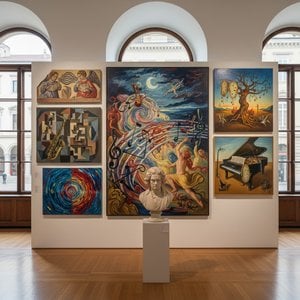
Harmonies on Canvas: Exploring the Visual Representation of Music in Art History
Explore the fascinating history of music's visual representation in art! From ancient symbolism to modern abstraction, discover how artists have captured sound and emotion on canvas. Expert insights & stunning examples.

Les 10 Chefs-d'œuvre du Néoclassicisme : Artistes et Décor Intemporels
Plongez au cœur du Néoclassicisme avec les 10 chefs-d'œuvre incontournables de David, Ingres et autres maîtres. Découvrez l'histoire fascinante de ces tableaux célèbres et trouvez l'inspiration déco classique sur !

L'Héritage Durable du Classicisme : Principes, Évolution et Influence dans l'Art Occidental
Explorez l'héritage durable du classicisme français : ses principes fondateurs, les grands maîtres (Poussin, Lorrain), et son influence sur l'art occidental. Analyse approfondie pour passionnés d'histoire de l'art.

Résonance Intemporelle : L'Esthétique Classique dans l'Art – Une Analyse Historique et Esthétique
Explorez l'esthétique classique dans l'art français avec notre analyse historique et philosophique approfondie. Découvrez les principes, figures clés et l'héritage durable de ce mouvement culturel majeur.

The Enduring Legacy of Classical Style: Form, Narrative & Influence in Art
Explore the enduring legacy of classical art – from ancient Greece & Rome to Neoclassicism. Discover key artists, philosophical roots & build a timeless collection with ArtsDot's expert guidance.


