


 Aperçu en situation
 Partager
 Partager
 Détails
 Guide
Guide

 Télécharger
 Articles similaires
 Radiographie
 Voir le diaporama
 Statistiques
Four Demons with a Book
 Acrylic On Paper
- WallArt
- Renaissance draftsmanship
 335.0 x 284.0 cm
 Pierpont Morgan Library
 Afficher la suite
Reproduction à l'huile faite à la main
Huile sur toile peinte à la main, avec cadre et dimensions personnalisés, réalisée sur commande par nos artistes. ( Passer au format impression Passer au format image numérique)




P118B $10

P118H $10

P118W $10

P438Z $10

P508JH $12

P508YH $12

P805H $10

P805Z $10

P919BZ $10

P919G $10

P919XJ $10

P959ZH $10

P968JZ $12

W106C $8

W218G $10

W218JH $8

W218Y $10

W307PJ $10

W316G $10

W316PJ $8

W316Y $10

W398PJ $8

W4111J $10

W500HY $15

W500JH $15

W692G $12

W849H $8

W940BG $15

W953PJ $8




Choisissez parmi nos formats prédéfinis qui respectent les proportions originales de l’œuvre.

Vous pouvez saisir vos propres dimensions pour l'adapter à un cadre ou à un espace spécifique. Si la taille sélectionnée ne correspond pas aux proportions de l'image d'origine, nous recadrerons l'œuvre ou prolongerons la peinture avec des éléments peints à la main supplémentaires. Une maquette numérique vous sera envoyée pour approbation avant le début de la production.
Veuillez noter que l'aperçu à l'écran ne reflète pas le recadrage ou l'extension réels. Seule la maquette montrera fidèlement la composition finale.
Bien que des tailles personnalisées soient disponibles, nous vous recommandons de sélectionner une dimension dans la liste prédéfinie afin de préserver les proportions d'origine.
Après la commande, l’équipe ArtsDot.com contactera le client par e-mail pour recueillir ses instructions et lui fournira une maquette d’aperçu
Livraison dans le monde entier () en 3 à 4 semaines au lieu des 5 semaines habituelles. (25 septembre). Aucun compromis sur la qualité.

Livraison express gratuite dans le monde entier

Toile de lin de haute qualité

Assurance transport complète

Garantie de remboursement des droits de douane

Garantie de fidélité des couleurs

Garantie de retour de 100 jours (uniquement en cas de défaut)

Garantie de remboursement à 100%

Tarifs dégressifs sur quantité
 L'option verre n'est disponible que pour les dimensions inférieures à 110 cm.

Four Demons with a Book
Technique de reproduction
Format de la reproduction
-


Prix total final
$ 338
The Genesis of a Masterpiece: Luca Signorelli's Preparatory Drawing
Luca Signorelli’s “Four Demons with a Book,” a remarkably detailed preparatory study for the monumental fresco cycle adorning Orvieto Cathedral, offers a captivating glimpse into the mind of one of the High Renaissance’s most potent visual storytellers. More than just a sketch, it's a concentrated distillation of ideas, a vibrant testament to Signorelli’s meticulous draftsmanship and his profound understanding of human psychology – particularly as manifested through the unsettling interplay of demonic figures and forbidden knowledge. The drawing itself, rendered in charcoal or silverpoint on aged paper, possesses an immediate power, radiating a palpable sense of urgency and contained chaos.
The work’s genesis lies within the Cappella Nova, a space already steeped in religious narrative through earlier frescoes by Fra Angelico. Signorelli was tasked with expanding this existing framework, creating a dramatic visual representation of the Apocalypse – a subject demanding both grandeur and terrifying intimacy. This preparatory study isn't merely a preliminary sketch; it’s a crucial stage in the artist’s process, revealing his initial compositional choices, anatomical explorations, and the evolution of individual figures before they were unleashed upon the vast cathedral walls.
A Symphony of Line: Technique and Composition
Signorelli's mastery is immediately evident in the drawing’s intensely linear quality. Hatching and cross-hatching dominate, building up volume with a remarkable degree of precision and control. The figures aren’t simply outlined; they are sculpted through layers of carefully applied lines, conveying not just their physical form but also the texture of skin, clothing, and even the suggestion of demonic musculature. The limited palette – primarily shades of gray and white – amplifies this effect, creating a dramatic chiaroscuro that emphasizes the figures’ powerful presence against an implied darkness. The composition itself is deliberately claustrophobic, with the demons crowding together in a dynamic, almost violent arrangement. There's no background; the focus remains entirely on these unsettling characters and their interaction with the central object of contemplation – the book.
The drawing’s flattened perspective, characteristic of preparatory studies, lends it an immediacy and intimacy rarely found in finished works. It feels as though we are witnessing Signorelli wrestling with his ideas directly, capturing a fleeting moment of creative struggle. The subtle erasures and adjustments visible throughout the piece further underscore this sense of process, revealing the artist’s willingness to experiment and refine his vision.
Symbolism and Psychological Depth
The subject matter – four demonic figures clustered around a book – is laden with symbolic weight. Demons, traditionally representing temptation, sin, and the forces of evil, are inherently unsettling. Their muscular physiques and aggressive postures convey power and menace. The book, however, introduces an element of ambiguity. It’s not simply a symbol of knowledge; it suggests a dangerous, potentially corrupting influence – a forbidden text promising enlightenment but ultimately leading to damnation. The positioning of the demons, particularly one holding the book aloft with a look of intense concentration, hints at a struggle between intellect and faith, reason and revelation.
Signorelli’s genius lies in his ability to imbue these archetypal figures with psychological depth. The expressions on their faces – ranging from rage and suspicion to curiosity and perhaps even a hint of despair – suggest a complex internal landscape. The drawing isn't merely a depiction of demons; it’s an exploration of the human condition, confronting us with our own vulnerabilities and temptations.
A Legacy in Stone and Charcoal
“Four Demons with a Book” stands as a pivotal work in Signorelli’s oeuvre, foreshadowing the dramatic intensity and psychological complexity that would define his masterpiece at Orvieto. It's a testament to his extraordinary draftsmanship, his profound understanding of human anatomy, and his ability to translate complex theological ideas into visually arresting imagery. The drawing offers a rare opportunity to connect with the creative process of one of the Renaissance’s most influential artists, revealing the meticulous care and intellectual rigor that underpinned his monumental achievements. Reproductions of this captivating study offer a window into a world of dramatic tension, profound symbolism, and enduring artistic power.
Œuvres similaires


Biographie de l'artiste
Premières années et formation
Lucca Signorelli, peintre de la Renaissance italienne, est né à Cortone, en Toscane, vers 1450. La date exacte de sa naissance reste incertaine, mais on estime qu'elle se situe entre 1441 et 1445. Il était réputé pour son talent exceptionnel en tant que dessinateur et son utilisation innovante du raccourci.Carrière artistique
Les premières influences artistiques de Signorelli semblent avoir pris racine à Pérouse, où il a été marqué par les styles d'artistes tels que Benedetto Bonfigli, Fiorenzo di Lorenzo et Pinturicchio. Selon Giorgio Vasari, Signorelli a été placé comme apprenti auprès de Piero della Francesca par son oncle maternel, Lazzaro Vasari. Ses œuvres se trouvent dans divers lieux, notamment à Arezzo (1472) et Città di Castello (1474). Parmi ses œuvres notables figure la peinture "École de Pan", qui a été présentée à Laurent de Médicis. Cette œuvre présente une représentation réaliste du corps humain, mettant en valeur la maîtrise de Signorelli du clair-obscur et de la perspective linéaire.Œuvres majeures
- Le Jugement dernier (1499-1503), cathédrale d'Orvieto - considérée comme son chef-d'œuvre, cette fresque monumentale témoigne du talent de Signorelli pour représenter l'apocalypse et le jugement dernier.
- Le Polyptyque de Saint Médard (1507), musée San Medardo, Arcevia, Italie - un exemple parfait du travail de Signorelli, présentant une représentation hautement détaillée et naturaliste du corps humain.
Mouvement artistique
Signorelli a fait partie du mouvement de la Renaissance italienne, qui marqua la transition entre l'Europe médiévale et le début de l'époque moderne. Cette période a vu un regain d'intérêt pour les traditions classiques, le naturalisme et l'humanisme.- Le mouvement artistique de la première Renaissance - une brève introduction au mouvement artistique qui a façonné l'histoire de l'art.
- Fra Angelico - le célèbre artiste qui a influencé Signorelli et était connu pour son talent exceptionnel en tant que peintre.
- Luca Signorelli - une brève biographie de l'artiste, présentant ses œuvres notables et son mouvement artistique.
Héritage
Le travail de Signorelli a eu un impact significatif sur le développement de l'art de la Renaissance. Son utilisation du raccourci et son talent en tant que dessinateur ont influencé de nombreux artistes qui lui ont succédé. En tant que figure importante de la Renaissance italienne, l'héritage de Signorelli continue d'être célébré à travers ses œuvres, qui peuvent être admirées dans divers musées et cathédrales à travers l'Italie. Dates importantes : * 1450 : né à Cortone, Toscane * 1499-1503 : a créé Le Jugement dernier, cathédrale d'Orvieto * 1523 : est décédé, laissant derrière lui un héritage d'art exceptionnel.
Luca Signorelli
1450 - 1523 , Italie
En bref
- Artistes Influents:
- Piero della Francesca
- Benvenuto Bonfigli
- Date De Décès: 1523
- Date De Naissance: vers 1450
- Influence Sur D'Autres Artistes: Nombreux artistes de la Renaissance
- Lieu De Naissance: Cortone, Italie
- Mouvement Artistique: Renaissance italienne
- Nationalité: Italienne
- Nom Complet: Luca Signorelli
- Oeuvres Notables:
- Le Jugement dernier
- Polyptyque de Saint Médard
Articles similaires

The Alchemy of Graphite: An Expert Guide to Mastering Detail and Depth in Pencil Sketching
Unlock the secrets of graphite sketching with our expert guide for art students. Learn to master pencil grades, create realistic depth, and capture intricate textures through professional techniques designed to elevate your observational drawing skills.

Luca Signorelli: Renaissance Innovation & Dramatic Foreshadowing of Modern Artistic Expression
Explore the revolutionary art of Luca Signorelli, a High Renaissance master renowned for his dramatic frescoes & anatomical precision. Discover his lasting impact on art history and techniques like foreshortening.

The Nuances of Graphite: Exploring Emotional Depth & Technical Mastery in Pencil Drawing
Explore the captivating world of graphite drawing! Discover its rich history, master essential techniques like chiaroscuro, and learn how artists evoke emotion through this timeless medium. Expert insights for art enthusiasts.

The Eloquent Line: Exploring the Artistic Significance of Sketches Across Movements and Media
Explore the profound artistic significance of sketches throughout history. From Renaissance masters to modern innovators like Van Gogh & Guston, discover how these foundational works reveal technique, emotion, and vision. Learn more at ArtsDot.
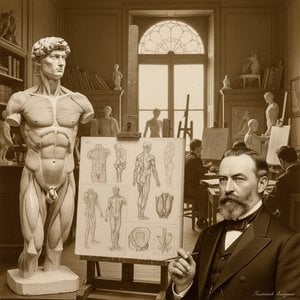
Frederick Bridgman: Anatomical Mastery & the Evolution of Figure Drawing Instruction
Explore the anatomical mastery of George B. Bridgman & his revolutionary figure drawing techniques. Discover how his methods transformed art instruction and continue to inspire artists today. Learn more at ArtsDot.


