


 Aperçu en situation
 Envoyer
 Partager
 Détails de l'œuvre

 Télécharger
 Articles similaires
 Radiographie
 Diaporama
 Statistiques
The Annunciation


 Lire la suite
Reproduction à l'huile faite à la main
Huile sur toile peinte à la main, avec cadre et dimensions personnalisés, réalisée sur commande par nos artistes. ( Passer au format impression Passer à l'image numérique)




P118B $10

P118H $10

P118W $10

P438Z $10

P508JH $12

P508YH $12

P805H $10

P805Z $10

P919BZ $10

P919G $10

P919XJ $10

P959ZH $10

P968JZ $12

W106C $8

W218G $10

W218JH $8

W218Y $10

W307PJ $10

W316G $10

W316PJ $8

W316Y $10

W398PJ $8

W4111J $10

W500HY $15

W500JH $15

W692G $12

W849H $8

W940BG $15

W953PJ $8




Choisissez parmi nos formats prédéfinis qui respectent les proportions originales de l’œuvre.

Vous pouvez saisir vos propres dimensions pour l'adapter à un cadre ou à un espace spécifique. Si la taille sélectionnée ne correspond pas aux proportions de l'image d'origine, nous recadrerons l'œuvre ou prolongerons la peinture avec des éléments peints à la main supplémentaires. Une maquette numérique vous sera envoyée pour approbation avant le début de la production.
Veuillez noter que l'aperçu à l'écran ne reflète pas le recadrage ou l'extension réels. Seule la maquette montrera fidèlement la composition finale.
Bien que des tailles personnalisées soient disponibles, nous vous recommandons de sélectionner une dimension dans la liste prédéfinie afin de préserver les proportions d'origine.
Après la commande, l’équipe ArtsDot.com contactera le client par e-mail pour recueillir ses instructions et lui fournira une maquette d’aperçu
Livraison dans le monde entier () en 3 à 4 semaines au lieu des 5 semaines habituelles. (11 septembre). Aucun compromis sur la qualité.

Livraison express gratuite dans le monde entier

Toile de lin de haute qualité

Assurance transport complète

Garantie de remboursement des droits de douane

Garantie de fidélité des couleurs

Garantie de retour de 100 jours (uniquement en cas de défaut)

Garantie de remboursement à 100%

Tarifs dégressifs sur quantité
 L'option verre n'est disponible que pour les dimensions inférieures à 110 cm.

The Annunciation
Technique de reproduction
Format de la reproduction
-


Prix total final
$ 263
A Divine Encounter in Gold and Grace
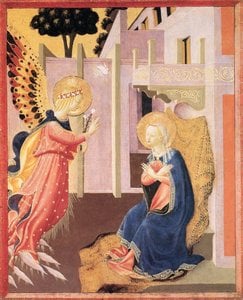
In the quiet sanctity of the Galleria dell'Accademia in Florence, there exists a moment frozen in time, a celestial intersection between heaven and earth captured by the hand of Lorenzo Monaco. His The Annunciation, painted around 1410, is far more than a mere religious illustration; it is a profound meditation on the arrival of divine grace. As one gazes upon this masterpiece, the viewer is transported to the dawn of the Italian Renaissance, a period where the ethereal elegance of the Gothic tradition began to breathe with the burgeoning realism of a new era. The scene depicts the pivotal instant when the Archangel Gabriel descends to deliver his transformative message to the Virgin Mary, an event rendered with such spiritual intensity that it feels as though the air around the panel is still vibrating with the weight of the divine word.
The composition is a masterclass in balanced tension and sacred geometry. On one side, the Angel Gabriel appears in dynamic motion, his wings spread wide to suggest a sudden, celestial arrival. His presence is marked by a serene focus, embodying the gravity of his mission. Opposite him, the Virgin Mary kneels in a posture of profound humility and contemplative prayer, her hands clasped in reverence. This symmetry is framed by an architectural backdrop—a Gothic archway that evokes the hallowed halls of Florentine churches—which provides a sense of structural depth and anchors the supernatural event within a recognizable, sacred space. The use of tempera on panel allows for an exquisite level of detail, from the delicate folds of Mary’s drapery to the intricate patterns that dance across her garments, inviting the eye to linger on the meticulous craftsmanship of the monk-artist.
The Radiance of Symbolism and Light
Lorenzo Monaco, often remembered as “Lawrence the Monk” due to his devotion to the Camaldolese order, infused this work with a unique spiritual luminosity. The color palette is dominated by warm, radiant hues—vibrant yellows and deep reds—that seem to emanate from Mary herself. This chromatic choice is deeply symbolic, representing the divine light of grace descending upon the earthly realm. High above the central figures, a dove descends, a subtle yet powerful emblem of the Holy Spirit, signaling that this encounter is orchestrated by the hand of God. Through these symbols, Monaco weaves a narrative that transcends language, speaking directly to the soul through the universal vocabulary of light and color.
For the discerning collector or interior designer, The Annunciation offers an unparalleled opportunity to introduce a sense of historical depth and spiritual tranquility into a space. The painting’s dramatic use of light and shadow—a precursor to the more intense chiaroscuro of later centuries—creates a focal point that commands attention without overwhelming its surroundings. Whether placed in a curated gallery setting or as a centerpiece in a sophisticated study, a high-quality reproduction of this work brings with it the prestige of Florentine heritage and the timeless beauty of the Gothic spirit. It is an invitation to contemplate the intersection of human devotion and divine mystery, making it a profound addition to any collection dedicated to the enduring power of fine art.
Œuvres similaires


Biographie de l'artiste
Première Vie et Formation
- Né: Sienne, Italie (c. 1370)
- Décédé: c. 1425
- On en sait peu sur la première vie de Lorenzo Monaco, à l'exception du fait qu'il a été apprenti à Florence.
- Il a été influencé par les œuvres de Giotto et de ses disciples, Spinello Aretino et Agnolo Gaddi. Cette exposition a façonné son développement artistique.
Carrière Artistique et Style
- En 1390, Lorenzo est entré au monastère camaldule de Santa Maria degli Angeli, devenant connu sous le nom de « Laurent l'ermite ».
- Ses premières œuvres (années 1390) montrent une forte influence du style gothique international, aux côtés d'influences provenant de Lorenzo Ghiberti et Gherardo Starnina.
- Le style de Monaco se caractérise par :
- Un linéaire tendu
- Une gamme chromatique froide initialement
- Plus tard, une adoption d'éléments gothiques internationaux
- Des figures allongées avec des draperies sinueuses
- Des bords nets et des couleurs vives (or et lapis-lazuli)
- Des gestes suggérés et un sentiment d'espace minimisé
- Il dépeint constamment des images avec une forte valeur spirituelle, souvent détachées du réalisme.
Œuvres Majeures
- Pietà : Exposée à la Galleria dell'Accademia, Florence – Démontre une ligne nerveuse et une tension émotionnelle.
- Coronation de la Vierge : Aujourd’hui à l’Uffizi – Présente un grand nombre de saints aux formes sinueuses et aux couleurs brillantes.
- Polyptyque de Monteoliveto : À la Galleria dell'Accademia – Expose une spiritualité qui préfigure Fra Angelico.
- Adoration des Mages (1420-1422) : Les raccourcis apparaissent surréalistes en raison de l’absence de perspective géométrique, mais maintiennent une grande qualité picturale.
- Histoires de la Vierge dans la chapelle Bartolini Salimbeni : L'une de ses rares fresques.
Influences et Héritage
- Le travail de Monaco a été influencé par Giotto, Spinello Aretino, Agnolo Gaddi, Lorenzo Ghiberti et Gherardo Starnina.
- Il est resté largement inaffecté par les innovations de Masaccio et Filippo Brunelleschi, maintenant son style distinctif.
- Giorgio Vasari a inclus une biographie de Monaco dans ses « Vies », notant sa mort d'une infection non identifiée.
- Malgré des informations biographiques limitées, les contributions de Lorenzo Monaco à l’art gothique tardif-renaissance précoce sont significatives. Son mélange unique de styles et son objectif spirituel ont laissé un impact durable sur les artistes ultérieurs.
Signification Historique
- Considéré comme le dernier important représentant du style Giotto avant la révolution de la Renaissance.
- A comblé le fossé entre les traditions gothiques tardives et les principes artistiques émergents de la Renaissance.
- Son insistance sur la spiritualité et les formes stylisées représentent une esthétique distincte dans la peinture florentine.

Lorenzo Monaco
1370 - 1425 , Italie
En bref
- Artistic Movement Or Style: Gothique tardif-Renaissance
- Artists Or Movements Influenced By This Artist:
- Masaccio
- Brunelleschi
- Artists Who Influenced This Artist:
- Giotto
- Spinello Aretino
- Agnolo Gaddi
- Date De Décès: c. 1425
- Date De Naissance: c. 1370
- Full Name: Lorenzo Monaco
- Lieu De Naissance: Sienne, Italie
- Nationalité: Italienne
- Notable Artworks:
- Pietà
- Coronation de la Vierge
- Adoration des Mages
Articles similaires

Au-delà des Frontières : Innovations Spirituelles et Stylistiques de l'Art Gothique International
Explorez l'art gothique international : ses innovations stylistiques, ses racines franco-flamandes et son héritage précieux. Découvrez les chefs-d'œuvre de cette période fascinante avec ArtsDot.

The Radiant Dusk of Medieval Vision: Exploring Late Gothic Art's Synthesis of Faith, Form & Emotionality (c. 1300-1500)
Explore the exquisite beauty & spiritual depth of Late Gothic art (c. 1300-1500). Discover key artists, symbolism, and its lasting influence on the Renaissance. Expert insights at ArtsDot.
L'Éclat Intemporel de la Tempera sur Panneau : Techniques Ancestrales et Héritage Artistique
Explorez l'art de la tempera : techniques ancestrales, maîtres italiens et héritage artistique exceptionnel. Découvrez les secrets de cette peinture durable et intemporelle.

Illuminating History: A Comprehensive Exploration of Tempera Painting Techniques & Artistic Legacy
Explore the rich history & techniques of tempera painting! Discover Renaissance masters like Botticelli & Fra Angelico, conservation insights, and the enduring legacy of this captivating art form.

L'Ombre de la Foi : Exploration de l'Intensité Spirituelle et de l'Innovation Architecturale dans l'Art Gothique
Explorez l'intensité spirituelle et l'innovation architecturale de l'art gothique. Découvrez la Basilique Saint-Denis, les cathédrales emblématiques et le symbolisme fascinant des vitraux. Un voyage au cœur d'un chef-d'œuvre historique.


