


 Aperçu en situation
 Partager
 Partager
 Détails
 Guide imprimable

 Télécharger
 Articles similaires
 Radiographie
 Voir le diaporama
 Statistiques
Self-Portrait
 Oil On Canvas
- WallArt
- Baroque
 1789
1789 70.0 x 60.0 cm
 Galerie nationale d’Écosse
 Afficher la suite
Reproduction à l'huile faite à la main
Huile sur toile peinte à la main, avec cadre et dimensions personnalisés, réalisée sur commande par nos artistes. ( Passer au format impression Passer au format image numérique)




P118B €10

P118H €10

P118W €10

P438Z €10

P508JH €12

P508YH €12

P805H €10

P805Z €10

P919BZ €10

P919G €10

P919XJ €10

P959ZH €10

P968JZ €12

W106C €8

W218G €10

W218JH €8

W218Y €10

W307PJ €10

W316G €10

W316PJ €8

W316Y €10

W398PJ €8

W4111J €10

W500HY €15

W500JH €15

W692G €12

W849H €8

W940BG €15

W953PJ €8




Choisissez parmi nos formats prédéfinis qui respectent les proportions originales de l’œuvre.

Saisissez la largeur et la hauteur souhaitées, pour s'adapter à votre cadre ou à votre mur. Cette œuvre est peinte à la main ; ainsi, pour un format de forme différente, l'artiste peut peindre un peu plus autour du tableau ou réduire légèrement les bords — c'est vous qui choisissez. Nous vous envoyons une maquette numérique pour approbation avant que la peinture ne commence. L'image présentée sur cette page ne reflète pas le résultat réel — seule la maquette le fait.
Après la commande, l’équipe ArtsDot.com contactera le client par e-mail pour recueillir ses instructions et lui fournira une maquette d’aperçu
Livraison dans le monde entier () en 3 à 4 semaines au lieu des 5 semaines habituelles. (24 octobre). Aucun compromis sur la qualité.

Livraison express gratuite dans le monde entier

Toile de lin de haute qualité

Assurance transport complète

Garantie de remboursement des droits de douane

Garantie de fidélité des couleurs

Garantie de retour de 100 jours (uniquement en cas de défaut)

Garantie de remboursement à 100%

Tarifs dégressifs sur quantité
 L'option verre n'est disponible que pour les dimensions inférieures à 110 cm.

Self-Portrait
Technique de reproduction
Format de la reproduction
-


Prix total final
€ 231
The Enigmatic Gaze: Unveiling John Opie’s Self-Portrait
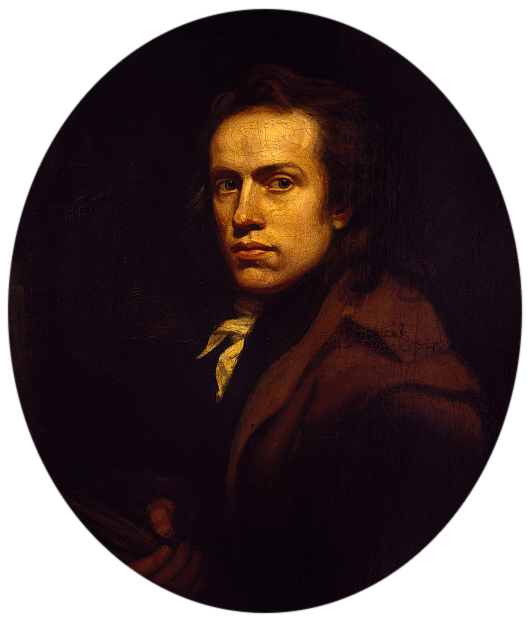
John Opie's 1789 “Self-Portrait” isn’t merely a likeness; it’s a carefully constructed window into the soul of a burgeoning artistic talent. Painted in oil on canvas, this oval composition immediately commands attention with its dramatic chiaroscuro – a masterful manipulation of light and shadow that plunges the viewer into an atmosphere of profound introspection. The portrait depicts Opie himself, not as a triumphant figure, but as a contemplative man, his gaze fixed directly upon the observer, inviting us to share in his thoughts and emotions. The choice of this particular pose—a slight turn of the head, a subtle furrowing of the brow—suggests a mind wrestling with ideas, a quiet intensity that belies the young artist’s burgeoning fame.
Baroque Drama and Cornish Roots
Opie’s style is deeply rooted in the Baroque tradition, a movement known for its theatricality, emotional intensity, and dramatic use of light. The influence of Caravaggio and Rembrandt—artists who were masters of chiaroscuro—is readily apparent in Opie's work. The stark contrast between the illuminated areas of the face and clothing and the deep shadows that envelop the background creates a sense of depth and volume, drawing our attention to the central figure. This technique wasn’t simply aesthetic; it was a deliberate choice to convey a powerful emotional state – here, a blend of seriousness, intelligence, and perhaps even melancholy. Born in Trevellas, Cornwall, Opie's artistic sensibility was profoundly shaped by his Cornish heritage, evident in the ruggedness of his features and the earthy tones that dominate the palette.
A Study in Form and Texture
Beyond the dramatic lighting, a closer examination reveals Opie’s meticulous attention to detail. The artist skillfully employs lines to define the contours of the face, clothing, and hair, creating a sense of solidity and form. The layering of paint—a technique known as impasto—adds texture to the surface, particularly in the rendering of the fabric draped over his shoulders and the delicate details of his hands. Note the subtle variations in color and tone that suggest the play of light on different surfaces. This careful observation and execution demonstrate Opie’s commitment to realism, a hallmark of his style.
Symbolism and the Portraiture of the Mind
The portrait transcends a simple likeness; it's a symbolic representation of the artist’s inner world. The direct gaze invites engagement, suggesting that Opie is not simply presenting himself but offering an invitation to share in his thoughts. The serious expression—a hallmark of many self-portraits from this period—hints at intelligence, introspection, and perhaps even a touch of melancholy. Considering the historical context – the late 18th century was a time of intellectual ferment and social change – Opie’s portrait can be interpreted as an exploration of identity in a rapidly evolving world. The choice to depict himself alone reinforces this sense of internal reflection, suggesting that the artist is grappling with profound questions about his place in society and his role as a creative force.
Further Exploration
- From Portrait to Icon: Exploring the Aesthetic and Digital Transformation of Self-Representation within Classical Art Traditions: Explore the fascinating evolution of portraiture from classical masterpieces to digital art! Discover symbolism, techniques & societal impact. Expert insights for collectors & enthusiasts at ArtsDot.
- John Opie - Wikipedia: A comprehensive overview of the artist’s life and work, including his early career, London years, and artistic influences.
- Self-Portrait by OPIE, John: A detailed examination of the painting’s composition, technique, and historical significance, with high-resolution images.
Questions et réponses
Quelle émotion «Self-Portrait» de John Opie exprime-t-il au sein du mouvement Baroque ?
L'émotion Melancholic de « Self-Portrait » accompagne son style Baroque.
Quelle taille de reproduction est suggérée pour «Self-Portrait» de John Opie ?
Pour «Self-Portrait», un format d'impression de Medium est recommandé. D'autres tailles sont disponibles avec les mêmes proportions.
Quelle est la saturation des couleurs de «Self-Portrait» de John Opie ?
La palette de « Self-Portrait » présente une saturation Muted.
Œuvres similaires


Biographie de l'artiste
A Cornish Prodigy Ascends: The Life and Art of John Opie
John Opie, born in the humble surroundings of Harmony Cottage, Trevellas, Cornwall in 1761, emerged as one of the most remarkable artistic figures of his generation. His story is a compelling narrative of raw talent nurtured against the odds, rising from a carpenter’s son to become a celebrated portraitist and history painter, a Royal Academician, and an influential voice within the British art world. Opie's early life was marked by a precocious aptitude for both drawing and mathematics – a duality that perhaps informed his meticulous approach to composition and form. Even as a young boy, he demonstrated an independent spirit, establishing an evening school to teach reading, writing, and arithmetic to local children while simultaneously mastering Euclid’s geometry. This thirst for knowledge, coupled with his artistic inclination, was initially met with resistance from his father, who insisted on an apprenticeship in carpentry. However, fate intervened in the form of Dr. John Wolcot, known as Peter Pindar, a physician and satirist whose discerning eye recognized the extraordinary potential within the young Opie. Wolcot became Opie’s champion, securing his release from the carpentry apprenticeship and providing him with invaluable guidance, encouragement, and crucial introductions. This mentorship proved pivotal in launching Opie's career. In 1781, they journeyed to London together, where Wolcot shrewdly presented Opie as a self-taught prodigy – a “Cornish wonder” untouched by formal artistic training. This narrative captivated the London art scene, drawing comparisons to masters like Caravaggio and Velázquez from none other than Sir Joshua Reynolds himself. The initial success was swift and dazzling. Commissions poured in, including portraits of members of the British royal family—the Duke and Duchess of Gloucester, Lady Salisbury, and Mary Delany among them. Opie’s residence on Castle Street became a hub of fashionable society, his talent commanding attention and admiration. However, the partnership with Wolcot eventually dissolved as Opie asserted his independence, seeking to forge his own path without the constraints of their profit-sharing agreement. This period solidified Opie's reputation, establishing him as a leading portraitist capable of capturing not only physical likeness but also the character and social standing of his sitters.Mentorship, London, and Royal Patronage
Reynolds recognized Opie’s talent immediately, praising his “natural genius” and comparing him favorably to Rembrandt. He championed Opie's cause, securing him a place at the Royal Academy and fostering his artistic development. Reynolds’ influence extended beyond mere encouragement; he instilled in Opie a profound understanding of artistic technique—particularly the use of dramatic lighting—a stylistic hallmark that would characterize Opie’s later works. This dedication to mastering Rembrandt’s chiaroscuro – the interplay between light and shadow – became a defining feature of Opie's oeuvre, elevating his paintings beyond mere representation to convey emotion and psychological depth. The Royal Academy’s patronage ensured Opie’s continued success and provided him with access to influential circles within London’s artistic community.Beyond Portraiture: Historical Paintings and Academic Recognition
Opie’s ambition transcended the realm of portraiture; he longed to engage with grand historical narratives, seeking to establish himself as a painter of significant subjects. This aspiration led him to explore history painting, culminating in works like *The Assassination of James I* (1786) and *The Murder of Rizzio* (1787). The latter proved particularly impactful, earning him immediate election as an Associate of the Royal Academy and full membership the following year. These historical paintings demonstrated a growing mastery of composition, dramatic lighting—often referencing Rembrandt’s style—and a commitment to conveying emotional intensity. Opie's meticulous attention to detail—evident in his depiction of textures and fabrics—further distinguished his work from many of his contemporaries. He skillfully employed techniques honed during his apprenticeship to achieve remarkable realism and expressive power.A Legacy of Artistry and Thought
Opie’s later life was marked by both professional success and personal challenges. His first marriage ended in divorce, leaving him heartbroken. However, he found lasting happiness with Amelia Alderson, a writer and abolitionist whom he married in 1798. Their partnership fostered mutual support and intellectual stimulation. Opie's unwavering belief in the transformative power of art extended beyond his own practice; he actively advocated for the establishment of a national gallery—a visionary undertaking that would ultimately realize his lifelong ambition. He eloquently articulated his convictions on artistic education and championed the importance of fostering creativity within society. John Boydell’s Shakespeare Gallery provided Opie with an invaluable platform to showcase his talent and disseminate his ideas, cementing his position as a respected figure among artists and intellectuals alike. His lectures delivered in 1806 and published posthumously in 1809 revealed a thoughtful and articulate mind deeply engaged with the principles of artistic creation—a testament to the enduring legacy of John Opie RA.
John Opie
1761 - 1807 , Royaume-Uni
En bref
- Artistic Movement Or Style: Histoire et portraiture
- Artists Who Influenced This Artist:
- Caravage
- Vélasquez
- Date Of Birth: 1761
- Full Name: John Opie
- Nationality: Britannique
- Notable Artworks: ['Œuvres de la Galerie Shakespearienne']
- Place Of Birth: Trevellas, UK
Articles connexes

Constable : Les 25 Chefs-d'Œuvre du Maître Anglais | ArtsDot
Plongez dans l'univers de John Constable avec les 25 œuvres incontournables du maître anglais. Découvrez l'histoire, la technique et l'émotion derrière ses paysages romantiques. Reproductions de qualité muséale sur ArtsDot.com.

L'Huile sur Toile : Exploration Historique et Technique d'un Médium Artistique Intemporel
Explorez l'histoire fascinante de la peinture à l'huile, des techniques ancestrales aux maîtres flamands comme Van Eyck. Découvrez les secrets des pigments, liants et glacis pour comprendre cet art intemporel.

The Enduring Legacy of Oil on Canvas: Technique, History & Aesthetic Impact
Explore the rich history & techniques of oil painting – from Renaissance masters to Impressionism. Discover pigments, layering methods, and why this timeless medium endures. Expert insights for artists & art enthusiasts.

John Singer Sargent : Les 25 Œuvres Maîtresses d'un Portraitiste Éminent | ArtsDot
Plongez dans l'univers de John Singer Sargent : découvrez les 25 œuvres qui ont marqué l'histoire de l'art. Portraits impressionnants, réalisme exquis et couleurs vibrantes. Retrouvez ces chefs-d'œuvre en reproduction haute définition sur ArtsDot.com.

L'héritage durable de la peinture à l'huile : technique, histoire et pratique contemporaine
Explorez l'histoire fascinante de la peinture à l'huile, des techniques ancestrales aux pratiques contemporaines. Découvrez les maîtres, apprenez et trouvez votre œuvre d'art idéale chez .
