

 Aperçu en situation
 Envoyer
 Partager
 Détails de l'œuvre
 Guide
Guide

 Télécharger l'image
 Articles similaires
 Radiographie
 Diaporama
 Questions et réponses
 Statistiques
Bacchante


 Lire la suite
Giclées et impressions d'art
Impressions giclées ou sur toile de qualité musée, avec une production rapide et des finitions au choix. ( Commander la reproduction peinte à la main Passer au format numérique)




P118B €10

P118H €10

P118W €10

P438Z €10

P508JH €12

P508YH €12

P805H €10

P805Z €10

P919BZ €10

P919G €10

P919XJ €10

P959ZH €10

P968JZ €12

W106C €8

W218G €10

W218JH €8

W218Y €10

W307PJ €10

W316G €10

W316PJ €8

W316Y €10

W398PJ €8

W4111J €10

W500HY €15

W500JH €15

W692G €12

W849H €8

W940BG €15

W953PJ €8




Choisissez parmi nos formats prédéfinis qui respectent les proportions originales de l’œuvre.

Saisissez la largeur et la hauteur souhaitées pour qu'elles s'adaptent à votre cadre ou à votre mur. Une impression peut être recadrée, mais jamais agrandie au-delà de l'image originale ; ainsi, un format de forme différente entraînera la perte d'une partie de l'image. Nous vous envoyons une maquette numérique pour approbation avant toute impression. L'image présentée sur cette page ne montre pas le recadrage réel — seule la maquette le permet.
Livraison dans le monde entier () en 2 semaines au lieu des 4/5 semaines habituelles. (7 novembre)

Livraison express gratuite dans le monde entier

Toile de lin de qualité supérieure

Assurance transport complète

Garantie de remboursement des droits de douane

Garantie de fidélité des couleurs

Politique de retour de 100 jours (uniquement en cas de défaut)

Garantie de remboursement à 100%

Offre de tarifs dégressifs
 L'option verre n'est disponible que pour les dimensions inférieures à 110 cm.

Bacchante
Giclées et impressions d'art
Format de la reproduction
-


Prix total
€ 56
A Moment of Quietude: Exploring Sorolla’s ‘Bacchante’
Joaquín Sorolla y Bastida's “Bacchante” offers a captivating glimpse into the artist’s masterful command of light and his profound understanding of the human form. This evocative painting, depicting a reclining nude woman within a richly appointed interior, is a quintessential example of Sorolla’s signature style – one characterized by an almost palpable sense of warmth, luminosity, and a deeply felt connection to the Spanish landscape. The scene, seemingly simple in its composition, unfolds with a remarkable sensitivity to texture, color, and spatial depth, inviting the viewer into a private moment of repose.
- Subject Matter: The central figure, a woman lost in slumber or quiet contemplation, embodies Sorolla’s fascination with the female nude. Unlike many depictions of the classical nude, however, this is not an idealized representation; rather, it's a portrait of vulnerability and peacefulness, suggesting a deeply personal experience.
- Technical Brilliance: Sorolla’s technique is immediately recognizable – a rapid, almost impressionistic brushstroke that captures the fleeting effects of light with breathtaking accuracy. The use of *alla prima* (wet-on-wet) painting allows for an immediacy and vibrancy rarely achieved in traditional academic styles.
- Color Palette: The dominant red background isn't merely decorative; it’s a crucial element, intensifying the warmth of the scene and creating a dramatic contrast that draws attention to the figure. Sorolla expertly employs complementary colors – the reds and blues – to heighten visual impact and create a sense of dynamism within the stillness.
The Valencia School and the Influence of Rome
Sorolla’s artistic journey was profoundly shaped by his time in Valencia and, crucially, his subsequent studies in Rome. Returning from Italy in 1889, he embraced the lessons learned from masters like Raphael and Titian, incorporating elements of classical composition and color theory into his own distinctive style. However, unlike many artists who simply replicated Italian techniques, Sorolla infused them with a distinctly Spanish sensibility – a passion for light, color, and the vibrancy of everyday life. The influence of the *macchiaioli*, a group of Florentine painters known for their loose brushwork and emphasis on direct observation, is also evident in his approach to capturing fleeting moments and atmospheric effects.
- Historical Context: “Bacchante” was painted during a period of significant artistic innovation in Spain. The *macchiaioli* movement challenged the prevailing academic style, advocating for a more direct and expressive approach to painting. Sorolla’s work exemplifies this shift, demonstrating a willingness to experiment with new techniques and subject matter.
- Roman Influence: His time in Rome exposed him to the grandeur of classical sculpture and architecture, which informed his understanding of form and composition. The careful arrangement of objects within the room – the chair, vase, and other details – reflects this influence.
Symbolism and Emotional Resonance
Beyond its technical brilliance, “Bacchante” possesses a subtle yet powerful emotional resonance. The scene evokes a sense of tranquility, intimacy, and perhaps even melancholy. The reclining figure suggests a moment of vulnerability and introspection, inviting the viewer to contemplate themes of beauty, mortality, and the fleeting nature of time. The red background, often associated with passion and vitality, here serves as a counterpoint to the quietude of the scene, adding another layer of complexity to its interpretation.
- Interior as Stage: The room itself functions almost as a stage, framing the figure and contributing to the overall atmosphere. The carefully chosen objects – the chair, vase – suggest a life of comfort and refinement, further enhancing the sense of intimacy.
- Light as Emotion: Sorolla’s masterful use of light is central to the painting's emotional impact. It doesn’t simply illuminate the figure; it imbues her with warmth, vitality, and an almost ethereal quality.
A Legacy of Light
Joaquín Sorolla’s “Bacchante” stands as a testament to his extraordinary talent and vision. This painting exemplifies his ability to capture not just the appearance of things but also their essence – the warmth, light, and emotion that make them truly beautiful. A hand-painted reproduction offers an unparalleled opportunity to experience the full impact of this masterpiece, bringing its radiant beauty into your home or studio.
Questions et réponses
À quelle période de la carrière de Joaquín Sorolla appartient « Bacchante » ?
«Bacchante» appartient à la période Mature Period de la carrière de Joaquín Sorolla. Cette classification relie l'œuvre à l'évolution de l'artiste.
L'œuvre «Bacchante» de Joaquín Sorolla est-elle plutôt claire ou sombre ?
Dans l'ensemble, « Bacchante » présente une luminosité de bright. La luminosité perçue décrit si l'œuvre paraît claire ou sombre.
Quelles sont les couleurs dominantes de «Bacchante» de Joaquín Sorolla ?
L'identité chromatique de «Bacchante» de Joaquín Sorolla : une palette Dark, dominée par le Putty (#d5bb9f).
Œuvres similaires


Biographie de l'artiste
Jeunesse et Formation
Joaquín Sorolla y Bastida, peintre espagnol renommé, est né le 27 février 1863 à Valence, en Espagne. Fils de Joaquín Sorolla, commerçant, et Concepción Bastida, il fut orphelin dès l'âge de deux ans et élevé par sa tante maternelle et son oncle. Son parcours artistique a débuté dans sa ville natale où il reçut une première formation artistique à l’âge de neuf ans. Il étudia ensuite sous la direction de Cayetano Capuz, Salustiano Asenjo et José Benlliure à Rome. Une bourse d'études de quatre ans lui permit de se perfectionner en peinture à Rome, en Italie, où il fut influencé par Francisco Pradilla.Développement Artistique et Style
Sorolla est surtout connu pour son impressionnisme espagnol, caractérisé par une luminosité exceptionnelle et un sens aigu du mouvement. Son style évolua au fil des ans, passant d'une phase plus académique à une approche plus libre et spontanée, capturant la lumière méditerranéenne avec une maestria inégalée. Il s’est distingué par sa capacité à saisir les effets de la lumière sur l'eau, le sable et la peau, créant des scènes vibrantes et pleines de vie. Son œuvre est marquée par un réalisme poétique, combinant observation attentive et interprétation personnelle.Œuvres Majeures et Réalisations
Sorolla a produit une œuvre prolifique couvrant divers sujets, mais il est particulièrement célèbre pour ses scènes de plage, ses portraits et ses représentations de la vie quotidienne en Espagne. Parmi ses œuvres les plus notables figurent :- Italian Girl with Flowers (fille italienne aux fleurs), témoignant de sa capacité à capturer l'essence de ses sujets.
- Bathing Time (temps de baignage), illustrant son équilibre entre lumière et couleur.
- White Slave Trade (trafic des blanches), une œuvre rare dans son répertoire, abordant un thème social important.
Influences et Héritage
Sorolla fut influencé par l'impressionnisme français, mais il développa un style distinctement espagnol, imprégné de la lumière et des couleurs du sud. Son œuvre a contribué à définir le paysage artistique espagnol de son époque et a inspiré de nombreux artistes ultérieurs. Il est considéré comme l’un des plus grands peintres réalistes et impressionnistes espagnols. Son héritage se perpétue à travers les collections de musées prestigieux du monde entier, notamment au musée Sorolla à Madrid, qui lui est entièrement dédié.Signification Historique
Joaquín Sorolla y Bastida a laissé une empreinte indélébile sur l'histoire de l'art espagnol et international. Son œuvre témoigne d’une époque de transformation sociale et culturelle en Espagne, tout en célébrant la beauté du paysage méditerranéen et la vitalité de son peuple. Il est reconnu pour sa contribution significative au réalisme et à l'impressionnisme, et ses peintures continuent d'inspirer et de captiver les spectateurs du monde entier.
Joaquín Sorolla
1863 - 1923 , Espagne
L'essentiel de l'artiste
- Artistes Influents:
- Francisco Pradilla
- Claude Monet
- John Singer Sargent
- Date De Décès: 10 août 1923
- Date De Naissance: 27 février 1863
- Influences Artistiques:
- Réalisme espagnol
- Luminisme
- Lieu De Naissance: Valence, Espagne
- Mouvement Artistique: Impressionnisme espagnol
- Nationalité: Espagnole
- Nom Complet: Joaquín Sorolla y Bastida
- Œuvres Notables:
- Fille italienne aux fleurs
- Temps de baignade
- Commerce des blanches
- Vision d'Espagne
Articles connexes
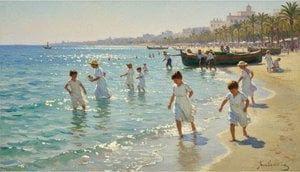
Joaquín Sorolla: Capturing Spanish Light & Life – A Legacy of Impressionism
Explore the luminous world of Joaquín Sorolla, Spanish master of Impressionism. Discover his life, techniques & legacy – a guide for art collectors and enthusiasts. Invest in timeless beauty.

Echoes of Time: Exploring the Enduring Appeal & Historical Context of Vintage Art Prints
Explore the captivating world of vintage art prints! Discover their history, collecting tips & enduring appeal. Expert insights on chromolithography and building a legacy collection with ArtsDot.

The Enduring Legacy of Fine Art Prints: Technique, History & Aesthetic Impact
Explore the rich history & techniques of fine art prints. Discover investment potential, assess authenticity, and learn how to preserve your collection with expert guidance. Trusted insights for discerning collectors.
Crimson Threads of Narrative: Exploring Symbolism & Representation in Artworks Featuring the Red Dress
Explore the rich symbolism of the red dress in art history! From ancient power displays to iconic portraits like Cézanne’s 'Madame Cezanne', discover the cultural and artistic significance behind this captivating color. Expert analysis & insights.

L'Excellence de l'Impression Giclée : Guide Technique pour des Reproductions d'Art de Qualité Musée
Maîtrisez la technique giclée et les encres pigmentaires pour vos collections. Découvrez les secrets d'une impression de qualité musée.


