


The picture follows your choices: , .
Description de la pièce
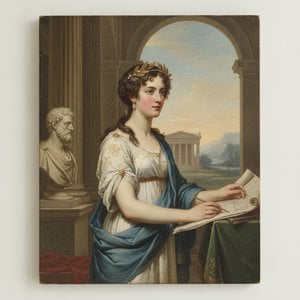
Jacques-Louis David's "Sappho et Phaon" captivates with neoclassical elegance—a poignant myth retelling embodying passion and idealized beauty. Admire its masterful technique & historical context!
 Lire la suite
Biographie de l'artiste
Jacques-Louis David (1748-1825) : Peintre néoclassique français majeur de la Révolution et des époques napoléoniennes. Connu pour 'Le Serment des Horaces', son art incarne le héroïsme, le drame et les idéaux classiques. Explorez son héritage chez ArtsDot!
Reproduction à l'huile faite à la main
Huile sur toile peinte à la main, avec cadre et dimensions personnalisés, réalisée sur commande par nos artistes. ( Passer au format impression Passer au format numérique)
More about this painting
 Aperçu en situation
 Envoyer
 Partager
 Détails de l'œuvre
 Guide
Guide

 Télécharger l'image
 Articles similaires
 Radiographie
 Diaporama
 Q&A
Q&A Statistiques
Order your painting in four simple steps
Take your time. You can change any answer; the price in your order card follows each choice.
1 Step one of four
Which size would you like?
These sizes keep the proportions of the original painting. The drawing shows your choice on a wall, above a two-metre sofa.
Or give your own measurements
Choisissez parmi nos formats prédéfinis qui respectent les proportions originales de l’œuvre.

Saisissez la largeur et la hauteur souhaitées, pour s'adapter à votre cadre ou à votre mur. Cette œuvre est peinte à la main ; ainsi, pour un format de forme différente, l'artiste peut peindre un peu plus autour du tableau ou réduire légèrement les bords — c'est vous qui choisissez. Nous vous envoyons une maquette numérique pour approbation avant que la peinture ne commence. L'image présentée sur cette page ne reflète pas le résultat réel — seule la maquette le fait.
2 Step two of four
How should it be prepared: rolled, stretched or framed?
The prices below are for the size you chose in step one.
Choose the edges of the stretched canvas
Choose your frame

White €1

Blurside €1

Extended €1

P118B €10

P118H €10

P118W €10

P438Z €10

P508JH €12

P508YH €12

P805H €10

P805Z €10

P919BZ €10

P919G €10

P919XJ €10

P959ZH €10

P968JZ €12

W106C €8

W218G €10

W218JH €8

W218Y €10

W307PJ €10

W316G €10

W316PJ €8

W316Y €10

W398PJ €8

W4111J €10

W500HY €15

W500JH €15

W692G €12

W849H €8

W940BG €15

W953PJ €8

H24-GOLD €30

H24-SILVER €30

H36-GOLD €45

H36-SILVER €45
Sous cadre
Moulding: . Overall size with the frame: .
3 Step three of four
Would you like anything changed in the painting?
Most people answer no. Because each painting is made by hand, our artist can also adapt it for you.
After order, ArtsDot.com team will email client for instructions and provide a mockup preview
4 Step four of four
A few finishing options
All of them are optional. The answers already selected cost nothing extra.
Who paints it?
Livraison dans le monde entier () en 3 à 4 semaines au lieu des 5 semaines habituelles. (29 octobre). Aucun compromis sur la qualité.
A nameplate, as in a museum?
Détails de la plaque en bronze gravée
This elegant plaque features the artist's name and the title of the artwork, finely engraved for a timeless presentation.
It is made from bronze with a refined, elegant finish. The text is precisely laser-engraved for a sharp and permanent result. Measuring 9x2 cm, the plaque is compact yet easy to read. It's built to be durable and scratch-resistant, offering a professional, museum-quality look. Mounting is simple thanks to the included adhesive backing.
Détails de la plaque en acrylique transparent
The plaque includes essential engraved details such as the artist's name, the title of the artwork, the date it was created, the type of media used-like oil on canvas or watercolor-a brief description of the piece, and a QR code that links to the complete artwork information.
It is crafted from clear acrylic, offering a sleek, modern appearance. The text is UV-engraved in black to ensure strong visual contrast. With a size of 10x15 cm, it ensures optimal readability. It comes equipped with two metal hooks for secure wall mounting. The plaque is designed to be weather-resistant, making it suitable for various environments, and it includes interactive features that work seamlessly with smartphone scanning.
Détails de la plaque en acrylique noir
This elegant plaque includes engraved information such as the artist's name, the title of the artwork, the date it was created, the type of media used (like oil on canvas or watercolor), a short description of the artwork, and a QR code for quick access to more information.
The plaque itself is made from refined black acrylic with a premium finish. The text is laser-engraved in white for high contrast and readability. Its size is 10x15 cm, designed to be easy to read. It comes with two metal hooks for professional mounting. The design is sleek and fits any interior style. It is also weather-resistant and durable, with built-in digital integration for mobile compatibility.
A protective varnish?
When do you need it?
✓ Check and order
Your painting, as you ordered it

Sappho et Phaon
Technique de reproduction
Format de la reproduction
-

Artiste de prestige
Plus de détails, de finesse et un temps de production accru
-

Cadre de reproduction
-
-
Pour les œuvres ou reproductions dont un côté mesure plus de 105 cm (environ 41 pouces), le cadre sera expédié sous forme de kit démonté. Cette méthode garantit une livraison sécurisée et prévient tout dommage pendant le transport.
Assemblage professionnel requis - ce produit n'est pas destiné au bricolage (DIY).
Le kit doit être assemblé et la toile tendue par un encadreur professionnel expérimenté, en utilisant de la colle à bois (non fournie), une pince à tendre la toile et des serre-joints pour maintenir les traverses d'équerre pendant le séchage de la colle. Un assemblage incorrect ou une tension inégale de la toile peut endommager l'œuvre de manière irréversible et n'est pas couvert par notre garantie.
 Pour les œuvres ou reproductions dont un côté mesure plus de 105 cm (environ 41 pouces), le cadre sera expédié sous forme de kit démonté. Cette méthode garantit une livraison sécurisée et prévient tout dommage pendant le transport.
Toutes les baguettes en bois massif sont incluses, découpées avec précision à la taille requise.
À assembler avec les vis fournies, ainsi qu'avec de la colle à bois pour les assemblages d'angles (non fournie), à prévoir par votre encadreur.
L'utilisation d'outils professionnels est requise et non incluse : une pince à tendre la toile (tendeur) et des serre-joints pour maintenir les baguettes bien d'équerre pendant le séchage de la colle.
Important :
L'assemblage des angles nécessite de la colle à bois, les barres doivent être maintenues avec des serre-joints jusqu'au séchage complet de la colle, et le tendage de la toile sur le châssis assemblé nécessite une pince à tendre la toile. Aucun de ces éléments n'est inclus dans le kit. Veuillez consulter un encadreur professionnel expérimenté avant de commander ce format.

Cartel
-
-

Vernis de protection
Vernis brillant (intensifie les couleurs, protège de la lumière et de l'humidité)
-

Personnaliser mon œuvre
Exemples de personnalisation : remplacer le visage par une photo du client ; ajouter un animal de compagnie (par exemple, remplacer un chat par un chien) ; inclure un message caché en arrière-plan ; modifier le paysage ou les éléments d'arrière-plan.
-

Livraison urgente
Livraison dans le monde entier () en 3 à 4 semaines au lieu des 5 semaines habituelles. (29 octobre). Aucune concession sur la qualité.
-
Livraison express
Livraison dans le monde entier () sous 5 semaines. (5 novembre).
Inclus
Prix total
€ 276
L'option verre n'est disponible que pour les dimensions inférieures à 110 cm.
Included with every order
- Livraison express gratuite dans le monde entier
- Toile de lin de qualité supérieure
- Assurance transport complète
- Garantie de remboursement des droits de douane
- Garantie de fidélité des couleurs
- Politique de retour de 100 jours (uniquement en cas de défaut)
- Garantie de remboursement à 100%
- Offre de tarifs dégressifs


Sappho and Phaon: A Neoclassical Tale of Passion and Desire
Jacques-Louis David’s “Sappho and Phaon” (1809) is a captivating neoclassical painting that transports viewers to a world of ancient myth, intense emotion, and dramatic storytelling. Commissioned by Prince Nikolai Yusupov, this masterpiece—the sole work by David housed in the Hermitage Museum—offers a compelling glimpse into the artist’s mastery of form, color, and narrative.Subject Matter: A Myth Retold
The painting depicts the legendary love story of Sappho, the renowned lyric poet from ancient Greece, and Phaon, the ferryman who captivated her heart. David portrays a pivotal moment in their romance – a scene brimming with longing, vulnerability, and burgeoning passion. Sappho is seated, leaning back as Phaon tenderly supports her head, while Cupid attempts to rekindle the flame of love with his lyre. The composition draws directly from the classical tale, reimagined through David’s distinctive artistic lens.Style & Technique: Neoclassical Perfection
“Sappho and Phaon” exemplifies the hallmarks of neoclassical art. David meticulously crafts a scene characterized by order, balance, and idealized beauty. The figures are rendered with anatomical precision, reminiscent of classical sculpture. His technique showcases:- Smooth brushwork that creates a polished surface
- Masterful use of chiaroscuro – the dramatic contrast between light and shadow – to heighten emotional impact.
- A rich, vibrant color palette that enhances the opulence of the setting.
- Precise detailing in fabrics, architectural elements, and facial expressions.
Historical Context: From Revolution to Empire
David’s career spanned a tumultuous period in French history – from the fervor of the French Revolution to the rise of Napoleon. While this painting was created later in his life, after the revolutionary period, it still reflects his commitment to classical ideals as a means of conveying universal truths about human experience. The work's commission by a Russian prince also speaks to the international demand for David’s art and the enduring appeal of neoclassical aesthetics. It echoes earlier works like “The Loves of Paris and Helen,” demonstrating a continued fascination with mythological narratives.Symbolism & Interpretation
Beyond its surface beauty, "Sappho and Phaon" is rich in symbolic meaning:- Cupid’s presence represents the power of love and desire.
- The lyre symbolizes Sappho's poetic voice and artistic expression.
- The opulent interior suggests a world of luxury, sensuality, and refined taste.
- Phaon’s protective gesture embodies the tenderness and devotion within their relationship.
Emotional Impact & Aesthetic Appeal
“Sappho and Phaon” evokes a powerful emotional response. The painting's dramatic composition, combined with its exquisite detail and vibrant colors, creates an atmosphere of intense passion and vulnerability. It’s a work that invites contemplation on the complexities of love, desire, and the enduring power of myth. Its balanced composition and refined aesthetic make it a stunning focal point for any interior—from classic to contemporary—and a treasured addition to any art collection. The painting's timeless quality ensures its continued relevance and appeal for generations to come. Photo Description: --Overall Impression-- The artwork is a neoclassical painting depicting a dramatic scene of Cupid and Psyche. It’s characterized by a rich color palette, dynamic composition, and meticulous detail typical of the era. The scene unfolds within an opulent interior setting – a richly decorated chamber with columns, drapery, and furniture – suggesting a luxurious and intimate space. The central figures, Cupid and Psyche, are engaged in a passionate embrace amidst a chaotic struggle. Cupid is depicted as muscular and heroic, holding a bow and arrow, while Psyche lies wounded on a bed, her expression conveying vulnerability and pain. Two cherubic attendants flank the scene, one presenting a mirror to Cupid and the other attempting to restrain Psyche’s movement. The composition is triangular, with the figures forming the apex of the triangle, drawing the viewer's eye towards the central action. Lines are used extensively to define forms – strong outlines delineate the bodies, drapery, and architectural elements. The use of shapes is predominantly organic, reflecting the human form and naturalistic details. Textures are rendered through careful brushwork, creating a sense of depth and realism in the fabrics, skin tones, and metallic objects. Lighting is dramatic, with a central light source illuminating the figures and casting shadows that emphasize their forms and create a sense of drama. Perspective is employed to establish spatial relationships within the scene, giving a feeling of depth to the room and the surrounding landscape visible through an arched window. The subject matter is based on the mythological tale of Cupid and Psyche, exploring themes of love, passion, jealousy, and reconciliation. Symbolically, the mirror represents self-knowledge and acceptance, while the struggle reflects the challenges inherent in romantic relationships. The style aligns with neoclassical art, emphasizing classical ideals of beauty, harmony, and order. The technique is characterized by smooth brushwork, precise rendering of details, and a masterful use of chiaroscuro (contrast between light and dark). Materials used appear to be oil paints on canvas, evident from the texture and luminosity of the pigments. Size: Unknown Date: Unknown ARTIST INFORMATION: ================== Artist: Jacques-Louis David Birth Year: 1748 Death Year: 1825 Birth City: Paris Birth Country: France Biography:A Brushstroke Across Revolution: The Life and Art of Jacques-Louis David
Jacques-Louis David (1748-1825): Leading French Neoclassical painter of the Revolution & Napoleonic eras. Known for 'Oath of the Horatii,' his art embodies heroism, drama & classical ideals."Questions et réponses
L'œuvre « Sappho et Phaon » est-elle dans le domaine public ?
Concernant les droits d'auteur, « Sappho et Phaon » est dans le dans le domaine public - ses droits d'auteur sont tombés dans le domaine public.
Comment "Sappho et Phaon" équilibre-t-il l'ombre et la lumière ?
«Sappho et Phaon» de Jacques-Louis David présente une luminosité de ombres profondes, avec une luminance de Sombre.
Comment puis-je prévisualiser une reproduction de «Sappho et Phaon» de Jacques-Louis David ?
Un aperçu de «Sappho et Phaon» de Jacques-Louis David est disponible sur la page Aperçu en situation de l'œuvre.
Œuvres similaires


Jacques-Louis David
1748 - 1800, France
Biographie de l'artiste
Jacques-Louis David : Une vie dans l’art et la Révolution
Jeunesse et Formation
Jacques-Louis David, né le 30 août 1748 à Paris, en France, a été une figure clé de la transition de l'art rococo au néoclassique. Son père, également nommé Jacques-Louis David, était fabricant de boutons et est décédé lorsque jeune David avait neuf ans. Il a été élevé par son oncle, adjoint d’église, qui a reconnu et encouragé son talent artistique. David a initialement été apprenti chez François Boucher, un peintre en chef du style rococo, mais il a trouvé le travail de Boucher frivole. Plus tard, il a étudié auprès de Joseph-Marie Vien, dont l'accent sur la peinture historique et les sujets classiques lui a davantage résonné avec ses sensibilités esthétiques en développement. Il a poursuivi sans relâche la perfection, tentant même (et échouant à plusieurs reprises) à gagner la bourse du Prix de Rome.Développement artistique et style néoclassique
Le style artistique de David a évolué considérablement tout au long de sa carrière. Ses premières œuvres présentaient des traces d'influence rococo, mais il a progressivement adopté une approche plus austère et disciplinée, inspirée par l’antiquité classique. Il a rejeté la décoration ornée et les thèmes ludiques du rococo en faveur de la clarté, de l'ordre et de la moralité sérieuse. Son engagement envers le néoclassicisme a été alimenté par les découvertes archéologiques à Pompéi et Herculanum, qui ont fourni aux artistes de nouvelles connaissances sur l’art et l’architecture romains antiques. Les caractéristiques clés de son style comprennent une représentation précise du dessin, un éclairage dramatique et un accent sur les sujets historiques ou mythologiques imprégnés de vertu civique.La Révolution française et l'art révolutionnaire
David s’est profondément impliqué dans le tourbillon politique de la Révolution française. Il a été un fervent partisan de la cause révolutionnaire et un proche collaborateur de Maximilien Robespierre. Cette période a marqué un tournant dans sa carrière, car il a commencé à créer des peintures célébrant les idéaux républicains et glorifiant les héros révolutionnaires. “L’Échange sur l’Aube” (1784), bien qu'il précède la révolution, préfigurait ses thèmes de sacrifice et de devoir civique. Pendant le règne de Terreur, David a servi au Comité de salut public et a même signé la sentence à mort de Robespierre. Ses peintures de cette époque, telles que “La Mort de Marat” (1793), sont devenues des symboles puissants du martyre révolutionnaire.L'ère napoléonienne et commandes impériales
Après la chute de Robespierre, David a habilement s’adapté au nouveau paysage politique sous Napoléon Bonaparte. Il est devenu le peintre officiel de Napoléon et a reçu de nombreuses commandes pour commémorer les victoires et les réalisations de Napoléon. Ses peintures de cette période, notamment “Napoléon franchissant les Alpes” (1801-1805) et “La Coronation de Napoléon” (1807), sont monumentales en taille et méticuleusement détaillées, présentant Napoléon comme un leader héroïque. Il a incorporé des couleurs plus chaudes venues de Venise dans sa palette, reflétant un changement de style tout en maintenant sa précision néoclassique.Exil et vie ultérieure
Après la Restauration bourbonnaise en 1814, l’association de David au régime napoléonien en a fait une cible de persécution. Il s'est choisi l'exil à Bruxelles en 1816, où il a continué à peindre et à enseigner jusqu'à sa mort le 29 décembre 1825. Malgré les défis politiques, il est resté influent, produisant des œuvres importantes telles que “Mars désarmé par Vénus et les trois Grâces” (1824).Héritage et influence
L'héritage de Jacques-Louis David s’étend bien au-delà de sa propre production artistique. Il a été un enseignant très influent qui a formé de nombreux élèves, dont Jean-Auguste-Dominique Ingres, l'un des peintres néoclassiques les plus importants du XIXe siècle. Son accent sur le dessin, la composition et la précision historique a eu un impact durable sur l’art français. De plus, ses distorsions expressives de la forme et de l’espace ont influencé des artistes ultérieurs tels que Henri Matisse et Pablo Picasso. L'œuvre de David est toujours célébrée pour son pouvoir dramatique, sa rigueur intellectuelle et sa pertinence durable.Principales réalisations et signification historique
- A établi le néoclassicisme comme le style dominant dans la peinture française.
- A créé des images iconiques qui ont capturé l'esprit de la Révolution française et de l'ère napoléonienne.
- A servi de propagandiste puissant pour les régimes révolutionnaire et impérial.
- A formé une génération d’artistes influents qui ont perpétué son héritage.
- Ses œuvres sont des piliers essentiels des collections muséales du monde entier, notamment le Musée d'Art et d'Histoire et l'Art Institute of Chicago.


Articles connexes
The Revival of Antiquity: Exploring Ideals of Beauty & Power in Neoclassical Portraiture
Explore the captivating world of Neoclassical portraiture! Discover the power & ideals behind masterpieces by David, Girodet & more. Expert analysis, custom reproductions & art appraisal at ArtsDot.

The Revival of Antiquity: Exploring the Neoclassical Movement & its Enduring Legacy
Explore the revival of classical art with our deep dive into Neoclassicism! Discover key artists like Jacques-Louis David, Enlightenment influences & lasting impact on art history. High-quality reproductions at ArtsDot.

Le Réveil de l'Antiquité : Idéaux et Héritage Durable de l'Art Néoclassique
Explorez l'art néoclassique : ses origines, figures clés (David, Canova), et son héritage durable. Découvrez la simplicité, l'harmonie et la vertu de ce mouvement artistique majeur avec ArtsDot.