

 Aperçu en situation
 Envoyer
 Partager
 Détails de l'œuvre
 Guide
Guide

 Télécharger l'image
 Articles similaires
 Radiographie
 Diaporama
 Questions et réponses
 Statistiques
Sin título (Hombre desnudo con cuchillo)


 Lire la suite
Giclées et impressions d'art
Impressions giclées ou sur toile de qualité musée, avec une production rapide et des finitions au choix. ( Commander la reproduction peinte à la main Passer au format numérique)




P118B €10

P118H €10

P118W €10

P438Z €10

P508JH €12

P508YH €12

P805H €10

P805Z €10

P919BZ €10

P919G €10

P919XJ €10

P959ZH €10

P968JZ €12

W106C €8

W218G €10

W218JH €8

W218Y €10

W307PJ €10

W316G €10

W316PJ €8

W316Y €10

W398PJ €8

W4111J €10

W500HY €15

W500JH €15

W692G €12

W849H €8

W940BG €15

W953PJ €8




Choisissez parmi nos formats prédéfinis qui respectent les proportions originales de l’œuvre.

Saisissez la largeur et la hauteur souhaitées pour qu'elles s'adaptent à votre cadre ou à votre mur. Une impression peut être recadrée, mais jamais agrandie au-delà de l'image originale ; ainsi, un format de forme différente entraînera la perte d'une partie de l'image. Nous vous envoyons une maquette numérique pour approbation avant toute impression. L'image présentée sur cette page ne montre pas le recadrage réel — seule la maquette le permet.
Livraison dans le monde entier () en 2 semaines au lieu des 4/5 semaines habituelles. (4 novembre)

Livraison express gratuite dans le monde entier

Toile de lin de qualité supérieure

Assurance transport complète

Garantie de remboursement des droits de douane

Garantie de fidélité des couleurs

Politique de retour de 100 jours (uniquement en cas de défaut)

Garantie de remboursement à 100%

Offre de tarifs dégressifs
 L'option verre n'est disponible que pour les dimensions inférieures à 110 cm.

Sin título (Hombre desnudo con cuchillo)
Giclées et impressions d'art
Format de la reproduction
-


Prix total
€ 56
Une Scène Tumulte : Décryptage de ‘Sin título (Hombre desnudo con cuchillo)’ de Jackson Pollock
Cette œuvre puissante et sans titre, attribuée à Jackson Pollock – souvent appelée *‘Sin título (Hombre desnudo con cuchillo)’* ou “Untitled (Nude Man with Knife)” – est une exploration viscérale du conflit et de la lutte humaine. Créée au cœur de sa carrière prolifique, cette peinture à l’huile témoigne d'une évolution artistique remarquable vers l’abstraction émotionnelle et une anticipation des compositions toutes-sur-faites qui lui apporteraient la gloire mondiale. Elle marque un tournant majeur dans l'histoire de l'art moderne. Décodage de la Composition et du Style L’œuvre saisit immédiatement le regard avec son énergie désordonnée. Une composition serrée présente des figures chevauchées dans une confrontation apparemment violente. Pollock abandonne la perspective traditionnelle, aplatissant le plan pictural et présentant les formes d'une manière simplifiée, presque géométrique. Cette déformation volontaire, associée à des lignes diagonales fortes, génère un sentiment d’inquiétude et de mouvement dynamique. Le style est profondément ancré dans l’Expressionnisme, partageant des affinités avec les premières explorations cubistes de la forme fragmentée, tout en forgeant sa propre voie vers une pure abstraction. Cette approche artistique reflète les préoccupations esthétiques et émotionnelles de son époque. Technique et Matière La maîtrise de Pollock au niveau de la peinture à l’huile est manifeste dans toute l'œuvre. Il utilise une technique d'impasto robuste – appliquant des couches épaisses de peinture – pour créer une richesse de texture et souligner l’énergie brute de la scène représentée. La palette chromatique, dominée par des rouges profonds, des bruns et du noir, évoque les sentiments du sang, de l’ombre et de la sauvagerie primaire. Des éclairs blancs et gris interrompent l’obscurité, accentuant le contraste dramatique. Les coups de pinceau visibles ne sont pas seulement un moyen d'application mais deviennent essentiels à la puissance expressive de la peinture, révélant l'engagement physique de l'artiste avec la toile. Cette méthode innovante est caractéristique du mouvement artistique auquel Pollock appartenait. Contexte Historique et Symbolisme Créée au milieu des années 1940, ‘Sin título (Hombre desnudo con cuchillo)’ fait partie d’une période où l’Expressionnisme américain était en pleine ascension. Cette œuvre reflète les tensions politiques et sociales de l'après-guerre et une quête pour exprimer les émotions profondes avec une liberté nouvelle. Bien que la narration exacte reste ouverte à l’interprétation, la présence d’un homme nu tenant un couteau suggère des thèmes de vulnérabilité, de menace et peut-être même de mort – préoccupations universelles explorées par les artistes expressionnistes de cette époque. Cette image puissante est une invitation à une réflexion sur la condition humaine et la lutte pour la survie. Impact Émotionnel et Réinterprétation Contemporaine La beauté esthétique de ‘Sin título (Hombre desnudo con cuchillo)’ réside dans sa capacité à provoquer une réaction émotionnelle chez le spectateur. Les couleurs vives et les textures riches invitent à une contemplation attentive, tandis que la composition désordonnée stimule l’imagination et encourage une interprétation personnelle. Aujourd'hui, cette œuvre continue d’inspirer artistes et designers qui cherchent à créer des œuvres originales et chargées d'émotion – une véritable héritage artistique du mouvement expressionniste américain. Une reproduction haute qualité permet de découvrir pleinement la puissance expressive de cette peinture emblématique.Questions et réponses
«Sin título (Hombre desnudo con cuchillo)» de Jackson Pollock est-il une œuvre célèbre ?
« Sin título (Hombre desnudo con cuchillo) » est classé comme Reconnue.
Comment le style de « Sin título (Hombre desnudo con cuchillo) » s'inscrit-il dans l'époque de son créateur ?
Dans «Sin título (Hombre desnudo con cuchillo)» de Jackson Pollock, le mouvement Expressionnisme Abstrait rencontre l'époque Époque moderne.
Quelle atmosphère se dégage de « Sin título (Hombre desnudo con cuchillo) » ?
«Sin título (Hombre desnudo con cuchillo)» dégage une atmosphère Dramatique.
Œuvres similaires


Biographie de l'artiste
Early Life and the Seeds of Innovation
Paul Jackson Pollock, born in Cody, Wyoming, in 1912, was a restless spirit from the outset. His early life was marked by frequent relocation as his father pursued work as a land surveyor across the vast landscapes of the American West. This itinerant existence instilled in young Pollock a deep connection to the natural world and an exposure to diverse cultures, particularly through encounters with Native American art during those surveying trips – impressions that would subtly permeate his artistic vision later in life.
Pollock’s formal artistic training began at the Manual Arts High School in Los Angeles, followed by studies at the Art Students League of New York under the tutelage of Thomas Hart Benton. Benton, a prominent figure in the Regionalist movement, emphasized rhythmic composition and narrative themes rooted in American life. While Pollock initially absorbed these lessons, his inherent inclination leaned toward more abstract explorations. He was also profoundly impacted by Mexican muralists like José Clemente Orozco, whose powerful depictions of social struggle resonated deeply with him. These early influences laid a foundation, but it was the burgeoning world of Surrealism that truly unlocked Pollock’s artistic potential.
The Birth of Action Painting and a Revolutionary Technique
The 1930s saw Pollock experimenting with various techniques, seeking alternatives to traditional brushwork. He began pouring paint, exploring its fluidity and unpredictable nature. However, it was around 1947 that his artistic trajectory underwent a radical transformation. Abandoning the easel altogether, Pollock laid canvases directly on the floor, initiating what would become known as his “drip painting” technique.
This wasn’t merely about applying paint; it was about embodying the act of creation itself. Pollock's canvases became arenas for physical expression, capturing the immediacy of his gestures and emotions. The resulting paintings are characterized by their “all-over” composition – a lack of central focus that invites the viewer to explore the entire surface as a unified field of energy. Intricate networks of lines and colors intertwine, creating a visual complexity that is both captivating and challenging. He employed unconventional tools—sticks, knives, even syringes—to manipulate the paint in unpredictable ways, further emphasizing the spontaneous nature of his process.
This innovative approach positioned Pollock as a central figure in the burgeoning Abstract Expressionist movement, which emerged in post-World War II New York City. Abstract Expressionism prioritized spontaneous gesture, large scale, and non-representational imagery, reflecting a broader cultural shift away from traditional artistic conventions. His marriage to fellow artist Lee Krasner was also pivotal; she provided unwavering emotional support and actively encouraged his artistic development, recognizing the groundbreaking nature of his work.
Iconic Works and Lasting Legacy
Pollock’s most celebrated works—such as Number 1, 1950 (Lavender Mist), One: Number 31, 1950, Blue Poles: Number 11, 1952, and Convergence—are testaments to his revolutionary technique. These paintings are not simply images; they are records of a performance, imbued with the artist’s physical presence and emotional intensity. The dynamic energy that emanates from these canvases is palpable, drawing viewers into a world of pure abstraction.
His style transcends mere aesthetics; it's an exploration of process over product. Pollock sought to capture the immediacy of his actions and emotions on canvas, rejecting traditional notions of composition and representation. He delved into Jungian psychology, exploring archetypes and the subconscious in his art, seeking to tap into universal symbols and primal energies.
Pollock’s impact on the history of art is immeasurable. He fundamentally altered the way artists approached painting, breaking free from easel-based methods and embracing a more performative approach. His work helped solidify New York City's position as a global center for modern art, shifting the focus away from European dominance. His influence can be seen in the work of countless artists who followed, including those associated with Color Field painting and later forms of abstract expressionism.
Though initially met with mixed reviews—some critics dismissed his work as chaotic or lacking skill—Pollock’s reputation grew steadily after his untimely death in 1956 at age 44. Today, he is universally recognized as one of the most important and influential artists of the 20th century, a visionary who dared to challenge conventions and redefine the boundaries of artistic expression.

Jackson Pollock
1912 - 1956 , États-Unis
L'essentiel de l'artiste
- Artistic Movement Or Style: Abstract Expressionism
- Artists Who Influenced This Artist:
- José Clemente Orozco
- Thomas Hart Benton
- Date Of Birth: January 28, 1912
- Date Of Death: August 11, 1956
- Full Name: Paul Jackson Pollock
- Nationality: American
- Notable Artworks:
- Number 1, 1950 (Lavender Mist)
- One: Number 31, 1950
- Blue Poles: Number 11, 1952
- Convergence
- Place Of Birth: Cody, USA
Articles connexes

Beyond Representation: Emotional Depth & Formal Innovation in Abstract Expressionism
Explore the profound emotional depth & formal innovation of Abstract Expressionism. Discover key artists, collecting insights, and investment potential with expert guidance. Learn more now.

Au-Delà de la Représentation : L'Évolution Durable et l'Impact Profond de l'Art Abstrait
Explorez l'évolution fascinante de l'art abstrait avec ArtsDot. Découvrez les maîtres (Kandinsky, Pollock…) et apprenez à collectionner des œuvres d'exception. Conseils d'experts pour investir et sublimer votre intérieur.
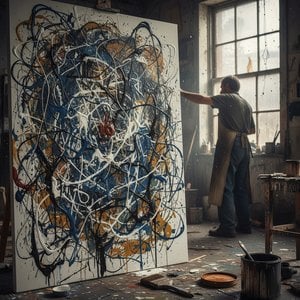
Jackson Pollock : Une Déconstruction Radicale de l'Expressionnisme Abstrait et Son Héritage Durable
Explorez l'univers révolutionnaire de Jackson Pollock et de l'expressionnisme abstrait. Découvrez son héritage, sa technique unique et l'impact durable de ce mouvement artistique majeur. Analyse approfondie pour collectionneurs avertis.

Au-Delà de la Représentation : Exploration du Paysage Émotionnel de l'Expressionnisme Abstrait
Explorez l'univers fascinant de l'Expressionnisme Abstrait avec ArtsDot. Analyse approfondie des maîtres (Pollock, Rothko, De Kooning) et conseils d'experts pour collectionner ces œuvres emblématiques. Découvrez une sélection unique.

Expressionnisme Abstrait : Les 10 Chefs-d'Œuvre Incontournables pour Décorer avec Art et Histoire
Plongez au cœur de l'Expressionnisme Abstrait avec ! Découvrez les 10 œuvres majeures de Pollock, Rothko et De Kooning. Histoire, techniques & inspiration déco. Explorez la collection complète en ligne.


