


L'image s'adapte à vos choix : , .
Description de la pièce
Découvrez Écho de Jackson Pollock : une œuvre abstraite emblématique du mouvement Expressionnisme Abstrait où les lignes et les formes chaotiques créent une danse visuelle fascinante.
 Lire la suite
Biographie de l'artiste
Expressionniste abstrait américain, célèbre pour ses techniques de dripping rythmiques et ses compositions all-over.
Commandez votre en quatre étapes simples
Prenez votre temps. Vous pouvez modifier chaque réponse ; le prix dans votre panier s'ajustera selon vos choix.
1 Première étape sur quatre
Quel format souhaitez-vous ?
Ces formats respectent les proportions de l'œuvre originale. Le dessin illustre votre choix sur un mur, au-dessus d'un canapé de deux mètres.
Ou indiquez vos propres dimensions
Choisissez parmi nos formats prédéfinis qui respectent les proportions originales de l’œuvre.

Saisissez la largeur et la hauteur souhaitées, pour s'adapter à votre cadre ou à votre mur. Cette œuvre est peinte à la main ; ainsi, pour un format de forme différente, l'artiste peut peindre un peu plus autour du tableau ou réduire légèrement les bords — c'est vous qui choisissez. Nous vous envoyons une maquette numérique pour approbation avant que la peinture ne commence. L'image présentée sur cette page ne reflète pas le résultat réel — seule la maquette le fait.
2 Deuxième étape sur quatre
Comment doit-il être préparé : roulé, tendu ou encadré ?
Les prix ci-dessous correspondent au format choisi à l'étape précédente.
Choisissez le type de bordure pour votre toile tendue
Choisissez votre cadre

Bords blancs €1

Bords estompés €1

Bords imprimés €1

P118B €10

P118H €10

P118W €10

P438Z €10

P508JH €12

P508YH €12

P805H €10

P805Z €10

P919BZ €10

P919G €10

P919XJ €10

P959ZH €10

P968JZ €12

W106C €8

W218G €10

W218JH €8

W218Y €10

W307PJ €10

W316G €10

W316PJ €8

W316Y €10

W398PJ €8

W4111J €10

W500HY €15

W500JH €15

W692G €12

W849H €8

W940BG €15

W953PJ €8

H24-GOLD €30

H24-SILVER €30

H36-GOLD €45

H36-SILVER €45
Sous cadre
Baguette : . Dimensions hors tout avec le cadre : .
3 Troisième étape sur quatre
Souhaitez-vous apporter des modifications à la peinture ?
La plupart des gens répondent non. Comme chaque peinture est réalisée à la main, notre artiste peut également l'adapter pour vous.
Après la commande, l'équipe de ArtsDot.com contactera le client par e-mail pour obtenir ses instructions et lui fournir un aperçu de la maquette
4 Quatrième étape sur quatre
Quelques options de finition
Tous sont facultatifs. Les réponses déjà sélectionnées ne comportent aucun coût supplémentaire.
Qui l'a peint ?
Livraison dans le monde entier () en 3 à 4 semaines au lieu des 5 semaines habituelles. (23 novembre). Aucun compromis sur la qualité.
Une plaque nominative, comme au musée ?
Détails de la plaque en bronze gravée
This elegant plaque features the artist's name and the title of the artwork, finely engraved for a timeless presentation.
It is made from bronze with a refined, elegant finish. The text is precisely laser-engraved for a sharp and permanent result. Measuring 9x2 cm, the plaque is compact yet easy to read. It's built to be durable and scratch-resistant, offering a professional, museum-quality look. Mounting is simple thanks to the included adhesive backing.
Détails de la plaque en acrylique transparent
The plaque includes essential engraved details such as the artist's name, the title of the artwork, the date it was created, the type of media used-like oil on canvas or watercolor-a brief description of the piece, and a QR code that links to the complete artwork information.
It is crafted from clear acrylic, offering a sleek, modern appearance. The text is UV-engraved in black to ensure strong visual contrast. With a size of 10x15 cm, it ensures optimal readability. It comes equipped with two metal hooks for secure wall mounting. The plaque is designed to be weather-resistant, making it suitable for various environments, and it includes interactive features that work seamlessly with smartphone scanning.
Détails de la plaque en acrylique noir
This elegant plaque includes engraved information such as the artist's name, the title of the artwork, the date it was created, the type of media used (like oil on canvas or watercolor), a short description of the artwork, and a QR code for quick access to more information.
The plaque itself is made from refined black acrylic with a premium finish. The text is laser-engraved in white for high contrast and readability. Its size is 10x15 cm, designed to be easy to read. It comes with two metal hooks for professional mounting. The design is sleek and fits any interior style. It is also weather-resistant and durable, with built-in digital integration for mobile compatibility.
Un vernis protecteur ?
Pour quand en avez-vous besoin ?
✓ Vérifier et commander
Votre tableau, tel que vous l'avez commandé

Écho
Technique de reproduction
Format de la reproduction
-

Artiste de prestige
Plus de détails, de finesse et un temps de production accru
-

Cadre de reproduction
-
-
Pour les œuvres ou reproductions dont un côté mesure plus de 105 cm (environ 41 pouces), le cadre sera expédié sous forme de kit démonté. Cette méthode garantit une livraison sécurisée et prévient tout dommage pendant le transport.
Assemblage professionnel requis - ce produit n'est pas destiné au bricolage (DIY).
Le kit doit être assemblé et la toile tendue par un encadreur professionnel expérimenté, en utilisant de la colle à bois (non fournie), une pince à tendre la toile et des serre-joints pour maintenir les traverses d'équerre pendant le séchage de la colle. Un assemblage incorrect ou une tension inégale de la toile peut endommager l'œuvre de manière irréversible et n'est pas couvert par notre garantie.
 Pour les œuvres ou reproductions dont un côté mesure plus de 105 cm (environ 41 pouces), le cadre sera expédié sous forme de kit démonté. Cette méthode garantit une livraison sécurisée et prévient tout dommage pendant le transport.
Toutes les baguettes en bois massif sont incluses, découpées avec précision à la taille requise.
À assembler avec les vis fournies, ainsi qu'avec de la colle à bois pour les assemblages d'angles (non fournie), à prévoir par votre encadreur.
L'utilisation d'outils professionnels est requise et non incluse : une pince à tendre la toile (tendeur) et des serre-joints pour maintenir les baguettes bien d'équerre pendant le séchage de la colle.
Important :
L'assemblage des angles nécessite de la colle à bois, les barres doivent être maintenues avec des serre-joints jusqu'au séchage complet de la colle, et le tendage de la toile sur le châssis assemblé nécessite une pince à tendre la toile. Aucun de ces éléments n'est inclus dans le kit. Veuillez consulter un encadreur professionnel expérimenté avant de commander ce format.

Cartel
-
-

Vernis de protection
Vernis brillant (intensifie les couleurs, protège de la lumière et de l'humidité)
-

Personnaliser mon œuvre
Exemples de personnalisation : remplacer le visage par une photo du client ; ajouter un animal de compagnie (par exemple, remplacer un chat par un chien) ; inclure un message caché en arrière-plan ; modifier le paysage ou les éléments d'arrière-plan.
-

Livraison urgente
Livraison dans le monde entier () en 3 à 4 semaines au lieu des 5 semaines habituelles. (23 novembre). Aucune concession sur la qualité.
-
Livraison express
Livraison dans le monde entier () sous 5 semaines. (30 novembre).
Inclus
Prix total
€ 235
L'option verre n'est disponible que pour les dimensions inférieures à 110 cm.
Inclus avec chaque commande
- Livraison express gratuite dans le monde entier
- Toile de lin de qualité supérieure
- Assurance transport complète
- Garantie de remboursement des droits de douane
- Garantie de fidélité des couleurs
- Politique de retour de 100 jours (uniquement en cas de défaut)
- Garantie de remboursement à 100%
- Offre de tarifs dégressifs


Écho : Une Danse entre Chaos et Contrôle
L’œuvre « Écho » de Jackson Pollock, numéro 25, réalisée en 1951, s'érige comme un témoignage vibrant de la ferveur de l'Expressionnisme Abstrait — un mouvement qui a cherché à libérer l'art des contraintes représentatives pour plonger dans les profondeurs de l'émotion humaine. Capturé ici par une photographie en noir et blanc saisissante, ce dessin incarne l'esprit de la technique révolutionnaire du drip painting de Pollock, privilégiant le geste et la spontanéité plutôt qu'une planification méticuleuse.
- Composition : L'image se concentre sur une section recadrée de la toile, délaissant la perspective traditionnelle pour accentuer une complexité visuelle. Les formes s'entrelacent et se superposent, créant un champ captivant où l'œil erre sans destination prédéterminée — une rupture délibérée avec les conventions artistiques classiques.
- Palette de couleurs : Dépouillé de toute couleur, « Écho » utilise des tons de gris avec de subtiles nuances, amplifiant l'impact dramatique de l'œuvre. Ce choix monochrome souligne la préoccupation de la peinture pour la texture et la forme plutôt que pour l'illusion visuelle.
- Technique : Exécuté à l'encre ou au fusain sur papier, le dessin illustre la méthode emblématique de Pollock — un processus où la peinture est projetée sur la surface depuis une certaine hauteur, produisant des motifs et des textures imprévisibles. Les lignes fluides transmettent une immédiateté et une intensité émotionnelle palpables.
L'éclairage soigné de la photographie révèle la texture de la surface de l'œuvre, mettant en lumière la superposition des traces qui contribuent à sa densité visuelle globale. C'est comme si Pollock lui-même nous avait invités dans son atelier, capturant un instant de pure ferveur créatrice.
Racines dans le Régionalisme et Premières Influences
Le voyage artistique de Paul Jackson Pollock a débuté au cœur des paysages expansifs du Wyoming — une expérience formatrice qui lui a inculqué un profond respect pour les formes et les textures naturelles. Ses études à l'Art Students League sous la direction de Thomas Hart Benton l'ont exposé aux principes du Régionalisme, un mouvement prônant un art ancré dans l'identité américaine et imprégné de résonance émotionnelle. L'accent mis par Benton sur la composition rythmique a sans aucun doute influencé l'approche de Pollock en matière de narration visuelle.
Résonance Symbolique : Le Chaos comme Expression
« Écho » n'est pas un simple exercice de forme abstraite ; il témoigne d'une exploration psychologique plus profonde. L'agencement chaotique des lignes et des formes reflète le paysage intérieur turbulent de l'artiste, véhiculant simultanément des sentiments d'anxiété et de dynamisme. À l'instar de nombreuses œuvres expressionnistes abstraites, « Écho » résiste à toute interprétation littérale, invitant le spectateur à s'engager avec son cœur émotionnel.
Un Héritage d'Innovation
La technique révolutionnaire de Pollock — le drip painting — a transformé la pratique artistique, établissant un nouveau paradigme pour l'expression visuelle. « Écho », numéro 25, 1951, illustre parfaitement cet héritage, consolidant la place de Pollock parmi les figures les plus influentes de l'art moderne et inspirant des générations d'artistes à repousser les limites et à embrasser la spontanéité.
Questions et réponses
Quelle couleur domine la composition de «Écho» de Jackson Pollock ?
Brun espresso (#615b55) est la couleur dominante de «Écho» de Jackson Pollock.
Comment puis-je télécharger l'image de «Écho» de Jackson Pollock ?
L'image de «Écho» de Jackson Pollock peut être téléchargée sur la page de téléchargement de l'œuvre : Téléchargement (téléchargement d'une image numérique haute résolution).
Quelle place occupe «Écho» de Jackson Pollock dans l'histoire de l'art ?
«Écho» de Jackson Pollock appartient au mouvement Abstract Expressionism, durant la période Époque moderne.
En savoir plus sur cette peinture
 Aperçu en situation
 Passer au format impression
 Envoyer
 Partager
 Détails de l'œuvre
 Guide
Guide

 Télécharger l'image
 Articles similaires
 Radiographie
 Diaporama
 Questions et réponses
 Statistiques
Œuvres similaires


Jackson Pollock
1912 - 1956, États-Unis
Biographie de l'artiste
Jeunesse, famille et formation
L'histoire de Paul Jackson Pollock commence dans les paysages sauvages de Cody, dans le Wyoming, où il est né le 28 janvier 1912. Dernier de cinq frères, il est le fils de Stella May McClure et de LeRoy Pollock. Son père exerçait le métier d'arpenteur, une profession exigeant des déplacements constants à travers l'immensité de l'Ouest américain. Cette existence nomade a marqué les premières années du jeune garçon par des déménagements fréquents, une instabilité qui semblait faire écho aux horizons changeants du travail de son père. Ces premiers voyages à travers l'Ouest lui ont offert une rencontre directe et brute avec le monde naturel et la résonance spirituelle de l'art amérindien, des impressions qui allaient s'imprégner silencieusement dans son subconscient bien avant qu'il ne tienne un pinceau.
En grandissant, sa quête d'appartenance l'a porté vers l'énergie urbaine de la côte. Il s'est inscrit à la Manual Arts High School de Los Angeles, cherchant une structure formelle pour ses impulsions naissantes. Cependant, la véritable maîtrise de son geste ne s'est opérée que bien plus tard, lors de son installation à New York. C'est là, à l'Art Students League, qu'il a entamé une période d'étude longue et transformative. De 1929 à 1942, il a travaillé sous la direction de Thomas Hart Benton. Tandis que Benton mettait l'accent sur les compositions rythmiques et la dimension narrative de la vie américaine, le jeune étudiant commençait déjà à dériver vers ses propres vérités intérieures, plus abstraites.
Le développement d'une technique unique
Dès 1947, un changement profond s'est emparé de sa manière d'aborder la toile. S'éloignant de l'usage traditionnel du chevalet, il choisit plutôt de poser ses toiles directement sur le sol. Cette mutation lui permettait de se tenir au-dessus de son œuvre, devenant ainsi une partie intégrante de l'acte créatif lui-même. Il ne se contentait plus d'appliquer la peinture ; il la laissait goutter, l'éclaboussait et la projetait depuis les hauteurs, laissant le liquide s'écouler selon des motifs imprévisibles. Cette méthode a transformé l'acte de peindre en une véritable performance physique, où la gravité et le geste dictaient la forme finale.
Ses outils étaient aussi peu conventionnels que ses méthodes. Il utilisait des bâtons, des couteaux et même des seringues pour manipuler ce médium fluide. Parfois, il employait des truelles ou de la peinture liquide pour obtenir des textures spécifiques. Il griffait souvent la surface ou utilisait des objets insolites pour bâtir une épaisse croûte de peinture, conférant à l'œuvre une qualité tactile et sculpturale. Ce processus relevait moins d'un travail de pinceau contrôlé que d'une libération d'énergie rythmique, presque primale, sur la surface de la toile.
Œuvres Clés et Expressions Artistiques
À mesure qu'il s'affranchissait des contraintes du chevalet, ses toiles ont commencé à refléter un engagement plus viscéral avec la matière. En 1943, il a produit Mural, une œuvre monumentale mesurant 2,4 par 6,1 m, qui témoignait de sa capacité à dompter une surface immense. Durant cette période, ses explorations de l'inconscient et l'acte même de peindre l'ont mené à des œuvres telles que Eyes in the Heat, créée vers 1946. Ces pièces n'étaient pas de simples images, mais les traces d'une présence physique, où le mouvement de tout son corps dictait l'emplacement de chaque éclaboussure et de chaque flaque de couleur.
Les années qui suivirent virent l'artiste perfectionner ces compositions rythmiques et "all-over" qui allaient définir sa réputation. Il cherchait à créer un sentiment d'espace infini, où aucun point unique ne dominait les autres. Cette approche est manifeste dans Number 1, 1949, une œuvre capturant un jaillissement d'énergie brute, ainsi que dans Lavender Mist, Number 1, 1950, qui demeure une pièce maîtresse de sa production. Dans ces œuvres, l'interaction entre le contrôle et le hasard crée un équilibre délicat, comme si la peinture était libérée plutôt qu'appliquée.
Ses expériences ultérieures ont continué de repousser les limites de la manipulation de la peinture sur une surface horizontale. Il utilisait souvent des bâtons, des couteaux, ou même les boîtes de peinture elles-mêmes pour projeter le pigment, créant ainsi des réseaux complexes de lignes. Cette méthode est clairement visible dans Blue Poles, Number 11, 1952 et dans l'énergique Convergence. À travers ces œuvres, il a atteint un état où la peinture semblait posséder sa propre vie, émergeant d'une immersion profonde dans sa propre imagination.
Mécènes, atelier et commandes
Le cours de sa carrière fut façonné tant par les nécessités publiques que par la générosité de quelques soutiens vitaux. Entre 1938 et 1942, il trouva un emploi stable en tant que peintre pour le WPA Federal Art Project, une période qui insuffla un rythme nécessaire à sa pratique en pleine évolution. Cette stabilité fit place à une alliance plus personnelle et transformatrice lorsque Peggy Guggenheim lui proposa un contrat de galerie en juillet 1943. Son soutien s'avéra bien plus que professionnel ; en 1945, elle lui accorda une avance de 2 000 dollars pour l'aider à s'installer, un geste qui entremêla profondément sa vie privée et sa survie artistique.
Sa vie créative finit par trouver son centre à East Hampton, New York. Là, au sein de la Pollock-Krasner House and Studio, il vécut et travailla aux côtés de son épouse, Lee Krasner. L'atelier était un lieu de mouvement physique intense, où les frontières entre l'artiste et la toile se dissolvaient. Il s'éloigna souvent du chevalet traditionnel, préférant poser ses toiles à même le sol pour interagir avec la peinture sous tous les angles. Cet espace de travail n'était pas une simple pièce de production, mais le théâtre d'une énergie profonde et tourmentée, là où s'opéraient ses expériences les plus radicales.
Les dernières années et la mort
La vie personnelle de l'artiste était profondément entrelacée avec ses luttes créatives. En 1945, il épousa l'artiste Lee Krasner, une union qui marqua sa vie par une présence essentielle durant ses années les plus transformatrices. Pourtant, sous la surface de son ascension professionnelle, une ombre persistante demeurait. Il fut confronté à une dépendance à l'alcool tout au long de son existence, un combat qui compliqua souvent son quotidien et sa capacité à affronter les pressions de sa célébrité grandissante.
Cette turbulence, tant intérieure qu'extérieure, connut une fin tragique à East Hampton, New York, aux États-Unis. Le 11 août 1956, à l'âge de 44 ans, sa vie fut brutalement fauchée par un accident soudain et violent. Alors qu'il conduisait, il fut impliqué dans une collision impliquant un seul véhicule, causée par l'alcool. L'accident s'avéra fatal, laissant derrière lui un héritage aussi tumultueux que la peinture qu'il projetait avec fureur sur ses toiles.
Héritage et influence sur l'art moderne
Les ondes de choc provoquées par ses méthodes radicales ont largement dépassé les murs de son atelier d'East Hampton. En brisant le lien traditionnel entre le pinceau et le chevalet, il est devenu une figure centrale du mouvement de l'expressionnisme abstrait, un basculement qui a fondamentalement altéré la trajectoire de la créativité américaine. Sa présence a contribué à consolider la position de New York comme centre mondial de l'art moderne, déplaçant le cœur de l'avant-garde de la domination européenne. Il fut l'un des premiers peintres américains à être reconnu comme l'égal des grands maîtres européens du XXe siècle, prouvant qu'un langage nouveau et viscéral pouvait émerger du sol des États-Unis.
Son influence a agi comme un catalyseur pour de nombreux mouvements artistiques ultérieurs qui ont suivi son sillage. Sa manière d'interagir avec la toile — la traitant comme une arène pour l'action physique plutôt que comme une simple surface de représentation — a ouvert des portes à ceux qui cherchaient à exprimer l'inconscient par le geste. Cette emphase sur le processus de création lui-même a laissé une empreinte indélébile dans l'histoire de l'art moderne, garantissant que la spontanéité et l'imprévu occupent à jamais une place dans l'arsenal de l'artiste.
- Number 1, 1949
- Blue Poles: Number 11, 1952
- Convergence
- Autumn Rhythm. Number 30, 1950
Où admirer ses œuvres aujourd'hui
Pour contempler les traces physiques de son mouvement, il faut se rendre dans les grandes institutions qui ont su préserver son énergie radicale. À New York, le Museum of Modern Art abrite plusieurs de ses toiles, permettant aux spectateurs de se tenir face à ces compositions tentaculaires et décentrées qui ont défini son époque. La National Gallery of Art, à Washington D.C., conserve également ses œuvres, offrant un espace pour observer les réseaux complexes de couleurs qu'il parvenait à créer grâce à ses méthodes uniques. De l'autre côté de l'Atlantique, la Tate Gallery à Londres maintient sa présence vivante au sein de ses collections, veillant à ce que son influence rayonne bien au-delà des rivages américains.
Pour ceux qui recherchent une connexion plus intime avec son processus créatif, la Pollock-Krasner House and Studio à East Hampton offre un sentiment de lieu profond et authentique. Ce site, classé monument historique national, était l'espace où il vivait et travaillait avec son épouse, Lee Krasner. La propriété demeure un lien vital avec son existence, préservant l'environnement qui a nourri sa transition des formes traditionnelles vers les méthodes spontanées au sol qui ont bouleversé le cours de la peinture moderne. Déambuler dans ces lieux permet de saisir l'échelle et la réalité physique de sa lutte créatrice.
- Number 1, 1949
- Blue Poles: Number 11, 1952
- Mural (1943)
- Convergence


Articles connexes
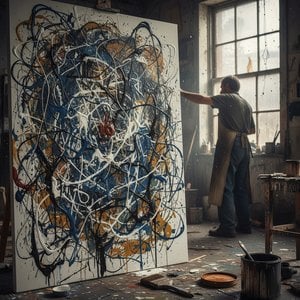
Jackson Pollock : Une Déconstruction Radicale de l'Expressionnisme Abstrait et Son Héritage Durable
Explorez l'univers révolutionnaire de Jackson Pollock et de l'expressionnisme abstrait. Découvrez son héritage, sa technique unique et l'impact durable de ce mouvement artistique majeur. Analyse approfondie pour collectionneurs avertis.

Trilogie Chromatique de l'Âme : Exploration Émotionnelle et Identitaire à Travers le Choix Artistique
Explorez l'art émotionnel et identitaire ! Découvrez comment les couleurs, sujets & compositions révèlent votre âme. Commandez des portraits personnalisés ou trouvez l'œuvre qui vous touche. Expertise ArtsDot.

Paul Jenkins: Abstraction, Color Field Painting & the Pursuit of Lyrical Expression
Explore the captivating world of Paul Jenkins, a pioneer of abstract expressionism & color field painting. Discover his unique ‘Phenomena’ series and investment potential for art collectors. Expert insights at ArtsDot.