


 Aperçu en situation
 Partager
 Partager
 Détails
 Guide imprimable

 Télécharger
 Articles similaires
 Radiographie
 Voir le diaporama
 Statistiques
Progression


 Afficher la suite
Giclées et impressions d'art
Impressions giclées ou sur toile de qualité musée, avec une production rapide et des finitions au choix. ( Acheter la peinture faite à la main Passer au format image numérique)




































Choisissez parmi nos formats prédéfinis qui respectent les proportions originales de l’œuvre.

Vous pouvez saisir vos propres dimensions pour vous adapter à un cadre ou à un espace spécifique. Si la taille sélectionnée ne correspond pas aux proportions de l'image originale, nous recadrerons l'œuvre ou étendrons l'image avec une bordure en miroir ou une couleur unie. Une maquette numérique vous sera envoyée pour approbation avant le début de la production.
Veuillez noter que l'aperçu à l'écran ne reflète pas le recadrage ou l'extension réelle. Seule la maquette montrera avec précision la composition finale.
Bien que des tailles personnalisées soient disponibles, nous vous recommandons de choisir une dimension dans la liste prédéfinie afin de préserver les proportions originales.
Livraison dans le monde entier () en 2 semaines au lieu des 4/5 semaines habituelles. (25 septembre)

Livraison express gratuite dans le monde entier

Toile de lin de haute qualité

Assurance transport complète

Garantie de remboursement des droits de douane

Garantie de fidélité des couleurs

Garantie de retour de 100 jours (uniquement en cas de défaut)

Garantie de remboursement à 100%

Tarifs dégressifs sur quantité
 L'option verre n'est disponible que pour les dimensions inférieures à 110 cm.

Progression
Giclées et impressions d'art
Format de la reproduction
-


Prix total final
$ 62
Œuvres similaires



Biographie de l'artiste
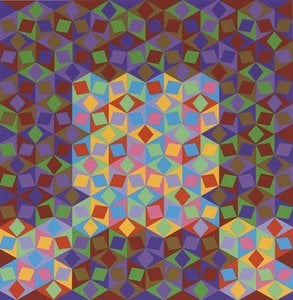
Horacio García Rossi: Architect of Illusion
Horacio García Rossi (1929 – 2012) stands as a singular figure in the landscape of twentieth-century art, recognized primarily for his pioneering contributions to Op Art and Kinetic Art. Born in Buenos Aires, Argentina, he embarked on an artistic journey marked by intellectual curiosity and a profound engagement with scientific principles—a duality that would permeate his distinctive visual language. His formative years were spent honing his skills at the Escuela de Publicidad de Buenos Aires before furthering his education at the Escuela Nacional de Bellas Artes, establishing a foundation for his subsequent explorations into abstraction and perceptual manipulation. A pivotal moment arrived in 1959 when García Rossi relocated to Paris, initiating a period of intense artistic experimentation within the Groupe de Recherche d’Art Visuel (Grav), alongside luminaries like Eduardo José Nery de Oliveira Goih and Héctor García Miranda. Grav served as a crucible for innovative ideas concerning visual perception, propelling García Rossi toward groundbreaking investigations into optical illusions and movement—concepts that would become central to his oeuvre. He wasn't merely replicating visual phenomena; he was actively reshaping them, challenging viewers’ assumptions about reality itself. This group of artists, united by a shared fascination with Victor Vasarely’s advancements in visual perception, sought to explore the potential of harnessing scientific understanding to elevate artistic expression. Collaborations included Julio Le Parc and François Morellet, cementing his place within the avant-garde movement of the time. Garcia Rossi’s artistic style is instantly recognizable by its mesmerizing execution. Utilizing geometric shapes – circles, squares, triangles – arranged in patterns that subtly shift and vibrate across the canvas, he achieved an extraordinary feat: creating artworks that appear to defy conventional perspective. This technique—often described as “optical illusion”—was heavily influenced by developments in mathematics, physics, and cybernetics, reflecting a broader fascination with harnessing scientific understanding to unlock artistic potential. His canvases aren’t passive surfaces; they are active participants in the perceptual process, inviting contemplation on how our eyes perceive depth and movement. He meticulously crafted his compositions, prioritizing precision and clarity—a characteristic that distinguishes his work from more expressive styles of the era. Throughout his prolific career spanning decades, García Rossi exhibited extensively across Europe, North America, and Asia, garnering critical acclaim for his daring explorations of visual perception. His work resides within prestigious collections worldwide, cementing his legacy as a visionary artist who fundamentally altered the trajectory of abstract art. Notably, Palazzo Rossi in Genoa houses a remarkable collection showcasing his artistic achievements alongside other Baroque masterpieces—a testament to his enduring influence on the history of art and a celebration of Argentinian-French cultural exchange. His dedication to experimentation and innovation ensured that Horacio García Rossi would remain an influential figure within the realm of modern art for generations to come.
Horacio García Rossi
1929 - 2012 , Argentine
En bref
- Artistic Movement Or Style: Op Art & Kinetic Art
- Artists Or Movements Influenced By This Artist: ['Grupo de Recherche d’Art Visuel']
- Artists Who Influenced This Artist:
- Hector García Miranda
- Eduardo José Nery de Oliveira Goih
- Date Of Birth: 1929
- Date Of Death: 2012
- Full Name: Horacio Garcia Rossi
- Nationality: Argentine-French
- Notable Artworks: ['Progression']
- Place Of Birth: Buenos Aires, Argentina