


 Aperçu en situation
 Partager
 Partager
 Détails
 Guide
Guide

 Télécharger
 Articles similaires
 Radiographie
 Voir le diaporama
 Statistiques
untitled (4805)


 Afficher la suite
Reproduction à l'huile faite à la main
Huile sur toile peinte à la main, avec cadre et dimensions personnalisés, réalisée sur commande par nos artistes. ( Passer au format impression Passer au format image numérique)




P118B $10

P118H $10

P118W $10

P438Z $10

P508JH $12

P508YH $12

P805H $10

P805Z $10

P919BZ $10

P919G $10

P919XJ $10

P959ZH $10

P968JZ $12

W106C $8

W218G $10

W218JH $8

W218Y $10

W307PJ $10

W316G $10

W316PJ $8

W316Y $10

W398PJ $8

W4111J $10

W500HY $15

W500JH $15

W692G $12

W849H $8

W940BG $15

W953PJ $8




Choisissez parmi nos formats prédéfinis qui respectent les proportions originales de l’œuvre.

Vous pouvez saisir vos propres dimensions pour l'adapter à un cadre ou à un espace spécifique. Si la taille sélectionnée ne correspond pas aux proportions de l'image d'origine, nous recadrerons l'œuvre ou prolongerons la peinture avec des éléments peints à la main supplémentaires. Une maquette numérique vous sera envoyée pour approbation avant le début de la production.
Veuillez noter que l'aperçu à l'écran ne reflète pas le recadrage ou l'extension réels. Seule la maquette montrera fidèlement la composition finale.
Bien que des tailles personnalisées soient disponibles, nous vous recommandons de sélectionner une dimension dans la liste prédéfinie afin de préserver les proportions d'origine.
Après la commande, l’équipe ArtsDot.com contactera le client par e-mail pour recueillir ses instructions et lui fournira une maquette d’aperçu
Livraison dans le monde entier () en 3 à 4 semaines au lieu des 5 semaines habituelles. (24 septembre). Aucun compromis sur la qualité.

Livraison express gratuite dans le monde entier

Toile de lin de haute qualité

Assurance transport complète

Garantie de remboursement des droits de douane

Garantie de fidélité des couleurs

Garantie de retour de 100 jours (uniquement en cas de défaut)

Garantie de remboursement à 100%

Tarifs dégressifs sur quantité
 L'option verre n'est disponible que pour les dimensions inférieures à 110 cm.

untitled (4805)
Technique de reproduction
Format de la reproduction
-


Prix total final
$ 263
A Vision of Renaissance Grace
In the quiet presence of Hans Holbein the Younger’s untitled (4805), one does not merely encounter a portrait, but enters a profound dialogue with the past. This exquisite work, emerging from the golden era of the Northern Renaissance around 1533, serves as a breathtaking window into the Tudor court. At its heart, the painting captures a moment of tender intimacy: a noblewoman, believed by many to be Anne Holland, Countess of Nottingham, cradling her two children. There is an undeniable gravity to the scene, a sense of weight not just in the heavy, textured fabrics of their attire, but in the very atmosphere of devotion and lineage that Holbein so masterfully orchestrates.
The composition is a masterclass in emotional storytelling. The mother’s gaze, characterized by a quiet dignity and a subtle, soulful depth, anchors the piece, while the children—standing with hands clasped in a gesture of pious innocence—symbolize the continuity of family and the sacredness of the next generation. For the discerning collector or interior designer, this painting offers more than mere decoration; it provides a focal point of historical substance, bringing an air of intellectual sophistication and timeless warmth to any curated space.
The Mastery of Light and Anatomical Truth
To study this work is to witness the pinnacle of Holbein’s technical virtuosity. Renowned for his scientific approach to art, Holbein applied a level of anatomical precision that was revolutionary for his time. Every fold of the woman's ruffled collar and every delicate feature of the children's faces is rendered with an almost tactile realism. He achieved this through the painstaking application of thin oil glazes, a technique that allows light to penetrate the layers of paint and reflect back, creating a soft, ethereal luminescence that seems to emanate from within the subjects themselves.
This luminous quality mimics the gentle flicker of candlelight, imbuing the portrait with a sense of living breath. The interplay between shadow and light—the chiaroscuro of the Northern tradition—does not merely define form; it sculpts emotion. The subtle shading around the eyes and the soft contours of the children's hands invite the viewer to linger, discovering new details with every glance. It is this marriage of scientific observation and poetic expression that makes a high-quality reproduction of this piece such a captivating addition to a refined collection.
A Legacy of Devotion and History
Beyond its aesthetic brilliance, untitled (4805) is steeped in the turbulent history of 16th-century England. Created during the reign of Henry VIII, a period defined by religious reformation and political upheaval, the painting carries an underlying current of stability and faith. The clothing, the poised gestures, and the very arrangement of the figures speak to a world where status was inextricably linked to piety and family duty. Holbein, serving as a trusted chronicler of the English court, captured not just the likenesses of the elite, but the values they sought to project to posterity.
For those seeking to infuse their surroundings with a sense of heritage and narrative depth, this portrait stands as an incomparable inspiration. It is a piece that transcends time, offering a bridge to the Renaissance spirit. Whether placed in a grand library or a contemporary living space, the painting’s ability to evoke both historical awe and intimate connection ensures it remains a timeless treasure for any lover of fine art.
Œuvres similaires


Biographie de l'artiste
jeune vie et formation
Hans Holbein le Jeune, figure marquante de la Renaissance du Nord, est né en 1497 à Augsbourg, en Allemagne. Bien qu'il soit souvent confondu avec son père, Hans Holbein le Vieux, artiste et graveur renommé, l'œuvre de Holbein le Jeune est distincte et remarquable à sa propre échelle.carrière artistique
La carrière artistique de Holbein le Jeune a commencé sous la tutelle de son père. Il a ensuite voyagé en Angleterre, où il est devenu peintre de cour pour le roi Henri VIII. Cette position lui a permis de capturer l'essence de la famille royale et de la noblesse anglaise émergente. Son œuvre se caractérise par :- réalisme exceptionnel : les portraits de Holbein sont célébrés pour leur qualité réaliste, comme en témoigne Portrait d'une dame inconnue (Renaissance du Nord).
- composition innovante : son utilisation de la composition est évidente dans Sir William Butts (37 x 46 cm, Renaissance du Nord, huile sur panneau).
- étude pour le portrait de famille de Thomas More (38 x 52 cm, Renaissance du Nord) illustre sa maîtrise de la capture de l'essence d'une famille.
œuvres notables et héritage
L'œuvre de Holbein le Jeune se trouve dans divers musées, notamment les Musées d'État de Berlin (Allemagne, en Allemagne), où son gentleman inconnu avec livres de musique et luth (huile sur panneau) est exposé. Son influence sur le mouvement de la Renaissance du Nord est indéniable, et son œuvre continue d'inspirer les artistes aujourd'hui. Holbein le Jeune est décédé en 1543, mais son héritage perdure grâce à ses portraits captivants et à ses études détaillées. Voir plus des œuvres de Hans Holbein le Jeune sur ArtsDot.
Hans Holbein le Jeune
1497 - 1543 , Italie
En bref
- Artistes Influents:
- Hans Holbein l'Ancien
- Albrecht Dürer
- Date De Décès: 1543
- Date De Naissance: 1497
- Lieu De Naissance: Augsbourg, Italie
- Mouvement Artistique: Renaissance du Nord
- Nationalité: Allemand
- Nom Complet: Hans Holbein le Jeune
- Oeuvres Notables:
- Portrait d'une dame inconnue
- Sir William Butts
- Les Ambassadeurs
- Portrait de Henri VIII
- Portrait d'Erasme
Articles similaires

Hans Holbein le Jeune : Maîtrise du Réalisme et Perspicacité Psychologique dans le Portrait Renaissance
Explorez la vie et l'œuvre de Hans Holbein le Jeune, maître du portrait Renaissance. Découvrez son réalisme saisissant, sa technique unique et les secrets psychologiques cachés dans ses célèbres tableaux. Un article expert pour les passionnés d'art.

The Grandeur of Presence: Exploring Representations of Stately Bearing in Western Portraiture
Explore the art of stately bearing in Western portraiture with expert analysis of Renaissance & Baroque masterpieces. Discover symbolism, techniques, and the legacy of iconic portraits – a guide for discerning collectors.
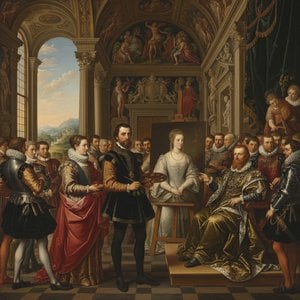
Hans von Aachen: Mannerism's Courtly Visionary & Imperial Portraiture
Explore the captivating world of Hans von Aachen, a leading Mannerist painter renowned for his exquisite imperial portraits & mythological scenes. Discover his legacy and influence on 16th-century European art.

Expressionnisme Allemand : 10 Chefs-d'œuvre Révolutionnaires à Découvrir | ArtsDot
Plongez au cœur de l'Expressionnisme Allemand avec ArtsDot. Découvrez 10 chefs-d'œuvre de Kandinsky, Munch et Kirchner. Explorez l'histoire, les couleurs et l'émotion derrière ces tableaux iconiques. Reproductions de qualité muséale disponibles sur ArtsDot.com

L'Héritage Durable du Portrait Formel : Pouvoir, Identité et Exploration Artistique
Explorez l'histoire fascinante du portrait formel : pouvoir, identité et techniques artistiques maîtrisées. Découvrez Velázquez, Rubens et les secrets de la collection d'art avec ArtsDot.


![Portrait double de Jean de Dinteville et Georges de Selve (alias Les Ambassadeurs) [détail]](/media/artworks/images-thumb/bb/ab/bbab7ce77b7dd15d23d21114a63b51a4.jpg)


