


 Envoyer
 Partager
 Détails de l'œuvre

 Télécharger
 Articles similaires
 Diaporama
 Statistiques
L
 Sculpture
- Sculpture
- Arte Povera
 1984
1984- Contemporary
 183.0 x 250.0 cm
 Galerie d’art de Nouvelle-Galles du Sud
 Lire la suite
Reproduction à l'huile faite à la main
Huile sur toile peinte à la main, avec cadre et dimensions personnalisés, réalisée sur commande par nos artistes. ( Passer au format impression Passer à l'image numérique)




































Choisissez parmi nos formats prédéfinis qui respectent les proportions originales de l’œuvre.

Vous pouvez saisir vos propres dimensions pour l'adapter à un cadre ou à un espace spécifique. Si la taille sélectionnée ne correspond pas aux proportions de l'image d'origine, nous recadrerons l'œuvre ou prolongerons la peinture avec des éléments peints à la main supplémentaires. Une maquette numérique vous sera envoyée pour approbation avant le début de la production.
Veuillez noter que l'aperçu à l'écran ne reflète pas le recadrage ou l'extension réels. Seule la maquette montrera fidèlement la composition finale.
Bien que des tailles personnalisées soient disponibles, nous vous recommandons de sélectionner une dimension dans la liste prédéfinie afin de préserver les proportions d'origine.
Après la commande, l’équipe ArtsDot.com contactera le client par e-mail pour recueillir ses instructions et lui fournira une maquette d’aperçu
Livraison dans le monde entier () en 3 à 4 semaines au lieu des 5 semaines habituelles. (9 septembre). Aucun compromis sur la qualité.

Livraison express gratuite dans le monde entier

Toile de lin de qualité supérieure

Assurance transport complète

Garantie de remboursement des droits de douane

Garantie de fidélité des couleurs

Politique de retour de 100 jours (uniquement en cas de défaut)

Garantie de remboursement à 100%

Offre de tarifs dégressifs
 L'option verre n'est disponible que pour les dimensions inférieures à 110 cm.

L
Technique de reproduction
Format de la reproduction
-


Prix total
$ 263
Giulio Paolini’s “L”: A Fragmented Echo of Antiquity
Giulio Paolini's "L," created in 1984, isn’t merely a sculpture; it’s an invitation to contemplate the very nature of representation and the weight of history. The work immediately commands attention with its stark simplicity: two imposing marble busts of heads, rendered in a classical style reminiscent of Roman antiquity, stand on slender pedestals beneath a scattering of shattered fragments – a deliberate chaos that belies the inherent order of the figures above. This juxtaposition isn’t accidental; it speaks to a profound meditation on destruction, loss, and the illusionistic strategies employed by artists throughout history.
Paolini's artistic lineage is deeply rooted in Arte Povera, an Italian movement that championed the use of humble, readily available materials – often discarded or overlooked – to challenge traditional notions of art. However, “L” transcends simple material exploration. It’s a conceptual piece, grappling with the philosophical questions posed by artists like Piero Manzoni and Lucio Fontana, who similarly questioned the boundaries of artistic expression and the role of the viewer. The work's genesis lies in Paolini’s early dissatisfaction with what he perceived as the overly polished and idealized representations prevalent in Art Informel – a movement characterized by expressive abstraction. He sought to strip away the superfluous, focusing instead on the fundamental components of painting itself: the canvas, the frame, and the very act of creation.
The Language of Brokenness
The shattered marble fragments beneath the busts are crucial to understanding Paolini’s intent. They aren't simply remnants of a disaster; they represent a deliberate disruption of classical ideals. The broken pieces mirror the fractured nature of historical narratives, suggesting that even the most enduring monuments – in this case, the idealized Roman heads – are ultimately subject to decay and interpretation. The act of smashing the busts can be seen as an assertion of the artist’s agency, a rejection of passive observation and a forceful engagement with the past. The deliberate imperfection introduces a sense of vulnerability and immediacy that contrasts sharply with the perceived permanence of classical sculpture.
Furthermore, the mirroring effect between the two heads is deeply symbolic. They face each other directly, creating an almost unsettling intimacy. This mirrored image isn’t simply a visual repetition; it evokes themes of duality, reflection, and perhaps even a sense of longing or unresolved conflict. The slight tilt of the heads adds to this dynamic, suggesting a subtle shift in perspective – as if one head is turning to acknowledge the other, initiating a silent dialogue across time.
Illusionism and the Rules of Perspective
Paolini’s work is a masterful demonstration of illusionistic techniques. The busts themselves are cast from plaster, mimicking the appearance of marble but retaining a distinctly artificial quality. This deliberate use of imitation highlights the constructed nature of representation – reminding us that what we perceive as “real” is always mediated by artistic choices. The arrangement on the floor further reinforces this concept; the fragmented pieces create an illusion of depth and space, drawing the viewer into the scene while simultaneously undermining any sense of stability or permanence.
The piece subtly critiques the conventions of perspective established during the Renaissance, a period marked by a relentless pursuit of accurate representation. Paolini’s use of slightly skewed angles and fragmented forms challenges these rules, suggesting that art can be more effective when it embraces ambiguity and paradox. The overall effect is one of controlled chaos – a visual puzzle that invites viewers to question their assumptions about how things “should” look and to appreciate the power of artistic manipulation.
A Timeless Meditation on Art and History
"L" remains a powerfully resonant work, continuing to provoke thought and discussion decades after its creation. It’s not just a sculpture; it's an exploration of art history, representation, and the human condition. Paolini’s ability to distill complex philosophical ideas into a deceptively simple composition is a testament to his artistic vision – a vision that continues to challenge and inspire.
Œuvres similaires


Biographie de l'artiste
Giulio Paolini: Bridging Arte Povera and Conceptual Thought
Giulio Paolini stands as a singular figure in Italian art, embodying the spirit of Arte povera while simultaneously delving into the intricacies of conceptual art. Born in Genoa in 1940, his artistic journey began amidst formative influences – a childhood spent in Bergamo instilled a deep appreciation for visual culture and fostered an early engagement with museums and galleries. His fascination extended beyond mere observation; he actively sought knowledge through art periodicals and meticulously studied the works of masters. This intellectual curiosity propelled him toward painting after graduating from the Giambattista Bodoni State Industrial Technical School of Graphics and Photography in 1959, specializing in graphic design.Early Explorations: The Monochrome Canvas
Paolini’s initial artistic endeavors centered on monochrome abstractions, reflecting a desire to distill visual experience into its purest form. Recognizing the profound impact of modern graphics—his brother Cesare's architectural pursuits—he embraced experimentation with materials and techniques. This influence shaped his approach to representation, prioritizing simplicity and conveying emotional resonance. The discovery of photography – particularly the work of Marcel Proust – further broadened his artistic horizons, prompting him to consider how images could evoke memory and emotion.The Pioneering Gesture: “Disegno Geometrico” - A Declaration of Intent
His breakthrough came with “ disegno geometrico” (geometric drawing), executed in 1960. This ambitious undertaking involved squaring a canvas painted entirely white tempera – an act of deliberate negation intended to liberate the image from preconceived notions and establish a foundational conceptual principle. Paolini explained that this gesture represented "the indication of the spatial setting in which the picture could have existed," signaling a decisive shift toward conceptual concerns. It was a radical departure from traditional painting, prioritizing form over content and challenging viewers to reconsider their understanding of artistic expression. This seminal piece cemented Paolini’s position as a pioneer within Arte povera—an artistic movement characterized by its rejection of illusionism and embrace of materiality.Conceptual Foundations: Eternal Recurrence and the Examination of Form
Paolini’s artistic philosophy revolved around capturing “eternal recurrence,” recognizing that each creative moment holds inherent significance and contributes to the artist's self-discovery. This perspective underpinned his subsequent explorations into the very components of painting – tools and space—marking a decisive shift toward conceptual art. He questioned how artists could engage with history, memory, and perception, prompting reflection on the role of the artwork within broader cultural contexts. Paolini’s work consistently interrogated these themes, demonstrating a profound engagement with philosophical ideas and challenging viewers to confront existential questions.The Arte Povera Movement and Beyond
Paolini emerged as a prominent voice within the Arte povera movement alongside Enrico Castellani, Michelangelo Pistoletto, Mario Merz, Lucio Fontana, and Alighiero Boetti. His collaboration with Carla Lonzi and Marisa Volpi established him as a key figure in Italian contemporary art—Lonzi’s initial assessments recognizing Paolini's innovative aesthetic vision. He participated in Documenta VII (1972), showcasing “Untitled” – a sculptural assemblage constructed from plaster casts and wood fragments—demonstrating his commitment to exploring materiality and challenging conventional artistic conventions. His work continued to evolve throughout the 1970s and 80s, reflecting ongoing engagement with conceptual art and philosophical inquiry. Paolini’s enduring legacy resides in his unwavering dedication to artistic innovation—his refusal to adhere to established norms and his persistent pursuit of expressive truth. He remains a vital contributor to the dialogue between Art History and Contemporary Thought.
Giulio Paolini
1940 - , Italie
L'essentiel de l'artiste
- Artistic Movement Or Style: Arte Povera & Conceptual Art
- Artists Or Movements Influenced By This Artist: ['Minimalism']
- Artists Who Influenced This Artist: ['Luciano Fabro']
- Date Of Birth: 1940
- Date Of Death: Living
- Full Name: Giulio Paolini
- Nationality: Italian
- Notable Artworks: ['L', 'senza titolo', 'Untitled (936)']
- Place Of Birth: Genoa, Italy
Articles connexes
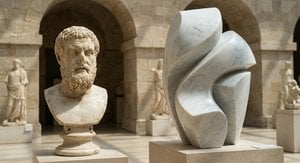
The Enduring Allure of Marble in Art History: From Classical Sculpture to Modern Abstraction
Explore the captivating history of marble sculpture from ancient Greece to modern art. Discover renowned artists like Canova & Michelangelo, carving techniques, and investment insights at ArtsDot.

Les 10 Chefs-d'œuvre en Bronze qui ont Révolutionné l'Art : Collection ArtsDot
Plongez dans l'univers fascinant des 10 chefs-d'œuvre en bronze qui ont marqué l'histoire de l'art. Découvrez Rodin, Degas et les secrets de ces sculptures iconiques. Reproductions d'art exceptionnelles sur ArtsDot.com – Explorez la collection !

The Enduring Form: Sculpture Across History, Technique & Emotional Resonance
Explore the rich history of sculpture with ArtsDot. Discover key techniques, influential artists & investment potential for discerning collectors. Expert insights into valuing and collecting timeless masterpieces.

Les 10 Chefs-d'œuvre Bronzes Qui Ont Révolutionné la Sculpture | ArtsDot
Plongez dans l'univers fascinant des 10 sculptures en bronze les plus emblématiques de l'histoire de l'art. Rodin, Degas et autres maîtres révélés ! Découvrez leur histoire, leurs techniques et trouvez l'œuvre parfaite pour sublimer votre intérieur sur ArtsDot.com.

The Enduring Form: Exploring Themes & Techniques in Sculpture Across Historical Periods
Explore the rich history of sculpture from ancient masterpieces to contemporary innovations. Discover key techniques, influential artists & investment potential for discerning art collectors.