


 Aperçu en situation
 Partager
 Partager
 Détails
 Guide
Guide

 Télécharger
 Articles similaires
 Radiographie
 Voir le diaporama
 Statistiques
Via Appia


 Afficher la suite
Reproduction à l'huile faite à la main
Huile sur toile peinte à la main, avec cadre et dimensions personnalisés, réalisée sur commande par nos artistes. ( Passer au format impression Passer au format image numérique)




P118B $10

P118H $10

P118W $10

P438Z $10

P508JH $12

P508YH $12

P805H $10

P805Z $10

P919BZ $10

P919G $10

P919XJ $10

P959ZH $10

P968JZ $12

W106C $8

W218G $10

W218JH $8

W218Y $10

W307PJ $10

W316G $10

W316PJ $8

W316Y $10

W398PJ $8

W4111J $10

W500HY $15

W500JH $15

W692G $12

W849H $8

W940BG $15

W953PJ $8




Choisissez parmi nos formats prédéfinis qui respectent les proportions originales de l’œuvre.

Vous pouvez saisir vos propres dimensions pour l'adapter à un cadre ou à un espace spécifique. Si la taille sélectionnée ne correspond pas aux proportions de l'image d'origine, nous recadrerons l'œuvre ou prolongerons la peinture avec des éléments peints à la main supplémentaires. Une maquette numérique vous sera envoyée pour approbation avant le début de la production.
Veuillez noter que l'aperçu à l'écran ne reflète pas le recadrage ou l'extension réels. Seule la maquette montrera fidèlement la composition finale.
Bien que des tailles personnalisées soient disponibles, nous vous recommandons de sélectionner une dimension dans la liste prédéfinie afin de préserver les proportions d'origine.
Après la commande, l’équipe ArtsDot.com contactera le client par e-mail pour recueillir ses instructions et lui fournira une maquette d’aperçu
Livraison dans le monde entier () en 3 à 4 semaines au lieu des 5 semaines habituelles. (21 septembre). Aucun compromis sur la qualité.

Livraison express gratuite dans le monde entier

Toile de lin de haute qualité

Assurance transport complète

Garantie de remboursement des droits de douane

Garantie de fidélité des couleurs

Garantie de retour de 100 jours (uniquement en cas de défaut)

Garantie de remboursement à 100%

Tarifs dégressifs sur quantité
 L'option verre n'est disponible que pour les dimensions inférieures à 110 cm.

Via Appia
Technique de reproduction
Format de la reproduction
-


Prix total final
$ 263
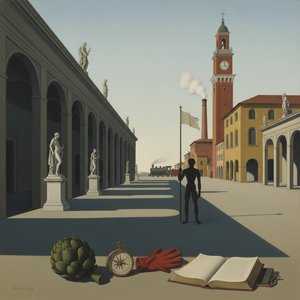
A Haunting Reverie: Giorgio de Chirico's "Via Appia"
Giorgio de Chirico’s “Via Appia,” painted in 1954, is more than just a depiction of a Roman street; it’s a meticulously crafted dreamscape born from the anxieties and philosophical explorations of the early 20th century. This neo-baroque masterpiece transports the viewer to a realm where classical grandeur collides with unsettling modernity, a signature characteristic of de Chirico's oeuvre. The painting immediately arrests the eye with its stark contrasts – the imposing solidity of the stone building, dominated by a clock tower, juxtaposed against the fleeting movement of the horse and rider. This deliberate dissonance speaks directly to the artist’s core concerns: the fragility of time, the illusion of order in a chaotic world, and the inherent alienation of the individual.
- Subject Matter & Composition: The scene unfolds along the ancient Appian Way, a road steeped in Roman history. De Chirico masterfully utilizes this historical backdrop to amplify the painting’s unsettling atmosphere. The central figure on horseback, rendered with precise detail, becomes an isolated protagonist within this timeless setting. The two horses – one ridden and one standing—add layers of complexity, hinting at themes of control versus freedom, movement versus stillness.
- Neo-Baroque Style: De Chirico’s style is a fascinating blend of influences. While rooted in classical Italian art, particularly the works of Raphael and Michelangelo, he deliberately introduces elements of surrealism and expressionism. The exaggerated perspective, the dramatic lighting, and the meticulous rendering of detail are hallmarks of the neo-baroque movement, creating an intensely theatrical effect.
Symbolic Layers & Philosophical Roots
“Via Appia” is saturated with symbolism, reflecting de Chirico’s engagement with philosophical currents of his time. The clock tower, a recurring motif in his work, represents the relentless march of time and the futility of human endeavors. Its presence evokes the writings of Schopenhauer, who viewed the world as driven by an irrational will, constantly striving for satisfaction yet perpetually failing. The deserted street itself symbolizes isolation and the absence of genuine connection – themes explored extensively by Nietzsche in his critique of traditional morality.
- Birds & Dog: Even seemingly minor details contribute to the painting’s overall meaning. The two birds soaring above the scene represent a yearning for transcendence, while the dog, positioned near the bottom right corner, could symbolize loyalty or perhaps even a primal instinct – a reminder of humanity's connection to nature and its inherent vulnerability.
- Color Palette: De Chirico’s use of muted tones—ochres, browns, and grays—further enhances the painting’s melancholic mood. The limited color palette contributes to the sense of detachment and reinforces the dreamlike quality of the scene.
Historical Context & Artistic Significance
Painted in 1954, “Via Appia” represents a late-career work for de Chirico, solidifying his position as one of the most important figures in the early Surrealist movement. Following his initial rejection by the Surrealists, he continued to develop his unique visual language, exploring themes of memory, illusion, and psychological states. This painting exemplifies his ability to create intensely evocative images that challenge conventional perceptions of reality. De Chirico’s work profoundly influenced subsequent generations of artists, including René Magritte and Edward Hopper.
- Technique: The painting is executed with meticulous detail using oil on canvas, demonstrating de Chirico's mastery of traditional techniques while simultaneously pushing the boundaries of artistic representation. The precise rendering of textures – from the rough stone of the building to the sleekness of the horse’s coat – adds to the painting’s realism and enhances its unsettling effect.
Perfect for Your Collection
ArtsDot offers a stunning, hand-painted reproduction of Giorgio de Chirico's “Via Appia,” meticulously crafted to capture the essence of this iconic artwork. This is more than just a print; it’s an authentic artistic interpretation that will bring a touch of timeless mystery and intellectual depth to any interior space. Ideal for collectors, art enthusiasts, and interior designers seeking to infuse their surroundings with a sense of profound contemplation.
Œuvres similaires


Biographie de l'artiste
jeunesse et influences
Giorgio de Chirico, artiste italien renommé, est né le 10 juillet 1888 à Volos, en Grèce, d'une mère génoise et d'un père sicilien. Sa jeunesse a été marquée par l'étude de l'art au polytechnique d'Athènes sous la direction des peintres grecs influents Georgios Roilos et Georgios Jakobides. Cette formation allait façonner son style artistique unique.le mouvement de l'art métaphysique
En 1910, de Chirico a inauguré le mouvement de l'art métaphysique, qui a profondément influencé les surréalistes. Ses œuvres de cette période, caractérisées par des atmosphères étranges et des scénarios oniriques, sont exemplifiées dans des peintures telles que les vexations du penseur (disponible sur la plateforme ArtsDot) et l'énigme de l'heure (visible sur ArtsDot). Ces œuvres évoquent un sentiment de mystère, souvent avec des contrastes nets de lumière et d'ombre.période post-métaphysique
Après 1919, l'intérêt de de Chirico s'est tourné vers les techniques de la peinture traditionnelle, adoptant un style néoclassique ou néo-baroque. Ce changement est évident dans ses œuvres ultérieures, qui, bien qu'elles ne reçoivent pas le même élan critique que ses premières pièces, démontrent une évolution mature de son approche artistique.héritage et influence
L'impact de de Chirico sur le mouvement surréaliste est indéniable, des artistes comme André Breton étant influencés par ses peintures métaphysiques. Bien que son œuvre ultérieure n'ait pas été aussi largement saluée, de Chirico reste une figure centrale dans l'histoire de l'art moderne. Son héritage continue d'inspirer, avec ses œuvres faisant partie de collections du monde entier, notamment le musée Giorgio de Chirico, qui se dresse désormais près des escaliers du marchepied à Rome.- explorez davantage les œuvres de Giorgio de Chirico sur ArtsDot
- découvrez le mouvement de l'art métaphysique et son influence sur le surréalisme grâce à cet article perspicace sur ArtsDot
- apprenez-en davantage sur la vie et les œuvres de de Chirico sur Wikipedia

Giorgio de Chirico
1888 - 1978 , Grèce
En bref
- Artistes Influencés:
- Surréalisme
- André Breton
- Date De Naissance: 10 juillet 1888
- Influenceurs Artistiques:
- Arnold Böcklin
- Max Klinger
- Lieu De Naissance: Volos, Grèce
- Mouvement Artistique: Art métaphysique
- Nationalité: Italienne
- Nom Complet: Giorgio de Chirico
- Oeuvres Notables:
- Les Vexations du penseur
- L'Énigme de l'heure
- La Chanson d'amour
Articles similaires

Giclée Prints: Archival Quality & Aesthetic Nuances for the Discerning Collector
Explore the world of giclée prints with ArtsDot. Learn about archival quality, aesthetic nuances & investment potential. Expert guidance for discerning art collectors seeking museum-quality reproductions and lasting value.

Goya : 25 Chefs-d'Œuvre Inoubliables d'un Maître de l'Âme
Plongez au cœur de l'œuvre inégalable de Goya ! Découvrez 25 chefs-d’œuvre emblématiques, des portraits saisissants aux scènes dramatiques. Explorez la vie et l'art du maître espagnol avec ArtsDot.com – reproductions d'art de qualité musée et inspirations déco.

À propos de nous
Découvrez notre univers artistique ! Nous mettons l’art de renommée mondiale à portée de main grâce à une sélection pointue, des créations sur mesure et des conseils personnalisés. Apprécié des particuliers et des professionnels depuis plus de 20 ans.

The Enduring Legacy of Fine Art Prints: Technique, History & Aesthetic Impact
Explore the rich history & techniques of fine art prints. Discover investment potential, assess authenticity, and learn how to preserve your collection with expert guidance. Trusted insights for discerning collectors.
Giorgio de Chirico: Metaphysical Realities & the Poetics of Absence
Explore the captivating world of Giorgio de Chirico and his groundbreaking Metaphysical painting movement. Discover the philosophical depths & surreal imagery that influenced generations of artists. Learn more at ArtsDot.


