

 Aperçu en situation
 Envoyer
 Partager
 Détails de l'œuvre
 Guide
Guide

 Télécharger l'image
 Articles similaires
 Radiographie
 Diaporama
 Questions et réponses
 Statistiques
Conversation

- 130.0 x 97.0 cm


 Lire la suite
L’œuvre d'art présentée sur cette page est protégée par le droit d'auteur, ce qui signifie que nous ne pouvons légalement créer ou vendre de reproduction identique. Cette protection est appliquée en vertu d'accords internationaux tels que la Convention de Berne et par les lois nationales, notamment celles énoncées par le Loi américaine sur le droit d'auteur - Titre 17.
Cette méthode est pleinement conforme aux réglementations sur le droit d'auteur car elle ne repose pas sur la copie ou la duplication de l'œuvre protégée. Il s'agit plutôt d'une réinterprétation créative — une nouvelle peinture qui s'inspire de l'original sans pour autant lui être identique.
Giclées et impressions d'art
Impressions giclées ou sur toile de qualité musée, avec une production rapide et des finitions au choix. ( Commander la reproduction peinte à la main Passer au format numérique)




P118B €10

P118H €10

P118W €10

P438Z €10

P508JH €12

P508YH €12

P805H €10

P805Z €10

P919BZ €10

P919G €10

P919XJ €10

P959ZH €10

P968JZ €12

W106C €8

W218G €10

W218JH €8

W218Y €10

W307PJ €10

W316G €10

W316PJ €8

W316Y €10

W398PJ €8

W4111J €10

W500HY €15

W500JH €15

W692G €12

W849H €8

W940BG €15

W953PJ €8




Choisissez parmi nos formats prédéfinis qui respectent les proportions originales de l’œuvre.

Saisissez la largeur et la hauteur souhaitées pour qu'elles s'adaptent à votre cadre ou à votre mur. Une impression peut être recadrée, mais jamais agrandie au-delà de l'image originale ; ainsi, un format de forme différente entraînera la perte d'une partie de l'image. Nous vous envoyons une maquette numérique pour approbation avant toute impression. L'image présentée sur cette page ne montre pas le recadrage réel — seule la maquette le permet.
Livraison dans le monde entier () en 2 semaines au lieu des 4/5 semaines habituelles. (8 novembre)

Livraison express gratuite dans le monde entier

Toile de lin de qualité supérieure

Assurance transport complète

Garantie de remboursement des droits de douane

Garantie de fidélité des couleurs

Politique de retour de 100 jours (uniquement en cas de défaut)

Garantie de remboursement à 100%

Offre de tarifs dégressifs
 L'option verre n'est disponible que pour les dimensions inférieures à 110 cm.

Conversation
Giclées et impressions d'art
Format de la reproduction
-


Prix total
€ 56
A Frozen Moment of Existential Inquiry: De Chirico’s *Conversation*
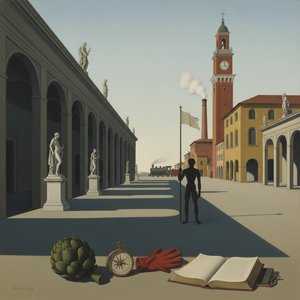
Giorgio de Chirico's 1927 painting, *Conversation*, is more than just a depiction of two figures engaged in dialogue; it’s a meticulously crafted evocation of the unsettling anxieties and philosophical questions that defined the burgeoning Metaphysical art movement. Executed during a period of profound intellectual and social upheaval – marked by the rise of Nietzschean thought and a growing sense of alienation within European cities – the painting captures a moment suspended between reality and dream, logic and irrationality. The scene unfolds within a classically rendered room, imbued with an almost theatrical stillness that amplifies the inherent tension of the interaction.
- Subject Matter: The central focus is undeniably the interaction between the man and woman. Their formal attire – the man’s tie, the woman's bun – speaks to a bygone era, yet their faces remain deliberately obscured, fostering an immediate sense of detachment and anonymity.
- Composition & Technique: De Chirico masterfully employs his signature technique of juxtaposing familiar objects in unexpected ways, creating a disconcerting effect. The dining table, the vase, and the two framed pictures contribute to this unsettling atmosphere, drawing the viewer into a space that feels both recognizable and profoundly strange. The use of sharp angles, receding planes, and a limited color palette – dominated by muted browns, grays, and ochres – further enhances the painting’s sense of depth and isolation.
The Roots of Metaphysical Art
De Chirico's *Conversation* is a cornerstone of the Metaphysical art movement, which emerged in Italy during the 1920s. This style sought to depict not what was seen, but what *could be seen*, tapping into subconscious anxieties and exploring themes of loneliness, alienation, and the illusory nature of reality. Influenced heavily by philosophers like Schopenhauer and Nietzsche, De Chirico aimed to capture the subjective experience of existence – a world perceived through fragmented memories and unsettling juxtapositions. The painting’s atmosphere mirrors the intellectual climate of the time, reflecting a growing disillusionment with traditional values and a fascination with the irrational.
- Historical Context: Created in 1927, *Conversation* reflects the anxieties of a Europe grappling with rapid industrialization, social change, and the rise of totalitarian ideologies.
- Philosophical Influences: The painting’s themes resonate directly with the existentialist philosophies gaining traction at the time, particularly concerning the isolation of the individual within a seemingly meaningless world.
Symbolism and Emotional Resonance
*Conversation* is rich in symbolic potential, though De Chirico deliberately avoids explicit interpretations. The obscured faces invite viewers to project their own anxieties and uncertainties onto the scene. The classical setting, combined with the unsettling composition, creates a sense of timelessness – as if these figures are trapped within an eternal loop of unspoken dialogue. The painting’s emotional impact is profoundly melancholic, evoking a feeling of unease and prompting contemplation about the nature of communication, identity, and the human condition. It's a visual meditation on the profound loneliness that can exist even in the midst of interaction.
Specifications
Title: Conversation
Artist: Giorgio de Chirico
Year: 1927
Size: 130 x 97 cm
Style: Metaphysical Art
Medium: Oil on Canvas
Questions et réponses
Quelle couleur domine dans « Conversation » ?
Rosy Brown (#c69975) est la couleur dominante de «Conversation» de Giorgio de Chirico.
Quel sujet et quelle atmosphère «Conversation» de Giorgio de Chirico associe-t-elle ?
«Conversation» de Giorgio de Chirico allie de chirico, metaphysical art, classical figures, conversation scene, italian painting, dreamscape, symbolic space à une atmosphère Elegant.
L'œuvre «Conversation» de Giorgio de Chirico est-elle plutôt claire ou sombre ?
En termes de luminosité perçue, «Conversation» de Giorgio de Chirico est bright.
Œuvres similaires


Biographie de l'artiste
jeunesse et influences
Giorgio de Chirico, artiste italien renommé, est né le 10 juillet 1888 à Volos, en Grèce, d'une mère génoise et d'un père sicilien. Sa jeunesse a été marquée par l'étude de l'art au polytechnique d'Athènes sous la direction des peintres grecs influents Georgios Roilos et Georgios Jakobides. Cette formation allait façonner son style artistique unique.le mouvement de l'art métaphysique
En 1910, de Chirico a inauguré le mouvement de l'art métaphysique, qui a profondément influencé les surréalistes. Ses œuvres de cette période, caractérisées par des atmosphères étranges et des scénarios oniriques, sont exemplifiées dans des peintures telles que les vexations du penseur (disponible sur la plateforme ArtsDot) et l'énigme de l'heure (visible sur ArtsDot). Ces œuvres évoquent un sentiment de mystère, souvent avec des contrastes nets de lumière et d'ombre.période post-métaphysique
Après 1919, l'intérêt de de Chirico s'est tourné vers les techniques de la peinture traditionnelle, adoptant un style néoclassique ou néo-baroque. Ce changement est évident dans ses œuvres ultérieures, qui, bien qu'elles ne reçoivent pas le même élan critique que ses premières pièces, démontrent une évolution mature de son approche artistique.héritage et influence
L'impact de de Chirico sur le mouvement surréaliste est indéniable, des artistes comme André Breton étant influencés par ses peintures métaphysiques. Bien que son œuvre ultérieure n'ait pas été aussi largement saluée, de Chirico reste une figure centrale dans l'histoire de l'art moderne. Son héritage continue d'inspirer, avec ses œuvres faisant partie de collections du monde entier, notamment le musée Giorgio de Chirico, qui se dresse désormais près des escaliers du marchepied à Rome.- explorez davantage les œuvres de Giorgio de Chirico sur ArtsDot
- découvrez le mouvement de l'art métaphysique et son influence sur le surréalisme grâce à cet article perspicace sur ArtsDot
- apprenez-en davantage sur la vie et les œuvres de de Chirico sur Wikipedia

Giorgio de Chirico
1888 - 1978 , Grèce
L'essentiel de l'artiste
- Artistes Influencés:
- Surréalisme
- André Breton
- Date De Naissance: 10 juillet 1888
- Influenceurs Artistiques:
- Arnold Böcklin
- Max Klinger
- Lieu De Naissance: Volos, Grèce
- Mouvement Artistique: Art métaphysique
- Nationalité: Italienne
- Nom Complet: Giorgio de Chirico
- Oeuvres Notables:
- Les Vexations du penseur
- L'Énigme de l'heure
- La Chanson d'amour
Articles connexes

Au-delà du Voile : Exploration de l'Art Métaphysique et de ses Mystères Intemporels
Explorez l'univers fascinant de la peinture métaphysique avec ArtsDot. Découvrez Giorgio de Chirico et son influence sur le surréalisme. Guide d'achat, analyses d'œuvres et conseils pour collectionneurs passionnés.

À propos de nous
Découvrez notre univers artistique ! Nous mettons l’art de renommée mondiale à portée de main grâce à une sélection pointue, des créations sur mesure et des conseils personnalisés. Apprécié des particuliers et des professionnels depuis plus de 20 ans.

Maîtriser l'ombre : les 25 chefs-d'œuvre puissants de Francisco Goya
Explorez les 25 chefs-d'œuvre de Goya, entre ombre et lumière. Trouvez l'art ultime sur ArtsDot.com.

Les 10 Chefs-d'œuvre du Néoclassicisme : Artistes et Décor Intemporels
Plongez au cœur du Néoclassicisme avec les 10 chefs-d'œuvre incontournables de David, Ingres et autres maîtres. Découvrez l'histoire fascinante de ces tableaux célèbres et trouvez l'inspiration déco classique sur !
Giorgio de Chirico: Metaphysical Realities & the Poetics of Absence
Explore the captivating world of Giorgio de Chirico and his groundbreaking Metaphysical painting movement. Discover the philosophical depths & surreal imagery that influenced generations of artists. Learn more at ArtsDot.


