


 Aperçu en situation
 Envoyer
 Partager
 Détails de l'œuvre

 Télécharger
 Articles similaires
 Radiographie
 Diaporama
Moritz
 Oil On Canvas
- WallArt
- Contemporary Realism
 2000
2000- Modern
 51.0 x 46.0 cm
 Lire la suite
Giclées et impressions d'art
Impressions giclées ou sur toile de qualité musée, avec une production rapide et des finitions au choix. ( Commander la reproduction peinte à la main Acheter l'image haute résolution)




P118B $10

P118H $10

P118W $10

P438Z $10

P508JH $12

P508YH $12

P805H $10

P805Z $10

P919BZ $10

P919G $10

P919XJ $10

P959ZH $10

P968JZ $12

W106C $8

W218G $10

W218JH $8

W218Y $10

W307PJ $10

W316G $10

W316PJ $8

W316Y $10

W398PJ $8

W4111J $10

W500HY $15

W500JH $15

W692G $12

W849H $8

W940BG $15

W953PJ $8




Choisissez parmi nos formats prédéfinis qui respectent les proportions originales de l’œuvre.

Vous pouvez saisir vos propres dimensions pour vous adapter à un cadre ou à un espace spécifique. Si la taille sélectionnée ne correspond pas aux proportions de l'image originale, nous recadrerons l'œuvre ou étendrons l'image avec une bordure en miroir ou une couleur unie. Une maquette numérique vous sera envoyée pour approbation avant le début de la production.
Veuillez noter que l'aperçu à l'écran ne reflète pas le recadrage ou l'extension réelle. Seule la maquette montrera avec précision la composition finale.
Bien que des tailles personnalisées soient disponibles, nous vous recommandons de choisir une dimension dans la liste prédéfinie afin de préserver les proportions originales.
Livraison dans le monde entier () en 2 semaines au lieu des 4/5 semaines habituelles. (3 septembre)

Livraison express gratuite dans le monde entier

Toile de lin de qualité supérieure

Assurance transport complète

Garantie de remboursement des droits de douane

Garantie de fidélité des couleurs

Politique de retour de 60 jours (uniquement en cas de défaut)

Garantie de remboursement à 100%

Offre de tarifs dégressifs
 L'option verre n'est disponible que pour les dimensions inférieures à 110 cm.

Moritz
Giclées et impressions d'art
Format de la reproduction
-


Prix total
$ 62
The Enigmatic Figure: An Exploration of Gerhard Richter's "Moritz"
Gerhard Richter’s 2000 painting, “Moritz,” isn’t a portrait in the traditional sense. It’s an invitation to contemplate the elusive nature of memory and identity, rendered through Richter’s signature blend of photographic realism and abstract expressionism. The image depicts a young child, partially obscured by a deliberate haze of paint, seated within a high chair – a scene both familiar and profoundly unsettling. The blurred features, the soft focus, and the muted palette evoke a sense of detachment, as if we are observing a fleeting moment captured from a dream or a faded photograph. This isn’t an attempt to depict a specific child; rather, it's a distillation of childhood itself – its vulnerability, its inherent mystery, and its inevitable passage into the unknown.
Richter’s technique is central to the work’s power. He employs a layering process, building up thin washes of oil paint that are then repeatedly scraped, smudged, and reworked. This creates a surface texture that is both tactile and ethereal, mirroring the way memories can feel – simultaneously vivid and fragmented. The deliberate blurring isn't simply an aesthetic choice; it’s a key element in Richter’s exploration of representation itself. He questions the very act of seeing and recording, suggesting that any attempt to capture reality inevitably involves distortion and loss.
A Fragmented History: Contextualizing "Moritz" within Richter’s Oeuvre
Understanding Gerhard Richter requires acknowledging his deeply personal and historically-charged artistic journey. Born in Dresden in 1932, Richter's childhood was profoundly shaped by the upheavals of post-war Germany – displacement, political uncertainty, and the lingering trauma of Nazi persecution. His father, a schoolteacher, navigated the complexities of life under authoritarian rule, while his mother fostered a love for literature and music within their family. This duality—a pragmatic acceptance of circumstance alongside a yearning for cultural expression—became a recurring theme in Richter’s work.
The late 1990s and early 2000s, the period encompassing “Moritz,” marked a shift in Richter's artistic focus. He increasingly explored photographic sources – not as direct copies, but as starting points for his own abstract compositions. This approach is evident in "Moritz," which can be seen as a meditation on the process of translation—the transformation of a visual image into an entirely new work of art. The photograph itself, likely a source for this piece, becomes merely a catalyst, prompting Richter to engage with the underlying themes and emotions rather than replicating the original scene.
Symbolism and Emotional Resonance: Unpacking the Painting’s Layers
The high chair itself is a potent symbol. It represents childhood, nourishment, and the transition from dependence to independence. However, in “Moritz,” this familiar image is imbued with ambiguity. The child's face is obscured, suggesting a loss of innocence or a detachment from experience. The bottle present in the background further reinforces this sense of vulnerability – a symbol of sustenance that may not be enough to satisfy the child’s needs.
The overall mood of the painting is melancholic and contemplative. It doesn't offer easy answers or resolutions; instead, it invites viewers to confront their own memories and anxieties about the passage of time. Richter’s masterful use of color and texture creates a visual experience that is both beautiful and unsettling, prompting us to consider the fragility of human existence and the enduring power of the past.
A Reproduction for Your Space: Bringing "Moritz" Home
ArtsDot offers meticulously crafted hand-painted reproductions of Gerhard Richter’s “Moritz,” allowing you to bring this iconic work into your home or office. Our skilled artists replicate Richter's unique technique with exceptional precision, capturing the subtle nuances of color, texture, and blurring that define the painting. Available in a range of sizes, our reproductions are printed on archival-quality canvas using vibrant pigments, ensuring long-lasting beauty and authenticity.
Whether you’re an art enthusiast, a collector, or simply seeking to add a touch of intellectual depth to your décor, “Moritz” is a compelling choice. It's more than just a painting; it’s a meditation on memory, identity, and the complexities of human experience – a timeless masterpiece brought to life through ArtsDot’s dedication to artistic excellence.
Œuvres similaires


Biographie de l'artiste
**Jeunesse et Éducation**
Gerhard Richter, artiste visuel allemand renommé, est né le 9 février 1932 à l'hôpital de Dresde-Neustadt, à Dresde, en Saxe. Il a grandi à Reichenau, Basse Silésie (aujourd’hui Bogatynia, Pologne), et à Waltersdorf (Zittauer Gebirge), dans la campagne supérieure de Lusace. Le père de Richter, Horst Richter, était étudiant en mathématiques et en physique à l'Technische Hochschule de Dresde.**Carrière artistique**
Richter a commencé son parcours artistique comme apprenti peintre décorateur et a ensuite étudié à l’Académie des Beaux-Arts de Dresde. Ses premières œuvres ont été influencées par les styles de Picasso et Jean Arp, ce qui est évident dans ses peintures abstraites et photoréalistes. En 1957, Richter a travaillé comme stagiaire maître à l'académie, réalisant des commandes pour l'époque de la République Démocratique allemande de l’Est.**Œuvres notables et réalisations**
* Abstrait (2012) a établi un prix de vente aux enchères record pour une peinture d'un artiste vivant à 34 millions de dollars (£21 million). * Domplatz, Mailand (Place de la cathédrale, Milan) (1968) a été vendu pour 37,1 millions de dollars (£24,4 million) à New York. * Abstrait (2015) a été vendu pour 44,52 millions de dollars (£30,4 million) lors de la vente aux enchères contemporaine de Sotheby's.**Style et mouvement artistique**
Le travail de Richter est caractérisé par son éclectisme, combinant des styles abstraits et photoréalistes. Avec Sigmar Polke, il a introduit le terme Kapitalistischer Realismus (Réalisme capitaliste), un anti-style d'art qui s'approprie le langage pictural de la publicité.**Vie personnelle**
Richter a épousé Marianne Eufinger en 1957 et a eu une fille. Il a plus tard épousé Isa Genzken en 1982 et Sabine Moritz en 1995, avec qui il a eu deux fils et une fille. **Note :** Cet article est basé sur les informations fournies et peut ne pas être une biographie complète. Pour plus d’informations détaillées, veuillez consulter les sources liées.
Gerhard Richter
1932 - , Allemagne
L'essentiel de l'artiste
- Artistes Influents:
- Picasso
- Jean Arp
- Date De Naissance: 9 février 1932
- Lieu De Naissance: Dresde, Allemagne
- Mouvement Artistique:
- Abstraction
- Photoréalisme
- Nationalité: Allemand
- Nom Complet: Gerhard Richter
- Oeuvres Notables:
- Abstraktes Bild (2012)
- Domplatz, Milan (1968)
- Nuages
- S. avec enfant
- Style Artistique: Réalisme capitaliste
Articles connexes

Gerhard Richter: A Retrospective on Abstraction, Memory & the Photographic Source
Explore the profound world of Gerhard Richter's abstract paintings. Discover his techniques, influences, and lasting impact on contemporary art – a guide for discerning collectors.
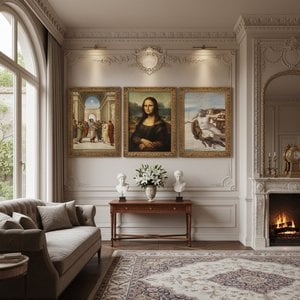
Les 10 Chefs-d'œuvre de la Haute Renaissance : Artistes et Décor d'Exception
Plongez au cœur de la Haute Renaissance avec les 10 chefs-d'œuvre incontournables de Léonard de Vinci, Michel-Ange et Raphaël. Découvrez l'histoire fascinante de ces tableaux emblématiques et trouvez l'inspiration pour une décoration intérieure d'exception sur .

Les 10 Chefs-d'œuvre de l'Art Médiéval : Décoration et Histoire
Plongez au cœur de l'art médiéval ! Découvrez les 10 chefs-d’œuvre incontournables, des vitraux gothiques aux enluminures. Histoire, artistes & inspiration déco sur ArtsDot.com.

La Haute Renaissance : Éclosion de l'Innovation Artistique et des Idéaux Humanistes
Explorez la Haute Renaissance italienne : ses artistes emblématiques (Léonard de Vinci, Michel-Ange), ses innovations artistiques et son héritage durable. Un guide expert pour les passionnés d'art.



