Aperçu en situation
 Partager
 Partager
 Détails
 Guide
Guide

 Télécharger
 Articles similaires
 Radiographie
 Voir le diaporama
 Statistiques
TheConcert


 Afficher la suite
Reproduction à l'huile faite à la main
Huile sur toile peinte à la main, avec cadre et dimensions personnalisés, réalisée sur commande par nos artistes. ( Passer au format impression Passer au format image numérique)




P118B $10

P118H $10

P118W $10

P438Z $10

P508JH $12

P508YH $12

P805H $10

P805Z $10

P919BZ $10

P919G $10

P919XJ $10

P959ZH $10

P968JZ $12

W106C $8

W218G $10

W218JH $8

W218Y $10

W307PJ $10

W316G $10

W316PJ $8

W316Y $10

W398PJ $8

W4111J $10

W500HY $15

W500JH $15

W692G $12

W849H $8

W940BG $15

W953PJ $8




Choisissez parmi nos formats prédéfinis qui respectent les proportions originales de l’œuvre.

Vous pouvez saisir vos propres dimensions pour l'adapter à un cadre ou à un espace spécifique. Si la taille sélectionnée ne correspond pas aux proportions de l'image d'origine, nous recadrerons l'œuvre ou prolongerons la peinture avec des éléments peints à la main supplémentaires. Une maquette numérique vous sera envoyée pour approbation avant le début de la production.
Veuillez noter que l'aperçu à l'écran ne reflète pas le recadrage ou l'extension réels. Seule la maquette montrera fidèlement la composition finale.
Bien que des tailles personnalisées soient disponibles, nous vous recommandons de sélectionner une dimension dans la liste prédéfinie afin de préserver les proportions d'origine.
Après la commande, l’équipe ArtsDot.com contactera le client par e-mail pour recueillir ses instructions et lui fournira une maquette d’aperçu
Livraison dans le monde entier () en 3 à 4 semaines au lieu des 5 semaines habituelles. (20 septembre). Aucun compromis sur la qualité.

Livraison express gratuite dans le monde entier

Toile de lin de haute qualité

Assurance transport complète

Garantie de remboursement des droits de douane

Garantie de fidélité des couleurs

Garantie de retour de 100 jours (uniquement en cas de défaut)

Garantie de remboursement à 100%

Tarifs dégressifs sur quantité
 L'option verre n'est disponible que pour les dimensions inférieures à 110 cm.

TheConcert
Technique de reproduction
Format de la reproduction
-


Prix total final
$ 263
A Symphony of Shadow and Light
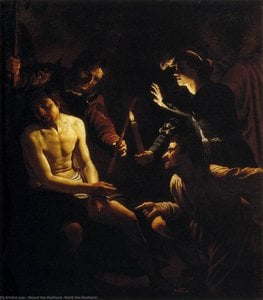
In the quiet, amber-hued depths of the Dutch Golden Age, few works capture the visceral tension between intimacy and drama as profoundly as Gerard van Honthorst’s “The Concert.” This masterpiece serves as a breathtaking window into a world where music is not merely heard, but felt through the very texture of light. As one of the most celebrated practitioners of the Utrecht Caravaggisti style, Honthorst earned the evocative moniker “Gherardo delle Notti”—Gerard of the Nights—a title that perfectly encapsulates his ability to conjure life from the impenetrable darkness. In this particular scene, the artist invites us into a dimly lit chamber, where the soft glow of unseen candlelight dances across scarlet drapery and illuminates a gathering of musicians caught in a moment of profound musical engagement.
The composition is a masterclass in tenebrism, a technique borrowed from the revolutionary Caravaggio. By juxtaposing intense, concentrated light against deep, swallowing shadows, Honthorost creates a sense of three-dimensional weight that pulls the viewer directly into the room. The eye is immediately drawn to the central figures: a woman seated gracefully on a bench, her hands poised with a violin, accompanied by companions whose faces emerge from the gloom like memories surfacing from sleep. There is a palpable sense of movement and rhythm in the way the light catches the curve of an instrument or the fold of a sleeve, transforming a static portrait into a living, breathing performance.
The Soul of the Dutch Golden Age
Beyond its technical brilliance, “The Concert” is steeped in the historical anxieties and cultural richness of the 17th-century Netherlands. Unlike the idealized, polished portraits common in other eras, Honthorst embraced a gritty, tactile realism. He eschewed perfection in favor of truth, capturing the textures of fabric, the sheen of wood, and the subtle expressions of human emotion. This dedication to realism allowed him to mirror the complexities of his era—a time of great prosperity but also profound uncertainty. The presence of the scarlet curtains adds a layer of theatrical grandeur, suggesting that this musical gathering is both a private sanctuary and a staged spectacle of high culture.
For the discerning collector or interior designer, this painting offers more than just aesthetic beauty; it provides an emotional anchor for a space. The interplay of warm tones and deep shadows makes it an ideal centerpiece for rooms designed to evoke intimacy, sophistication, and contemplation. Whether placed in a contemporary gallery setting or a classic study, the artwork commands attention through its silent narrative. It is a piece that does not merely decorate a wall but transforms an environment, inviting guests to linger in the glow of its historical mystery and to find their own rhythm within its beautifully orchestrated shadows.
Œuvres similaires


Biographie de l'artiste
Première jeunesse et formation
Gérard van Honthorst, peintre néerlandais important de l'âge d'or néerlandais, est né le 4 novembre 1590 à Utrecht. Il était le fils d’un peintre décorateur et a initialement été formé sous la direction de son père. Plus tard, il a poursuivi sa formation artistique sous Abraham Bloemaert.Carrière et influences
La carrière précoce de van Honthorst a impliqué une visite à Rome, où il a été fortement influencé par le style de Caravage. Cette influence se manifeste dans ses œuvres ultérieures, en particulier dans son utilisation de scènes éclairées artificiellement, ce qui lui a valu le surnom de « Gherardo delle Notti » ou « Gérard des nuits ». À son retour aux Pays-Bas, van Honthorst est devenu un peintre portraitiste de premier plan.Commandes notables et mécénat
Le travail de van Honthorst était très demandé, avec des mécènes notables tels que Vincenzo Giustiniani, qui l’a chargé de peindre « Christ devant le grand prêtre », exposé à la National Gallery de Londres. Il a également travaillé pour Cosme II de Médicis, grand-duc de Toscane, et était un favori auprès de la République néerlandaise et à l’étranger.Héritage et vie ultérieure
En 1620, van Honthorst est retourné à Utrecht, où il a bâti une réputation considérable. En 1623, année de son mariage, il était devenu président de la guilde Saint-Luc d’Utrecht. Son succès a conduit à des recommandations par Sir Dudley Carleton pour l'Earl of Arundel et Lord Dorchester.Œuvres clés et collaborations
- La prise du Christ, une œuvre collaborative initialement attribuée à van Honthorst, aujourd'hui reconnue comme l’œuvre d’un autre artiste.
- Christ devant le grand prêtre, commandée par Vincenzo Giustiniani, met en valeur la capacité de van Honthorst à capturer des scènes éclairées artificiellement.
- Des collaborations avec d’autres artistes, tels que Peter Paul Rubens, démontrent son influence sur le style baroque flamand.
Mouvement artistique et style
Van Honthorst faisait partie du mouvement des Utrecht Caravaggistes, caractérisé par l’utilisation d’un éclairage dramatique et d’une profondeur émotionnelle intense. Son travail reflète l’influence de la baroque italienne, tout en contribuant au développement de l'âge d'or néerlandais. Principaux liens :
Gérard van Honthorst
1590 - 1656 , Pays-Bas
En bref
- Artistic Movement Or Style: Caravagisme d'Utrecht, Baroque
- Artists Or Movements Influenced By This Artist:
- Rembrandt van Rijn
- Georges de la Tour
- Artists Who Influenced This Artist:
- Caravage
- Abraham Bloemaert
- Date Of Birth: 4 novembre 1590
- Date Of Death: 27 avril 1656
- Full Name: Gérard van Honthorst
- Nationality: Néerlandais
- Notable Artworks:
- Christ avant le grand prêtre
- La Prise du Christ
- Place Of Birth (City And Country): Utrecht, Pays-Bas
Articles similaires

L'Âge d'Or Néerlandais : Lumière, Réalisme et l'Émergence d'une Nouvelle Esthétique Picturale
Explorez l'Âge d'Or néerlandais : un tour d'horizon expert du réalisme révolutionnaire de Rembrandt, de Keyser et des maîtres hollandais. Découvrez l'histoire, les techniques et l'héritage durable de cette période artistique unique.

L'Âge d'Or Néerlandais : 10 Chefs-d'œuvre Incontournables pour Décorer avec Art et Histoire
Plongez au cœur de l'Âge d'Or néerlandais ! Découvrez 10 chefs-d'œuvre intemporels de Rembrandt, Vermeer et autres maîtres hollandais. Explorez leur histoire, technique & trouvez l'inspiration déco sur

Les 10 Chefs-d'œuvre du Baroque Néerlandais : Artistes et Décor Intemporels
Plongez au cœur du Baroque néerlandais avec les 10 œuvres incontournables de Rembrandt, Vermeer et autres maîtres hollandais. Découvrez l'histoire, la lumière et les couleurs qui ont façonné ce mouvement artistique. Reproductions d'art de qualité muséale sur ArtsDot.com
Illuminating Realism: Exploring the Dutch Golden Age of Painting (1600-1700)
Explore the Dutch Golden Age of painting (1600-1700) with ArtsDot. Discover Rembrandt, Vermeer & other masters. Learn about techniques, history & find museum-quality reproductions.

L'Âge d'Or Néerlandais : Splendeur Baroque et Révolution Artistique
Explorez l'Âge d'Or néerlandais : découvrez les maîtres baroques (Rembrandt, Fabritius) et leur révolution artistique. Analyse approfondie, contexte historique et héritage durable. Un voyage au cœur de la peinture du XVIIe siècle.