

 Aperçu en situation
 Envoyer
 Partager
 Détails de l'œuvre
 Guide
Guide

 Télécharger l'image
 Articles similaires
 Radiographie
 Diaporama
 Q&A
Q&A Statistiques
Bring your death out!


 Lire la suite
L’œuvre d'art présentée sur cette page est protégée par le droit d'auteur, ce qui signifie que nous ne pouvons légalement créer ou vendre de reproduction identique. Cette protection est appliquée en vertu d'accords internationaux tels que la Convention de Berne et par les lois nationales, notamment celles énoncées par le Loi américaine sur le droit d'auteur - Titre 17.
Cette méthode est pleinement conforme aux réglementations sur le droit d'auteur car elle ne repose pas sur la copie ou la duplication de l'œuvre protégée. Il s'agit plutôt d'une réinterprétation créative — une nouvelle peinture qui s'inspire de l'original sans pour autant lui être identique.
Giclées et impressions d'art
Impressions giclées ou sur toile de qualité musée, avec une production rapide et des finitions au choix. ( Commander la reproduction peinte à la main Passer au format numérique)




P118B €10

P118H €10

P118W €10

P438Z €10

P508JH €12

P508YH €12

P805H €10

P805Z €10

P919BZ €10

P919G €10

P919XJ €10

P959ZH €10

P968JZ €12

W106C €8

W218G €10

W218JH €8

W218Y €10

W307PJ €10

W316G €10

W316PJ €8

W316Y €10

W398PJ €8

W4111J €10

W500HY €15

W500JH €15

W692G €12

W849H €8

W940BG €15

W953PJ €8




Choisissez parmi nos formats prédéfinis qui respectent les proportions originales de l’œuvre.

Saisissez la largeur et la hauteur souhaitées pour qu'elles s'adaptent à votre cadre ou à votre mur. Une impression peut être recadrée, mais jamais agrandie au-delà de l'image originale ; ainsi, un format de forme différente entraînera la perte d'une partie de l'image. Nous vous envoyons une maquette numérique pour approbation avant toute impression. L'image présentée sur cette page ne montre pas le recadrage réel — seule la maquette le permet.
Livraison dans le monde entier () en 2 semaines au lieu des 4/5 semaines habituelles. (2 novembre)

Livraison express gratuite dans le monde entier

Toile de lin de qualité supérieure

Assurance transport complète

Garantie de remboursement des droits de douane

Garantie de fidélité des couleurs

Politique de retour de 100 jours (uniquement en cas de défaut)

Garantie de remboursement à 100%

Offre de tarifs dégressifs
 L'option verre n'est disponible que pour les dimensions inférieures à 110 cm.

Bring your death out!
Giclées et impressions d'art
Format de la reproduction
-


Prix total
€ 55
A Visceral Encounter with Mortality
In the hauntingly profound charcoal drawing "Bring Your Death Out!", Georges Rouault invites the viewer into a somber realm where the boundaries between life and decay dissolve. Created in 1946, as the shadows of World War II were only just beginning to recede, this work serves as a visceral embodiment of existential dread and spiritual reckoning. The scene is dominated by skeletal figures, their forms etched with an unsettling energy that transcends mere anatomical study. Rather than presenting a clinical view of death, Rouault captures the psychological weight of mortality, using the starkness of the medium to mirror the profound anxiety and loss felt by a world recovering from unprecedented conflict. It is not merely a depiction of the end of life, but an immersive experience into the artist’s deeply felt spiritual convictions and his unflinching gaze upon human suffering.
The composition is masterfully orchestrated through a pyramidal arrangement, a classical technique that Rouault subverts to create a sense of rising tension. The viewer's eye is drawn upward, following the jagged, expressive lines of the skeletal forms toward a central figure that commands the space with dramatic gesture. There is no stillness here; instead, there is a rhythmic, unsettling dynamism created by the overlapping limbs and the diagonal thrust of bones and ribs. This structural complexity ensures that the gaze never rests, mirroring the restless, searching nature of the human soul when confronted with the inevitable. For the collector or designer, this piece offers a powerful focal point—a work that demands attention through its sheer emotional gravity and sophisticated structural balance.
The Mastery of Shadow and Line
Rouault’s technical prowess is most evident in his command over light and shadow, a skill likely honed during his early years as an apprentice in stained glass restoration. In this work, he employs meticulous hatching and cross-hatching to sculpt the skeletal figures out of the darkness. The lines are not merely outlines; they are thick, bold, and pulsating with life, acting as heavy contours that delineate the fragility of the bones against a muted, atmospheric background. This dramatic use of chiaroscuro creates deep, engulfing shadows that swallow portions of the figures, emphasizing their vulnerability and suggesting that the confrontation with darkness is an unavoidable facet of the human condition.
The monochromatic palette—a disciplined range of blacks, grays, and whites—strips away the distractions of color to focus entirely on texture and form. The rough, tactile quality of the charcoal creates a surface that feels as weathered and ancient as the subject matter itself. This emphasis on texture adds a layer of visceral impact, making the decay feel tangible to the observer. For those seeking to incorporate fine art into a sophisticated interior, the monochromatic elegance of this piece provides a versatile yet profound aesthetic, capable of anchoring a room with its intense, brooding presence and timeless artistic merit.
Symbolism and the Spiritual Legacy
Beyond its striking visual impact, "Bring Your Century Out!" is steeped in symbolic resonance. The skeletal figures serve as universal symbols of mortality, yet within Rouault’s specific theological framework, they also represent a form of spiritual purification. The presence of figures in clerical garb suggests a critique or perhaps a profound commentary on the role of organized religion amidst human catastrophe. There is an inherent tension between the grotesque nature of the decay and the underlying search for compassion and faith that characterized Rouault's entire oeuvre.
To possess a reproduction of this work is to hold a piece of history that speaks to the resilience of the human spirit in the face of despair. It is a work that resonates with anyone moved by the themes of empathy, suffering, and the eternal struggle between light and dark. As an investment in fine art, it offers more than just decoration; it provides a window into the soul of one of the 20th century's most poignant Expressionists, making it an invaluable addition to any collection dedicated to works of deep emotional and historical significance.
Questions et réponses
Quelle intensité lumineuse les couleurs de "Bring your death out!" semblent-elles refléter ?
Les couleurs de « Bring your death out! » présentent une luminance Gentle Luminance.
Puis-je utiliser la réalité augmentée pour visualiser «Bring your death out!» de Georges Rouault dans ma pièce ?
Visualisez «Bring your death out!» de Georges Rouault sur votre propre mur grâce à la page Aperçu en RA de l'œuvre, en utilisant la réalité augmentée sur un appareil compatible.
Est-il possible de télécharger l'image de « Bring your death out! » ?
«Bring your death out!» de Georges Rouault peut être téléchargé depuis la page Téléchargement de l'œuvre, en tant que téléchargement d'une image numérique haute résolution.
Œuvres similaires


Biographie de l'artiste
Premières années et formation
Georges Henri Rouault, peintre, dessinateur et graveur français, est né à Paris le 27 mai 1871, dans une famille modeste. Sa mère encouragea son amour pour les arts, et dès l'âge de 14 ans, il commença un apprentissage de verrier et restaurateur, qui dura jusqu’en 1890. Cette expérience précoce influença probablement son style pictural mature, caractérisé par des contours noirs marqués et des couleurs lumineuses, rappelant le vitrail.Carrière artistique
Pendant son apprentissage, Rouault suivit des cours du soir à l'École des Beaux-Arts puis entra à l'École des beaux-arts en 1891, où il étudia sous la direction de Gustave Moreau. Ses premières œuvres révèlent un symbolisme dans l’utilisation de la couleur, reflétant l'influence de Moreau. Après le décès de Moreau en 1898, Rouault fut nommé conservateur du musée Moreau à Paris.Fauvisme et Expressionnisme
Rouault rencontra des artistes notables tels que Henri Matisse, Albert Marquet, Henri Manguin et Charles Camoin, ce qui l'amena vers le mouvement fauviste, avec Matisse comme leader. Son utilisation de contrastes saisissants et d’émotion fut influencée par Vincent van Gogh. Ses caractérisations de personnalités grotesques exagérées inspirèrent les peintres expressionnistes.Œuvres notables et expositions
* En 1891, Rouault peignit *Le Chemin de Calvary*. * À partir de 1895, il participa à d'importantes expositions publiques, dont le Salon d’Automne qu’il contribua à fonder. * En 1907, Rouault commença une série de peintures consacrées aux tribunaux, aux clowns et aux prostituées, interprétées comme une critique morale et sociale.Héritage et vie ultérieure
À partir de 1917, Rouault se consacra à la peinture, sa foi chrétienne influençant son œuvre. Il créa des dessins pour le ballet *Le Fils prodigue* de Diaghilev en 1929. En 1930, il commença à exposer dans d'autres pays, principalement à Londres, New York et Chicago. Rouault est décédé à Paris le 13 février 1958, laissant derrière lui un héritage en tant que l’un des artistes chrétiens les plus passionnés du XXe siècle. Important : À la fin de sa vie, Rouault brûla 300 de ses tableaux, estimés aujourd'hui à plus d'un demi-milliard de francs.
Georges Rouault
1871 - 1958 , France
L'essentiel de l'artiste
- Artistes Influents:
- Gustave Moreau
- Vincent van Gogh
- Henri Matisse
- Date De Décès: 13 février 1958
- Date De Naissance: 27 mai 1871
- Influences Artistiques:
- Expressionnisme
- Fauvisme
- Lieu De Naissance: Paris, France
- Mouvement Artistique: Expressionnisme, Fauvisme
- Nationalité: Française
- Nom Complet: Georges Rouault
- Œuvres Notables:
- Le Chemin de Calvary
- Dame du Haut-Quartier
Articles connexes

Georges Seurat : Les 25 Œuvres Maîtresses du Pointillisme | ArtsDot
Plongez dans l'univers lumineux de Georges Seurat ! Découvrez les 25 œuvres majeures du pointillisme, de 'Un dimanche après-midi à l'Île de la Grande Jatte' aux 'Poseuses'. Reproductions d'art exceptionnelles et inspiration déco sur ArtsDot.com.

Unlocking Emotion: A Beginner's Guide to the Raw Power of Symbolic Expressionism Art
Discover the raw emotion of Symbolic Expressionism. Our expert guide explores how masters like Munch use color and form to convey inner feelings, offering inspiration for collectors looking to bring powerful, soulful art into their modern homes.
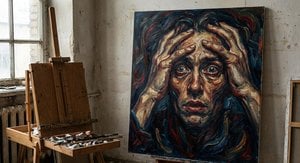
L'Expressionnisme Figuratif : Émotion Intense et Subjectivité au XXe Siècle
Explorez l'Expressionnisme Figuratif : ses origines, artistes clés (Kirchner, Die Brücke), thèmes puissants et impact durable sur l'art. Découvrez des reproductions de haute qualité sur ArtsDot.

Expressionnisme : Les 10 Chefs-d'œuvre qui ont Marqué l'Histoire de l'Art
Plongez au cœur de l'Expressionnisme avec les 10 œuvres majeures qui ont marqué ce mouvement puissant. Découvrez Munch, Kirchner, Kandinsky et plus encore. Reproductions d'art de qualité muséale sur – Explorez la collection !

Maîtriser le Cubisme : Les 25 plus grands chefs-d'œuvre de Georges Braque
Explorez les 25 chefs-d'œuvre de Georges Braque et l'essence du Cubisme. Découvrez ces trésors sur ArtsDot.com.


