


 Aperçu en situation
 Partager
 Partager
 Détails
 Guide imprimable

 Télécharger
 Articles similaires
 Radiographie
 Voir le diaporama
 Statistiques
untitled (8739)


 Afficher la suite
Reproduction à l'huile faite à la main
Huile sur toile peinte à la main, avec cadre et dimensions personnalisés, réalisée sur commande par nos artistes. ( Passer au format impression Passer au format image numérique)




P118B $10

P118H $10

P118W $10

P438Z $10

P508JH $12

P508YH $12

P805H $10

P805Z $10

P919BZ $10

P919G $10

P919XJ $10

P959ZH $10

P968JZ $12

W106C $8

W218G $10

W218JH $8

W218Y $10

W307PJ $10

W316G $10

W316PJ $8

W316Y $10

W398PJ $8

W4111J $10

W500HY $15

W500JH $15

W692G $12

W849H $8

W940BG $15

W953PJ $8




Choisissez parmi nos formats prédéfinis qui respectent les proportions originales de l’œuvre.

Vous pouvez saisir vos propres dimensions pour l'adapter à un cadre ou à un espace spécifique. Si la taille sélectionnée ne correspond pas aux proportions de l'image d'origine, nous recadrerons l'œuvre ou prolongerons la peinture avec des éléments peints à la main supplémentaires. Une maquette numérique vous sera envoyée pour approbation avant le début de la production.
Veuillez noter que l'aperçu à l'écran ne reflète pas le recadrage ou l'extension réels. Seule la maquette montrera fidèlement la composition finale.
Bien que des tailles personnalisées soient disponibles, nous vous recommandons de sélectionner une dimension dans la liste prédéfinie afin de préserver les proportions d'origine.
Après la commande, l’équipe ArtsDot.com contactera le client par e-mail pour recueillir ses instructions et lui fournira une maquette d’aperçu
Livraison dans le monde entier () en 3 à 4 semaines au lieu des 5 semaines habituelles. (26 septembre). Aucun compromis sur la qualité.

Livraison express gratuite dans le monde entier

Toile de lin de haute qualité

Assurance transport complète

Garantie de remboursement des droits de douane

Garantie de fidélité des couleurs

Garantie de retour de 100 jours (uniquement en cas de défaut)

Garantie de remboursement à 100%

Tarifs dégressifs sur quantité
 L'option verre n'est disponible que pour les dimensions inférieures à 110 cm.

untitled (8739)
Technique de reproduction
Format de la reproduction
-


Prix total final
$ 263
A Symphony of Light and Color: The Luminous World of Georges Seurat
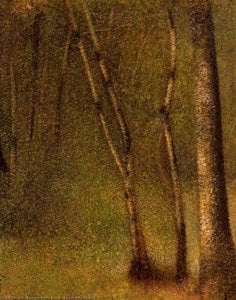
To stand before Georges Seurat’s “Untitled (8739)” is to witness a moment where the fleeting magic of Impressionism meets the rigorous, almost mathematical precision of science. In this breathtaking post-impressionist masterpiece, the air itself seems to shimmer, not through broad and sweeping strokes, but through a meticulous dance of millions of tiny, individual dots of pure pigment. Seurat, a pioneer who irrevocably altered the course of modern art, did not merely seek to paint what he saw; he sought to reconstruct the very physics of light. Through his revolutionary technique of Pointillism, or Chromoluminarism, he invites the viewer's eye to participate in the creation of the image, blending colors optically on the retina to achieve a brilliance that traditional pigment mixing could never replicate.
The scene captured within this canvas is one of profound tranquility and pastoral grace. Amidst a vibrant field of wildflowers, two women stand as central figures of serenity, sheltered by umbrellas against the sun’s gentle glare. This quiet tableau is brought to life by the subtle presence of nature's inhabitants: a dog rests peacefully on the ground, while a cat observes the scene from a nearby stone, and birds soar subtly in the sky above. Every element—from the soft textures of the flora to the rhythmic placement of the animals—contributes to an idyllic atmosphere that feels both timeless and deeply grounded in the natural world.
The Science of Perception and Artistic Innovation
Seurat’s approach was far more than a stylistic choice; it was an intellectual pursuit informed by the optical theories of his era. While contemporaries like Monet and Renoir focused on capturing the subjective, emotional impressions of light, Seurat looked toward the scientific principles of color wavelengths. He approached the canvas with the mind of a scientist and the soul of a poet, applying tiny, deliberate dots of pigment to create a visual symphony. This painstaking process demanded an extraordinary level of patience and observation, transforming the act of painting into a controlled experiment in light and perception.
For the discerning collector or interior designer, this piece offers much more than mere decoration. It serves as a focal point of intellectual and aesthetic depth. The way the light appears to vibrate within the field of wildflowers makes it an ideal centerpiece for spaces designed to evoke calm, sophistication, and contemplation. Whether placed in a sun-drenched gallery or a refined contemporary living space, the painting’s unique texture and luminous quality command attention, drawing the eye into its intricate, dot-by-dot construction.
An Emotional Resonance for Modern Spaces
Beyond its technical brilliance, “Untitled (8739)” carries an emotional weight that resonates across generations. There is a sense of eternal stillness within the composition—a captured breath of a summer afternoon that remains untouched by the chaos of the modern world. The harmony between the human figures and the natural landscape suggests a deep, symbiotic relationship with the earth, making the work a powerful symbol of peace and ecological beauty.
Investing in a high-quality reproduction of this Seurat masterpiece allows one to bring this sense of historical grandeur and scientific wonder into the home. It is an invitation to slow down, to observe the minute details, and to rediscover the joy of pure color. For those seeking to curate an environment filled with inspiration, this artwork provides a window into a pivotal moment in art history, offering a timeless elegance that complements both classical and modern interior aesthetics.
Œuvres similaires




Biographie de l'artiste
Georges Seurat : Pionnier du Néo-Impressionnisme
Jeunesse et Formation
- Né le: 2 décembre 1859 à Paris, en France.
- La famille de Seurat s'est installée sur le Boulevard de Magenta peu après sa naissance.
- Son père, Antoine Chrysostome Seurat, était un ancien fonctionnaire juridique devenu riche grâce à la spéculation immobilière.
- Il a commencé ses études artistiques à l’École Municipale de Sculpture et Dessin, près de chez lui, sous la direction du sculpteur Justin Lequien.
- En 1878, il s'est inscrit à l’illustre École des Beaux-Arts, où il a étudié auprès d'Henri Lehmann.
Développement Artistique et Influences
- La personnalité artistique de Seurat était un mélange unique de sensibilité et d’abstraction logique. Il combinait une délicate sensibilité avec une précision mathématique.
- Influences: Bien que les influences spécifiques soient débattues, il a étudié les théories des couleurs de scientifiques tels que Michel Eugène Chevreul et Ogden Rood.
- Il a initialement expérimenté avec des techniques de dessin traditionnelles avant de développer son style caractéristique.
- Ses premières œuvres montrent un intérêt pour la peinture académique, mais se sont progressivement orientées vers une approche plus innovante.
Chromoluminarisme et Pointillisme
- Seurat a inventé les techniques du chromoluminarisme (la science de la couleur) et du pointillisme, appliquant de petites touches distinctes de couleurs pures à une toile.
- Il utilisait le crayon Conté pour des dessins détaillés sur papier à surface rugueuse dans le cadre de son processus.
- Objectif du Pointillisme: L'idée était que l’œil du spectateur mélangerait ces couleurs optiquement, créant un effet vibrant et lumineux.
Réalisations Majeures et Œuvres Notables
- Un Dimanche après-midi à l’Île de la Grande Jatte (1884-1886): Son œuvre la plus célèbre, marquant le début du Néo-Impressionnisme. Elle illustre sa technique pointilliste et son approche méticuleuse.
- Alfalfa, Saint-Denis (1886-1887): Démontre son application de la théorie des couleurs à un paysage rural.
- Paysage à Saint-Ouen (1882-1883): Un exemple précoce montrant son style évolutif et son intérêt pour la lumière et l’atmosphère.
- La Tour Eiffel (1889): Une représentation du célèbre monument parisien, réalisée à l'aide de techniques pointillistes.
- Les Baigneurs d’Asnières (1884): Une autre œuvre significative explorant le loisir et la vie moderne avec son style distinctif.
Signification Historique et Héritage
- Le travail de Seurat a profondément influencé le développement de l’art moderne, en particulier par son accent sur l’expression subjective et l’exploration de nouvelles techniques.
- A ouvert la voie: Il a ouvert la voie aux mouvements tels que le Fauvisme, le Cubisme et l’Expressionnisme abstrait.
- Son approche scientifique de la peinture a défié les conventions artistiques traditionnelles.
- Malgré sa courte vie (il est décédé à l'âge de 31 ans), Seurat a laissé une marque indélébile sur l’histoire de l’art, inspirant des générations d'artistes avec sa vision novatrice.

Georges Pierre Seurat
1859 - 1891 , France
En bref
- Artistic Movement Or Style: Néo-impressionnisme, Pointillisme
- Artists Or Movements Influenced By This Artist:
- Fauvisme
- Cubisme
- Expressionnisme abstrait
- Artists Who Influenced This Artist:
- Michel Eugène Chevreul
- Ogden Rood
- Date Of Birth: 2 décembre 1859
- Full Name: Georges Pierre Seurat
- Nationality: Français
- Notable Artworks:
- Un dimanche à La Grande Jatte
- Baigneurs d'Asnières
- La Tour Eiffel
- Place Of Birth (City And Country): Paris, France
Articles similaires

Georges Seurat : Pointillisme, Perception et les Fondements Scientifiques de l'Art Moderne
Explorez l'univers révolutionnaire de Georges Seurat et du pointillisme. Découvrez la science derrière cette technique picturale unique, son influence sur l'art moderne et l'analyse approfondie de ses œuvres majeures.

Les Îles Chromatiques : Exploration de la Théorie et de l'Héritage du Pointillisme dans l'Art du XIXe Siècle
Explorez l'univers fascinant du pointillisme ! Découvrez la théorie, les artistes clés (Seurat, Signac) et l'héritage de ce mouvement révolutionnaire. Guide pour collectionneurs et passionnés d'art.

Chromatic Harmonies & Discord: A History of Color Theory in Art
Explore the fascinating evolution of color theory in art history! Discover Impressionism, Neo-Impressionism & beyond with expert insights for collectors and enthusiasts. Learn about Seurat's techniques & the psychology of color.

Georges Seurat : Les 25 Œuvres Maîtresses du Pointillisme | ArtsDot
Plongez dans l'univers lumineux de Georges Seurat ! Découvrez les 25 œuvres majeures du pointillisme, de 'Un dimanche après-midi à l'Île de la Grande Jatte' aux 'Poseuses'. Reproductions d'art exceptionnelles et inspiration déco sur ArtsDot.com.

Georges Braque : Les 25 Œuvres Maîtresses du Cubisme et de la Modernité | ArtsDot
Plongez dans l'univers de Georges Braque avec les 25 œuvres incontournables du cubisme. Découvrez l'histoire, les techniques et l'impact de ce maître de l'art moderne. Reproductions d'art exceptionnelles sur ArtsDot.com.


